Opinion - (2025) Volume 16, Issue 3
Received: 02-May-2025, Manuscript No. jhmi-26-178836;
Editor assigned: 05-May-2025, Pre QC No. P-178836;
Reviewed: 19-May-2025, QC No. Q-178836;
Revised: 23-May-2025, Manuscript No. R-178836;
Published:
30-May-2025
, DOI: 10.37421/2157-7420.2025.16.591
Citation: El-Shazly, Ahmed N.. ”Predicting Hospital Readmissions: AI, Data, Interventions, Ethics.” J Health Med Informat 16 (2025):591.
Copyright: © 2025 El-Shazly N. Ahmed This is an open-access article distributed under the terms of the Creative Commons Attribution License, which permits unrestricted use, distribution and reproduction in any medium, provided the original author and source are credited.
Predictive analytics has emerged as a pivotal tool in modern healthcare, offering a robust framework for proactively identifying patients at elevated risk of hospital readmission. By leveraging the vast datasets contained within electronic health records (EHRs) and other relevant patient information, sophisticated machine learning models can accurately flag individuals who are most likely to require readmission. This capability enables healthcare providers to implement targeted interventions, thereby enhancing patient care and optimizing resource allocation [1].
One significant area of focus within predictive analytics is the application of deep learning models, which have demonstrated remarkable efficacy in forecasting 30-day hospital readmissions. These advanced AI techniques achieve high levels of accuracy by integrating a comprehensive array of patient features, encompassing demographics, intricate clinical diagnoses, detailed medication histories, and critical laboratory results. The insights derived from these models can refine risk stratification and guide the strategic deployment of resources for preventative care initiatives [2].
The practical implementation of predictive models for readmission risk within tertiary care settings has yielded tangible benefits, most notably a significant reduction in unplanned hospital readmissions. These models effectively pinpoint key risk factors, such as advanced patient age, the presence of comorbidities, and a history of previous hospitalizations. This underscores the critical importance of integrating predictive analytics seamlessly into established clinical workflows to facilitate timely and effective interventions for high-risk patient populations [3].
Further research has explored the application of various machine learning algorithms, including random forests and support vector machines, for the specific task of predicting hospital readmission risk. These studies highlight the inherent robustness of these models in discerning and capturing the complex interrelationships present within diverse patient datasets. The successful and accurate prediction of readmission events paves the way for proactive care management strategies, ultimately leading to improved patient outcomes and a notable reduction in overall healthcare expenditures [4].
In a comparative study focusing on cardiovascular patients, the evaluation of several predictive models for hospital readmissions revealed that those incorporating a broad spectrum of patient data, including demographics, disease severity, and social determinants of health, exhibited superior performance. This research strongly emphasizes the necessity of adopting a comprehensive approach to risk assessment that extends beyond purely clinical data, recognizing the multifaceted nature of readmission risk factors [5].
A systematic review delving into the literature on artificial intelligence (AI) applications for predicting hospital readmissions has observed a notable and growing adoption of AI techniques. Methods such as neural networks and ensemble learning are increasingly employed to enhance prediction accuracy. The review also acknowledges inherent challenges, including issues related to data quality, the interpretability of model outputs, and the practicalities of clinical integration of these advanced AI systems [6].
The development and validation of machine learning models specifically for predicting 30-day readmission risk in patients diagnosed with heart failure have shown promising results. By effectively incorporating Electronic Health Record (EHR) data, these models have demonstrated good predictive performance. The findings strongly suggest that such data-driven models can serve as invaluable tools for designing highly tailored post-discharge care plans for individuals identified as being at high risk [7].
The exploration of Natural Language Processing (NLP) techniques has opened new avenues for enhancing readmission risk prediction by extracting valuable features from unstructured clinical notes. NLP offers the unique ability to uncover critical insights that may not be readily apparent in structured EHR fields, thereby significantly improving the accuracy of predictive models. This approach holds considerable promise for achieving a more holistic and nuanced patient risk assessment [8].
The integration of patient-reported outcome measures (PROMs) into predictive models designed for hospital readmissions represents a significant advancement. This research indicates that by incorporating patient-specific data, such as their self-reported quality of life and the severity of their symptoms, the predictive power of readmission risk algorithms can be substantially enhanced. This patient-centric approach offers a more complete picture of an individual's health status and risk profile [9].
Finally, a critical examination of the ethical considerations and implementation challenges associated with employing predictive analytics for hospital readmission risk assessment is essential. This includes addressing vital issues such as data privacy concerns, the potential for algorithmic bias, and the imperative need for clearly defined clinical guidelines. Establishing these frameworks is crucial for ensuring the responsible, equitable, and effective deployment of these powerful predictive technologies within healthcare systems [10].
Predictive analytics offers a transformative approach to managing hospital readmissions by enabling early identification of high-risk patients. Through the analysis of electronic health records and other comprehensive patient data, machine learning models can accurately identify individuals prone to readmission. This allows for the implementation of timely and tailored interventions, such as enhanced discharge planning and post-discharge follow-up, leading to reduced readmission rates, improved patient outcomes, and significant cost savings for healthcare systems [1].
The utilization of deep learning models has shown particular promise in accurately predicting 30-day hospital readmissions. These sophisticated AI models achieve high predictive accuracy by integrating a wide range of patient characteristics, including demographic information, detailed clinical diagnoses, medication histories, and laboratory test results. The insights gained from these models are instrumental in refining the process of readmission risk stratification and guiding the allocation of resources for preventative care strategies [2].
The successful implementation of predictive models for readmission risk within tertiary care hospitals has demonstrably led to a substantial decrease in unplanned readmissions. These models effectively identify critical risk factors, such as advanced patient age, the presence of multiple chronic conditions (comorbidities), and a history of prior hospitalizations. This highlights the crucial role of integrating predictive analytics into routine clinical practice to ensure that high-risk patients receive timely and appropriate interventions [3].
Research has extensively investigated the application of various machine learning algorithms, including random forests and support vector machines, for the prediction of hospital readmission risk. These studies consistently highlight the robust capabilities of these models in capturing intricate relationships within patient data. The ability to accurately predict readmission events empowers healthcare providers to implement proactive care management strategies, which contribute to better patient outcomes and reduced healthcare expenditures [4].
A comparative study focused on cardiovascular patients has identified that predictive models incorporating a broader range of data, such as patient demographics, disease severity, and social determinants of health, perform most effectively in forecasting hospital readmissions. This research underscores the importance of a holistic approach to risk assessment, moving beyond a sole reliance on clinical data to encompass a wider array of influential factors [5].
A systematic review examining the literature on artificial intelligence (AI) in predicting hospital readmissions reveals a growing trend in the adoption of AI techniques. Advanced methods like neural networks and ensemble learning are increasingly being utilized to enhance the accuracy of readmission predictions. The review also thoughtfully discusses existing challenges, including issues related to the quality of data, the interpretability of AI model outputs, and the practicalities of integrating these models into existing clinical workflows [6].
In the context of heart failure patients, the development and validation of a machine learning model capable of predicting 30-day readmission risk have yielded promising results. By effectively leveraging Electronic Health Record (EHR) data, this model has demonstrated commendable predictive performance. The research indicates that such models can be a vital asset in the design and implementation of targeted post-discharge care plans for individuals identified as being at a higher risk of readmission [7].
The application of Natural Language Processing (NLP) for extracting relevant features from clinical notes has significantly advanced the field of readmission risk prediction. By analyzing unstructured text data within patient records, NLP can uncover valuable insights that are often missed in structured EHR fields, thereby enhancing the accuracy and comprehensiveness of predictive models. This methodology offers potential for a more complete and nuanced patient risk assessment [8].
This study further investigates the role of patient-reported outcome measures (PROMs) in enhancing predictive models for hospital readmissions. The findings suggest that the inclusion of patient-specific data, such as their subjective reports on quality of life and symptom severity, can substantially improve the predictive accuracy of readmission risk algorithms. This patient-centered data provides a crucial layer of insight into individual patient experiences and risks [9].
Finally, a comprehensive discussion on the ethical considerations and implementation challenges inherent in using predictive analytics for hospital readmission risk assessment is paramount. Key issues include safeguarding data privacy, mitigating algorithmic bias, and establishing clear clinical guidelines to ensure that these powerful technologies are deployed responsibly and effectively within healthcare settings [10].
Predictive analytics, utilizing machine learning and AI, offers a powerful approach to identifying patients at high risk of hospital readmission. By analyzing diverse patient data, including EHRs, clinical notes, and patient-reported outcomes, models can accurately predict readmission likelihood. This enables targeted interventions like enhanced discharge planning, leading to reduced readmissions, improved patient outcomes, and lower healthcare costs. Advanced techniques such as deep learning and NLP enhance prediction accuracy. However, ethical considerations and implementation challenges, including data privacy and algorithmic bias, must be carefully addressed for responsible deployment.
None
None
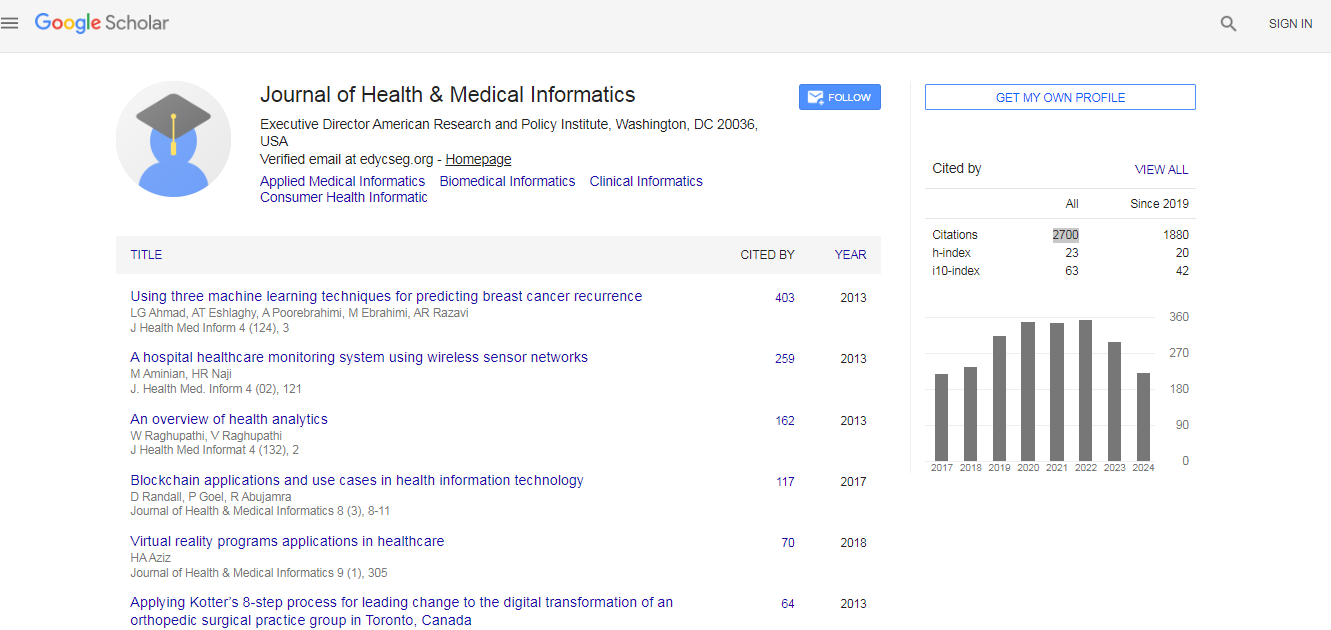
Journal of Health & Medical Informatics received 2700 citations as per Google Scholar report