Short Communication - (2025) Volume 9, Issue 6
Received: 02-Nov-2025, Manuscript No. hps-26-184495;
Editor assigned: 04-Nov-2025, Pre QC No. P-184495;
Reviewed: 18-Nov-2025, QC No. Q-184495;
Revised: 24-Nov-2025, Manuscript No. R-184495;
Published:
29-Nov-2025
, DOI: 10.37421/2573-4563.2025.9.381
Citation: Bianchi, Nicola S.. ”Precision Medicine Transforms HCC and PDCA Treatment.” J Hepatol Pancreat Sci 09 (2025):381.
Copyright: © 2025 Bianchi S. Nicola This is an open-access article distributed under the terms of the Creative Commons Attribution License, which permits unrestricted use, distribution and reproduction in any medium, provided the original author and source are credited.
Precision medicine in hepatocellular carcinoma (HCC) and pancreatic ductal adenocarcinoma (PDCA) is an area of rapid development, fueled by advancements in genomic profiling, targeted therapies, and immunotherapy. For HCC, this involves identifying actionable mutations in genes such as TERT, TP53, and CTNNB1, which guides the utilization of tyrosine kinase inhibitors and immune checkpoint inhibitors. In PDCA, despite a historically challenging molecular landscape, progress is being made in identifying patient subsets who benefit from specific targeted agents based on KRAS mutations, BRCA alterations, and MSI-H status. Liquid biopsies are also emerging as powerful tools for non-invasive monitoring of treatment response and early detection of recurrence in both malignancies [1].
Genomic alterations in HCC are diverse, with recent studies highlighting the role of novel driver mutations and their implications for therapy. Understanding the tumor microenvironment and immune landscape is crucial for optimizing immunotherapy responses, with biomarkers like PD-L1 expression and tumor mutational burden being investigated. Combination strategies involving targeted agents and immunotherapy are showing promise, particularly in patients with specific genetic profiles [2].
For PDCA, the therapeutic landscape is being reshaped by advancements in identifying patients with rare genetic drivers, such as NTRK fusions or MSI-H/dMMR, who can benefit from targeted therapies or immunotherapies. Ongoing clinical trials are exploring novel drug combinations and delivery systems to overcome resistance mechanisms inherent in PDCA. The integration of predictive biomarkers is essential for stratifying patients and maximizing treatment efficacy [3].
The utility of liquid biopsies, including circulating tumor DNA (ctDNA) and circulating tumor cells (CTCs), is gaining traction in both HCC and PDCA. These approaches enable real-time monitoring of treatment response, detection of minimal residual disease (MRD), and identification of emerging resistance mutations, thereby facilitating dynamic treatment adjustments [4].
Immunotherapy, particularly immune checkpoint inhibitors (ICIs), has revolutionized the treatment of advanced HCC. While responses can be durable, predicting which patients will benefit remains a challenge. Research is focused on identifying predictive biomarkers beyond PD-L1, such as tumor mutational burden and the gut microbiome, to improve patient selection and combination strategies [5].
Pancreatic cancer remains a highly lethal disease, but precision medicine offers glimmers of hope. Identifying patients with rare driver mutations like KRAS G12C or BRCA mutations allows for targeted intervention with specific inhibitors. Furthermore, the promise of targeting the tumor microenvironment and exploring novel drug delivery systems is driving research efforts [6].
The integration of artificial intelligence (AI) and machine learning (ML) is poised to accelerate the progress of precision medicine in hepatobiliary and pancreatic cancers. These technologies can analyze vast datasets to identify novel biomarkers, predict treatment responses, and personalize therapeutic strategies, ultimately improving patient outcomes [7].
Recent advances in understanding the molecular pathogenesis of PDCA have unveiled new therapeutic targets. Efforts are underway to develop drugs that can overcome the dense stroma and immunosuppressive tumor microenvironment, which are hallmarks of this disease. Combination therapies, including chemotherapy with targeted agents or immunotherapies, are being explored [8].
The development of novel targeted therapies for HCC continues, with a focus on overcoming resistance mechanisms to existing treatments. Personalized approaches are being refined based on detailed molecular profiling of individual tumors, aiming to match patients with the most effective treatments [9].
Understanding the complex tumor microenvironment in pancreatic cancer is critical for developing effective precision therapies. Strategies to overcome stromal barriers, modulate immune cell infiltration, and target specific signaling pathways are under active investigation, offering new hope for patients with this devastating disease [10].
Precision medicine in hepatocellular carcinoma (HCC) and pancreatic ductal adenocarcinoma (PDCA) is rapidly evolving, driven by advancements in genomic profiling, targeted therapies, and immunotherapy. For HCC, this includes identifying actionable mutations in genes like TERT, TP53, and CTNNB1, guiding the use of tyrosine kinase inhibitors and immune checkpoint inhibitors. In PDCA, despite a historically challenging molecular landscape, progress is being made in identifying subsets of patients who benefit from specific targeted agents based on KRAS mutations, BRCA alterations, and MSI-H status. Liquid biopsies are also emerging as powerful tools for non-invasive monitoring of treatment response and early detection of recurrence in both malignancies [1].
Genomic alterations in HCC are diverse, with recent studies highlighting the role of novel driver mutations and their implications for therapy. Understanding the tumor microenvironment and immune landscape is crucial for optimizing immunotherapy responses, with biomarkers like PD-L1 expression and tumor mutational burden being investigated. Combination strategies involving targeted agents and immunotherapy are showing promise, particularly in patients with specific genetic profiles [2].
For PDCA, the therapeutic landscape is being reshaped by advancements in identifying patients with rare genetic drivers, such as NTRK fusions or MSI-H/dMMR, who can benefit from targeted therapies or immunotherapies. Ongoing clinical trials are exploring novel drug combinations and delivery systems to overcome resistance mechanisms inherent in PDCA. The integration of predictive biomarkers is essential for stratifying patients and maximizing treatment efficacy [3].
The utility of liquid biopsies, including circulating tumor DNA (ctDNA) and circulating tumor cells (CTCs), is gaining traction in both HCC and PDCA. These approaches enable real-time monitoring of treatment response, detection of minimal residual disease (MRD), and identification of emerging resistance mutations, thereby facilitating dynamic treatment adjustments [4].
Immunotherapy, particularly immune checkpoint inhibitors (ICIs), has revolutionized the treatment of advanced HCC. While responses can be durable, predicting which patients will benefit remains a challenge. Research is focused on identifying predictive biomarkers beyond PD-L1, such as tumor mutational burden and the gut microbiome, to improve patient selection and combination strategies [5].
Pancreatic cancer remains a highly lethal disease, but precision medicine offers glimmers of hope. Identifying patients with rare driver mutations like KRAS G12C or BRCA mutations allows for targeted intervention with specific inhibitors. Furthermore, the promise of targeting the tumor microenvironment and exploring novel drug delivery systems is driving research efforts [6].
The integration of artificial intelligence (AI) and machine learning (ML) is poised to accelerate the progress of precision medicine in hepatobiliary and pancreatic cancers. These technologies can analyze vast datasets to identify novel biomarkers, predict treatment responses, and personalize therapeutic strategies, ultimately improving patient outcomes [7].
Recent advances in understanding the molecular pathogenesis of PDCA have unveiled new therapeutic targets. Efforts are underway to develop drugs that can overcome the dense stroma and immunosuppressive tumor microenvironment, which are hallmarks of this disease. Combination therapies, including chemotherapy with targeted agents or immunotherapies, are being explored [8].
The development of novel targeted therapies for HCC continues, with a focus on overcoming resistance mechanisms to existing treatments. Personalized approaches are being refined based on detailed molecular profiling of individual tumors, aiming to match patients with the most effective treatments [9].
Understanding the complex tumor microenvironment in pancreatic cancer is critical for developing effective precision therapies. Strategies to overcome stromal barriers, modulate immune cell infiltration, and target specific signaling pathways are under active investigation, offering new hope for patients with this devastating disease [10].
Precision medicine is transforming the treatment of hepatocellular carcinoma (HCC) and pancreatic ductal adenocarcinoma (PDCA). For HCC, progress involves identifying actionable mutations and utilizing targeted therapies and immunotherapy, with liquid biopsies aiding in monitoring. Genomic studies in HCC are revealing new therapeutic targets and emphasizing the importance of the tumor microenvironment for immunotherapy response. Similarly, PDCA treatment is benefiting from the identification of rare genetic drivers for targeted and immune therapies, alongside ongoing research into drug combinations and delivery systems. Liquid biopsies are becoming essential for real-time monitoring and early detection of resistance in both cancers. Immunotherapy, particularly checkpoint inhibitors, has shown significant promise in advanced HCC, with ongoing efforts to identify better predictive biomarkers. For PDCA, precision medicine offers hope through targeted inhibitors for specific mutations and strategies to address the tumor microenvironment. Artificial intelligence and machine learning are emerging as powerful tools to analyze data, discover biomarkers, and personalize treatments for these cancers. Overcoming the dense stroma and immunosuppressive environment in PDCA remains a key therapeutic challenge, driving research into novel combination therapies. Continued development of targeted therapies for HCC focuses on overcoming resistance and refining personalized treatment strategies based on molecular profiling. Understanding and targeting the pancreatic cancer microenvironment, including stromal and immune components, is crucial for developing more effective therapies.
None
None
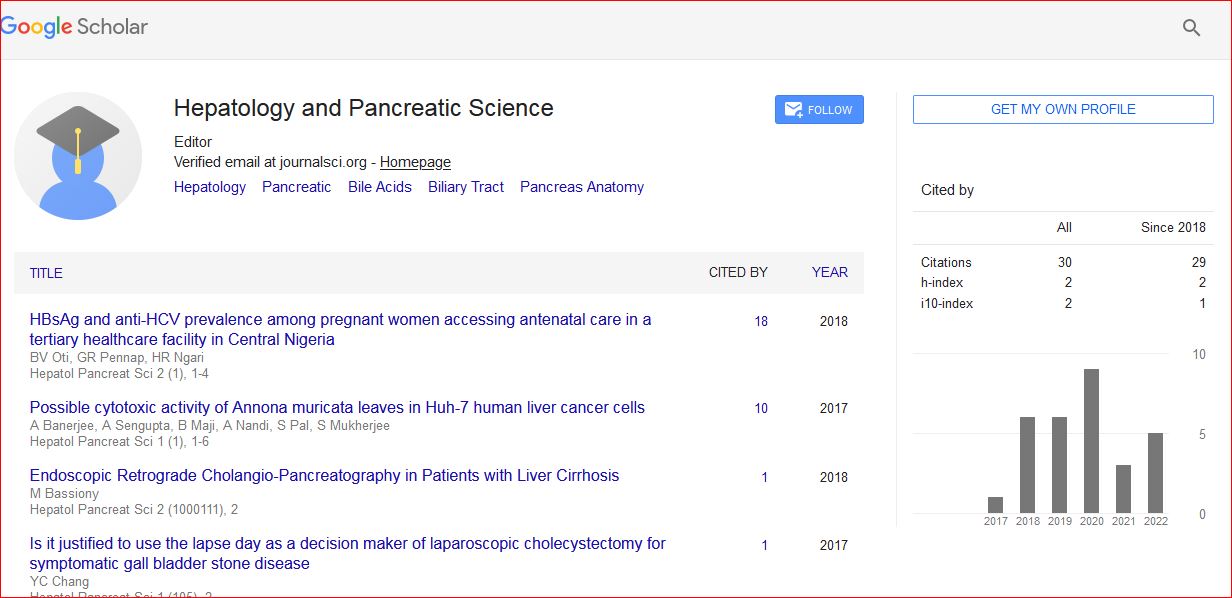
Hepatology and Pancreatic Science received 34 citations as per Google Scholar report