Short Communication - (2025) Volume 19, Issue 3
Received: 01-Jun-2025, Manuscript No. jmgm-26-185647;
Editor assigned: 03-Jun-2025, Pre QC No. P-185647;
Reviewed: 17-Jun-2025, QC No. Q-185647;
Revised: 23-Jun-2025, Manuscript No. R-185647;
Published:
30-Jun-2025
, DOI: 10.37421/1747-0862.2025.19.731
Citation: Hassan, Ibrahim. ”Precision Medicine: Transforming Healthcare Through Genomics.” J Mol Genet Med 19 (2025):731.
Copyright: © 2025 Hassan I. This is an open-access article distributed under the terms of the Creative Commons Attribution License, which permits unrestricted use, distribution and reproduction in any medium, provided the original author and source are credited.
Precision medicine is a transformative paradigm in healthcare, fundamentally altering how diseases are diagnosed and treated by emphasizing individual variability in genes, environment, and lifestyle [1].
This approach represents a significant shift from the traditional one-size-fits-all model, aiming to provide the most effective preventive and therapeutic strategies tailored to each person's unique biological profile. The integration of genomic information is central to this revolution, enabling a deeper understanding of disease predisposition and treatment response at an individual level [1].
Pharmacogenomics plays a crucial role within precision medicine by allowing clinicians to predict how a patient will respond to specific medications based on their genetic makeup [2].
This personalized approach to drug therapy helps in optimizing drug selection, dosage, and administration, thereby maximizing efficacy while minimizing the risk of adverse drug reactions and treatment failure [2].
In the field of oncology, genomic screening for inherited cancer predisposition has become a cornerstone of personalized care [3].
Identifying germline mutations that confer an increased risk for certain cancers allows for proactive surveillance, early detection, and the implementation of targeted therapeutic strategies, significantly improving patient survival and quality of life [3].
Advancements in single-cell genomics are further enhancing our understanding of cellular heterogeneity within tissues and tumors [4].
This high-resolution technology enables the dissection of complex biological systems, which is critical for developing more precise diagnostic tools and targeted therapies for diseases such as cancer [4].
Liquid biopsies, a non-invasive diagnostic technique that analyzes circulating tumor DNA (ctDNA) in bodily fluids, offer a powerful new method for cancer monitoring [5].
They are instrumental in the early detection of disease recurrence, assessment of treatment effectiveness, and identification of mechanisms of resistance, thereby guiding personalized therapeutic adjustments [5].
The ethical, legal, and social implications (ELSI) associated with the widespread adoption of precision medicine are profound and require careful consideration [6].
Ensuring equitable access to advanced genomic technologies, safeguarding patient data privacy, and obtaining informed consent are critical challenges that must be addressed for the responsible and ethical implementation of personalized healthcare [6].
Polygenic risk scores (PRS) are emerging as valuable tools for predicting an individual's susceptibility to common, complex diseases [7].
By aggregating the effects of thousands of genetic variants, PRS can provide insights into an individual's risk profile, informing preventive strategies and personalizing screening protocols for various health conditions [7].
The application of gene-editing technologies, such as CRISPR-Cas9, holds immense potential for the treatment of genetic disorders [8].
These powerful tools offer the possibility of correcting specific genetic mutations at their source, paving the way for potential cures for diseases that were previously considered untreatable [8].
Integrating artificial intelligence (AI) and machine learning (ML) into precision medicine workflows is essential for managing and interpreting the vast quantities of genomic and clinical data generated [9].
AI and ML algorithms can identify complex patterns, predict treatment outcomes, and assist clinicians in making more informed diagnostic and therapeutic decisions [9].
The development of robust diagnostic biomarkers based on genetic and molecular profiles is fundamental to the success of precision medicine [10].
These biomarkers are crucial for early disease detection, stratifying patients based on risk, and monitoring the efficacy of treatments, ultimately guiding the selection of personalized therapeutic interventions [10].
Precision medicine represents a paradigm shift in healthcare, characterized by its focus on tailoring medical treatments and interventions to the individual characteristics of each patient, including their genetic makeup, environment, and lifestyle [1].
This approach moves away from generalized treatments towards highly individualized care plans, aiming to optimize therapeutic outcomes and minimize adverse effects by understanding the unique biological underpinnings of disease in each person [1].
The integration of pharmacogenomics into clinical practice is a key component of precision medicine, enabling the prediction of an individual's drug response based on their genetic profile [2].
This allows for the judicious selection of appropriate drug dosages and the avoidance of ineffective or harmful treatments, thereby enhancing the safety and effectiveness of pharmacotherapy and ensuring that patients receive the most suitable medications for their needs [2].
Genomic screening for inherited cancer predisposition has become a critical aspect of precision oncology, empowering clinicians and patients with knowledge about genetic risks [3].
The identification of germline mutations that increase cancer susceptibility facilitates proactive surveillance, early diagnosis, and the development of targeted therapeutic strategies, which collectively contribute to significantly improved survival rates and enhanced quality of life for affected individuals and their families [3].
Single-cell genomics is a cutting-edge technology that is unlocking unprecedented insights into cellular heterogeneity within complex biological systems, particularly in tissues and tumors [4].
By enabling the dissection of these systems at the highest resolution, single-cell genomics is crucial for the development of highly precise diagnostic methods and targeted therapeutic interventions for diseases, notably cancer [4].
Liquid biopsies, a non-invasive methodology that detects circulating tumor DNA (ctDNA) in various bodily fluids, represent a significant advancement in cancer monitoring and management [5].
These biopsies facilitate the early detection of cancer recurrence, allow for the assessment of treatment response, and help identify mechanisms of drug resistance, thereby providing crucial information for guiding personalized therapeutic adjustments and improving patient care [5].
The ethical, legal, and social implications (ELSI) arising from the implementation of precision medicine are of paramount importance and necessitate careful consideration and proactive management [6].
Key challenges include ensuring equitable access to advanced genomic technologies for all populations, protecting the privacy of sensitive genetic information, and establishing robust frameworks for informed consent to guarantee the responsible and ethical application of personalized healthcare [6].
Polygenic risk scores (PRS) are emerging as powerful predictive tools that estimate an individual's susceptibility to common complex diseases by analyzing the cumulative effect of numerous genetic variants [7].
These scores are becoming increasingly valuable in informing personalized preventive strategies and tailoring screening protocols, allowing for earlier interventions and more proactive health management [7].
The groundbreaking potential of gene-editing technologies, such as CRISPR-Cas9, in treating genetic disorders is immense and continues to be explored [8].
By enabling the precise correction of specific genetic mutations at their source, these tools offer a promising pathway toward developing permanent cures for a range of inherited diseases that have historically been difficult or impossible to treat effectively [8].
The integration of artificial intelligence (AI) and machine learning (ML) into precision medicine workflows is indispensable for efficiently analyzing and interpreting the massive datasets generated from genomic and clinical information [9].
AI and ML algorithms excel at identifying intricate patterns, predicting patient responses to various treatments, and supporting clinical decision-making processes, thereby enhancing diagnostic accuracy and therapeutic selection [9].
The development and validation of effective diagnostic biomarkers, which are based on an individual's genetic and molecular profiles, are foundational to the successful implementation of precision medicine [10].
These biomarkers play a critical role in enabling early disease detection, stratifying patients based on their risk of developing certain conditions, and monitoring the effectiveness of therapeutic interventions, thereby guiding the selection of the most appropriate personalized treatment strategies [10].
Precision medicine revolutionizes healthcare by tailoring treatments to individual genetic profiles, improving disease prediction, diagnosis, and therapy selection while minimizing adverse drug reactions. Pharmacogenomics enables personalized drug regimens based on genetic makeup, enhancing treatment safety and efficacy. In oncology, genomic screening identifies cancer predisposition, allowing for proactive management and targeted therapies. Single-cell genomics offers high-resolution insights into cellular heterogeneity for precise diagnostics and treatments. Liquid biopsies provide non-invasive cancer monitoring through ctDNA analysis, aiding in early detection and treatment adjustment. The ethical, legal, and social implications, including access and privacy, are critical considerations. Polygenic risk scores predict disease susceptibility, informing prevention and screening. Gene editing technologies like CRISPR-Cas9 hold promise for correcting genetic disorders. Artificial intelligence and machine learning are essential for analyzing complex genomic and clinical data. Diagnostic biomarkers are fundamental for early detection, risk stratification, and monitoring treatment efficacy in personalized medicine.
None
None
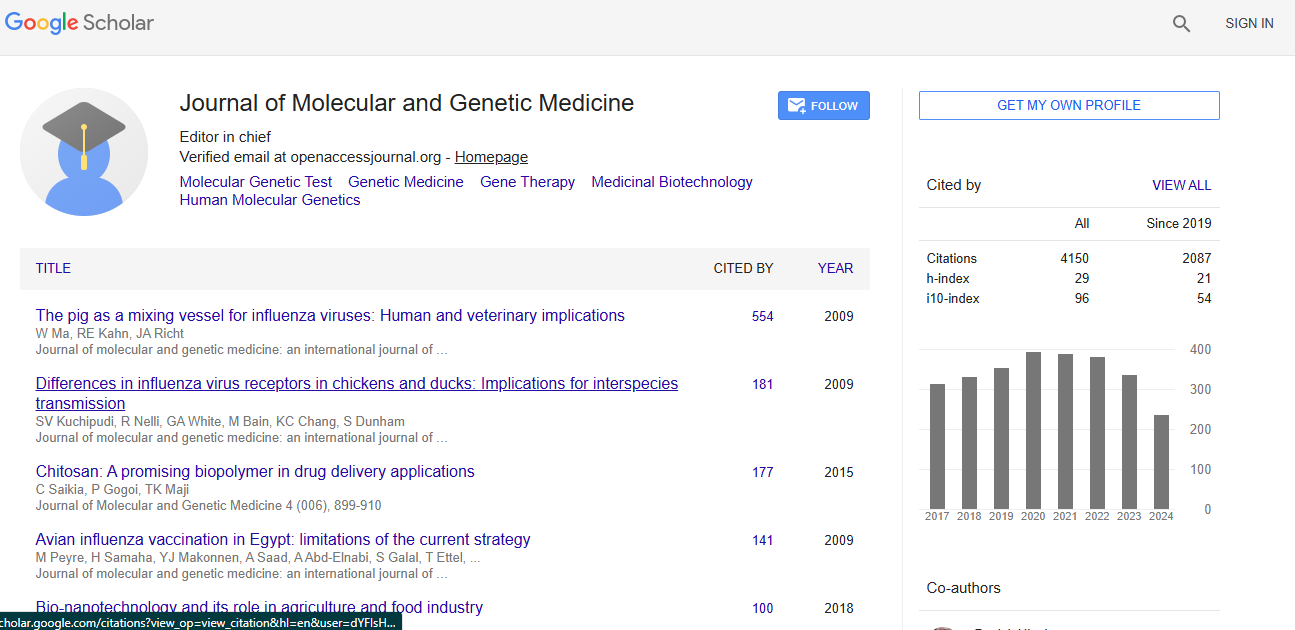
Molecular and Genetic Medicine received 3919 citations as per Google Scholar report