Short Communication - (2025) Volume 9, Issue 2
Received: 01-Apr-2025, Manuscript No. ahbs-26-182410;
Editor assigned: 03-Apr-2025, Pre QC No. P-182410;
Reviewed: 17-Apr-2025, QC No. Q-182410;
Revised: 22-Apr-2025, Manuscript No. R-182410;
Published:
29-Apr-2025
, DOI: 10.37421/2952-8097.2025.9.311
Citation: Al-Farsi, Laila H.. ”Precision Livestock Farming: Better
Animal Welfare And Productivity.” J Anim Health Behav Sci 09 (2025):311.
Copyright: © 2025 Al-Farsi H. Laila This is an open-access article distributed under the terms of the Creative Commons Attribution License, which permits unrestricted use,
distribution and reproduction in any medium, provided the original author and source are credited.
Precision Livestock Farming (PLF) represents a paradigm shift in animal health and behavior monitoring, leveraging advanced technologies to enhance the well-being and productivity of livestock. This integrated approach facilitates continuous, non-invasive data collection on individual animals, enabling the early detection of health issues and deviations in behavior. A core component of PLF involves the utilization of various sensors, sophisticated AI-driven analytics, and comprehensive data management platforms, all of which are crucial for implementing timely interventions, improving animal welfare, and boosting overall productivity. The ultimate goal is to translate raw data into practical, actionable insights for farmers and veterinarians alike, fostering a more proactive and informed approach to animal husbandry [1].
One of the key technological advancements within PLF is the use of wearable sensors for real-time monitoring of physiological and behavioral parameters in cattle. These devices are capable of tracking a wide range of metrics, including activity levels, rumination time, body temperature, and even heart rate, thereby providing an in-depth understanding of an animal's overall well-being. By detecting deviations from established normal patterns, these sensors can signal the early onset of disease or stress, prompting prompt veterinary attention and contributing to improved animal health outcomes and reduced economic losses [2].
Complementing sensor-based approaches, automated video analysis, powered by artificial intelligence, offers an effective means of observing animal behavior in group settings without causing disturbance. This technology can precisely identify and quantify specific behaviors such as feeding, resting, social interactions, and subtle signs of lameness. By recognizing minute changes in behavioral patterns, it aids in the early detection of illness or distress, thus enabling prompt and informed management decisions. The integration of AI significantly enhances the objectivity and efficiency of behavioral monitoring in livestock [3].
The application of machine learning algorithms to sensor data is fundamental to the interpretation of complex patterns related to animal health and behavior within livestock farming. These algorithms are designed to learn from extensive datasets, allowing them to identify anomalies, predict disease outbreaks, and optimize crucial aspects like feeding strategies. This predictive capability shifts management from a reactive stance to a proactive one, moving beyond simply responding to existing health issues and contributing to more sustainable farming practices [4].
Further enriching the PLF toolkit are acoustic monitoring systems. These systems utilize microphones to capture the sounds produced by animals, providing a non-invasive method for detecting signs of distress or disease. Vocalizations can undergo significant alterations in response to pain, stress, or respiratory problems. Analyzing these sound patterns with AI can aid in identifying individual animals that may be suffering, thereby enabling targeted interventions and serving as a valuable complement to other monitoring methods by providing a unique data stream [5].
The overarching implications of integrating precision livestock farming technologies are profoundly positive for animal welfare standards. By furnishing continuous, detailed insights into individual animal health and behavior, PLF empowers farmers to make more informed decisions aimed at preventing suffering and improving living conditions. This transition towards proactive care, driven by data, directly aligns with increasing societal expectations for responsible and ethical animal husbandry practices [6].
Environmental monitoring sensors, which measure parameters such as temperature, humidity, and air quality within barns, are also integral to the successful implementation of PLF. These environmental factors have a substantial impact on animal health and behavior, influencing stress levels, susceptibility to disease, and overall productivity. The ability to correlate environmental data with observed animal responses allows for the optimization of housing conditions, fostering a healthier and more comfortable environment for livestock [7].
The successful deployment of PLF for health and behavioral monitoring critically depends on robust data management and analytical frameworks. The sheer volume of data generated by diverse sensors necessitates secure and efficient platforms capable of processing, analyzing, and visualizing information for end-users. This essential infrastructure is the cornerstone for deriving meaningful insights and enabling informed decision-making processes in the complex domain of livestock management [8].
Subtle shifts in an animal's behavior can serve as early indicators of pain, a crucial aspect of welfare monitoring. Precision livestock farming techniques, especially automated observation systems and wearable sensors, are adept at detecting alterations in posture, gait, and activity patterns that might otherwise go unnoticed by human observation. The early identification of pain is paramount for enabling prompt treatment and ultimately improving animal welfare [9].
The economic advantages stemming from the adoption of PLF for health and behavioral monitoring are considerable. Early detection of diseases significantly reduces veterinary treatment costs and mitigates production losses. Furthermore, enhanced animal welfare often translates into higher quality products and can improve market access. Consequently, PLF represents a strategic investment that drives efficiency and sustainability in animal production systems [10].
Precision Livestock Farming (PLF) is fundamentally transforming the way animal health and behavior are monitored through the integration of advanced technologies. This progressive approach enables the continuous and non-invasive collection of data on individual animals, which is instrumental in achieving early detection of health concerns and behavioral anomalies. Key technologies central to PLF include sophisticated sensors, analytical tools powered by artificial intelligence, and comprehensive data management platforms that together facilitate prompt interventions, thereby enhancing animal welfare and increasing productivity. The core objective is to translate raw data into practical and actionable insights for both farmers and veterinarians, promoting a more proactive and informed approach to animal husbandry [1].
Wearable sensors play a crucial role in the real-time monitoring of physiological and behavioral parameters in cattle, offering significant advantages in understanding animal well-being. These sensors are capable of tracking a variety of metrics, such as activity levels, duration of rumination, body temperature, and even heart rate, providing a holistic view of an animal's health status. Any deviations from normal patterns can serve as an early warning sign for disease or stress, prompting timely veterinary intervention and leading to improved health outcomes and reduced economic losses for producers [2].
Automated video analysis, enhanced by artificial intelligence, provides an efficient and effective method for observing animal behavior in group settings without causing any disruption to the animals. This technology is adept at identifying and quantifying specific behaviors including feeding, resting, social interactions, and subtle signs of lameness. By recognizing nuanced changes in behavioral patterns, it assists in the early detection of illness or distress, thereby enabling rapid management decisions. The integration of AI further enhances the objectivity and efficiency of behavioral observation in livestock management [3].
The application of machine learning algorithms to the vast datasets generated by sensors in livestock farming is essential for deciphering complex patterns associated with animal health and behavior. These algorithms possess the capability to learn from extensive data, enabling them to identify anomalies, forecast disease outbreaks, and optimize operational strategies such as feeding regimens. This predictive power allows for proactive management, moving beyond a purely reactive approach to animal health issues and contributing to more sustainable and resilient farming practices [4].
Acoustic monitoring systems, which employ microphones to capture animal vocalizations, offer a valuable non-invasive method for detecting signs of distress or disease. Changes in vocalizations can be indicative of pain, stress, or respiratory ailments. By analyzing these sound patterns using AI, it becomes possible to identify individual animals that may be experiencing suffering, thereby enabling targeted interventions. This technology acts as a complementary data stream to other monitoring techniques [5].
The widespread integration of precision livestock farming technologies has direct and substantial implications for elevating animal welfare standards. By providing continuous and detailed insights into the health and behavior of individual animals, PLF empowers farmers to make more informed decisions aimed at preventing suffering and enhancing the overall living conditions of their livestock. This fundamental shift towards proactive care, driven by data analytics, strongly aligns with growing societal expectations for ethical and responsible animal husbandry [6].
Environmental monitoring sensors are a critical component of PLF systems, measuring key parameters within livestock barns such as temperature, humidity, and air quality. These environmental factors significantly influence animal health and behavior, affecting stress levels, susceptibility to diseases, and overall productivity. By correlating environmental data with observed animal responses, it becomes possible to optimize housing conditions, thereby ensuring a healthier and more comfortable environment for the animals [7].
The successful implementation and widespread adoption of PLF technologies for health and behavioral monitoring are contingent upon the availability of robust data management and analytical frameworks. The immense volume of data generated by the diverse array of sensors necessitates the development and deployment of secure, efficient platforms capable of processing, analyzing, and visualizing this information effectively for end-users. Such an infrastructure is paramount for extracting meaningful insights and facilitating informed decision-making in livestock management [8].
Subtle behavioral changes in livestock can serve as early indicators of pain, a critical aspect of animal welfare. Precision livestock farming techniques, particularly automated observation systems and wearable sensors, are instrumental in detecting alterations in posture, gait, and activity patterns that might otherwise escape human observation. The early identification of pain is crucial for enabling timely treatment and substantially improving overall animal welfare [9].
The economic benefits derived from the implementation of PLF for health and behavioral monitoring are substantial and far-reaching. Early disease detection directly contributes to reduced treatment costs and prevents significant production losses. Moreover, improved animal welfare can lead to higher quality products and enhance market access, positioning PLF as a vital strategic investment for achieving efficient and sustainable animal production [10].
Precision Livestock Farming (PLF) revolutionizes animal health and behavior monitoring through advanced technologies like sensors, AI analytics, and data platforms. These tools enable continuous, non-invasive data collection for early detection of health issues and behavioral deviations, leading to timely interventions, improved welfare, and enhanced productivity. Wearable sensors track physiological and behavioral parameters, while automated video analysis observes group behavior. Machine learning algorithms interpret sensor data for anomaly detection and prediction. Acoustic monitoring identifies distress through vocalizations, and environmental sensors optimize barn conditions. The integration of PLF leads to better animal welfare, reduced economic losses, and more sustainable farming practices.
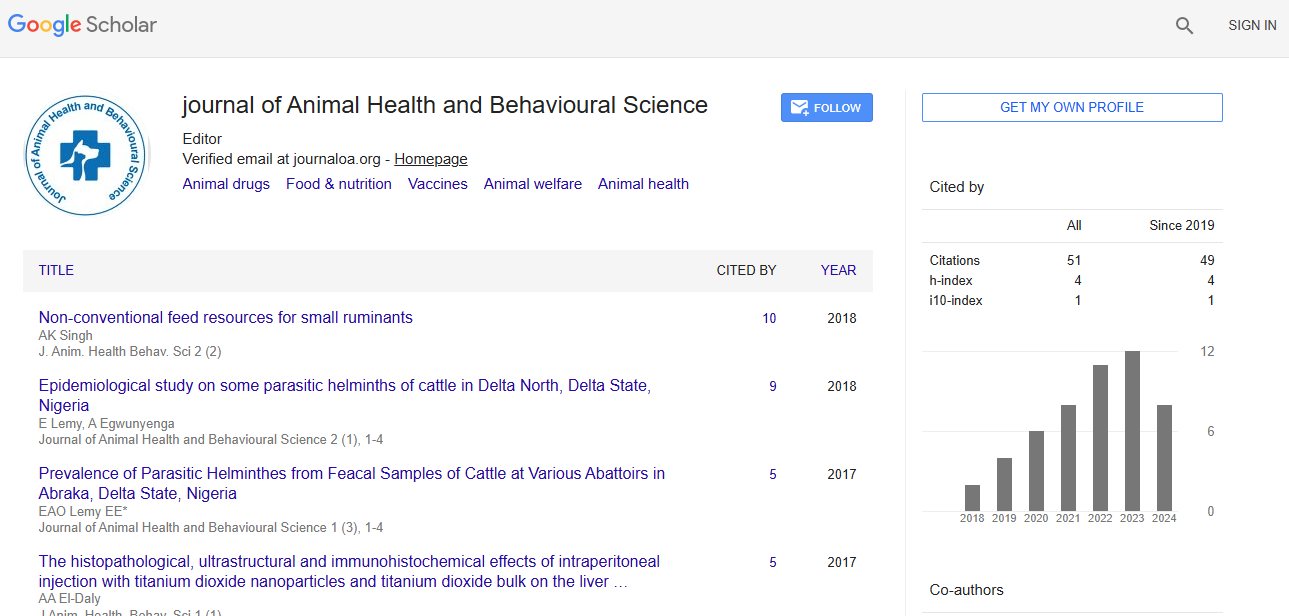
Journal of Animal Health and Behavioural Science received 38 citations as per Google Scholar report