Commentary - (2025) Volume 9, Issue 4
Received: 01-Jul-2025, Manuscript No. jgdr-26-179183;
Editor assigned: 03-Jul-2025, Pre QC No. P-179183;
Reviewed: 17-Jul-2025, QC No. Q-179183;
Revised: 22-Jul-2025, Manuscript No. R-179183;
Published:
29-May-2025
, DOI: 10.37421/2684-6039.2025.09.275
Citation: Ferreira, Camila. ”Precision Genetic Diagnosis and Management of Syndromes.” J Genet DNA Res 09 (2025):275.
Copyright: © 2025 Ferreira C. This is an open-access article distributed under the terms of the Creative Commons Attribution License, which permits unrestricted use, distribution and reproduction in any medium, provided the original author and source are credited.
The advent of molecular diagnostics has ushered in a new era for the identification of inherited genetic syndromes, significantly enhancing diagnostic accuracy and enabling personalized management strategies. Advancements in DNA sequencing technologies, particularly next-generation sequencing (NGS), have been instrumental in pinpointing causative genetic variations, thereby improving patient outcomes and quality of life [1].
The intricate molecular basis of rare genetic disorders is increasingly being unraveled, facilitating a transition from phenotype-driven to genotype-driven identification, especially for syndromes with overlapping clinical presentations. This shift has profound implications for genetic counseling and family planning [2].
Furthermore, the development of gene editing technologies, such as CRISPR-Cas9, holds immense promise for correcting disease-causing mutations at the DNA level, offering a glimpse into future therapeutic avenues that extend beyond symptomatic management [3].
The integration of comprehensive sequencing approaches, including whole-exome and whole-genome sequencing, has markedly improved the diagnostic yield for complex genetic syndromes. These methods facilitate the identification of variants in both coding and non-coding regions, leading to a deeper understanding of genotype-phenotype correlations and enabling timely interventions [4].
In the realm of inherited metabolic disorders, early molecular diagnosis is paramount for effective treatment. Current therapeutic strategies, encompassing dietary interventions, enzyme replacement therapy, and gene therapy, are increasingly tailored to the specific molecular defect identified [5].
Alongside these diagnostic and therapeutic advancements, the widespread adoption of genetic testing for inherited syndromes necessitates careful consideration of ethical implications. Issues such as genetic discrimination, informed consent, and the psychological impact of receiving a genetic diagnosis require robust ethical frameworks and comprehensive patient support systems [6].
Emerging techniques like liquid biopsy are also revolutionizing the management of genetic syndromes. The analysis of cell-free DNA and circulating tumor DNA offers potential for non-invasive diagnosis and the development of personalized therapeutic strategies through monitoring disease progression and treatment response [7].
A critical aspect of molecular diagnosis involves the accurate classification and interpretation of genetic variants. Distinguishing pathogenic variants from benign polymorphisms remains a challenge, underscoring the importance of standardized interpretation guidelines and comprehensive databases [8].
The application of advanced sequencing technologies, such as long-read sequencing, is proving invaluable for detecting complex structural variants that are often implicated in genetic syndromes and can be missed by traditional short-read methods, thereby improving diagnostic resolution [9].
Finally, pharmacogenomics plays a crucial role in tailoring drug therapies for individuals with inherited genetic syndromes. By understanding an individual's genetic makeup and its influence on drug response, clinicians can optimize treatment efficacy and minimize adverse drug reactions, leading to more personalized and effective care [10].
Molecular diagnostics represents a paradigm shift in the identification of inherited genetic syndromes, with next-generation sequencing (NGS) technologies at the forefront of pinpointing causative genetic variations and enabling personalized management [1].
Understanding the molecular underpinnings of rare genetic disorders is pivotal for refining diagnostic strategies, moving towards genotype-driven identification for syndromes with complex phenotypes and overlapping presentations, thereby informing genetic counseling and family planning [2].
The therapeutic landscape for inherited genetic syndromes is being reshaped by gene editing technologies like CRISPR-Cas9, which offer the potential for direct correction of mutations and novel treatment avenues beyond symptom management [3].
Comprehensive genomic sequencing, including whole-exome and whole-genome sequencing, has substantially enhanced the diagnostic capabilities for complex genetic syndromes, allowing for the identification of variants across the genome and a more nuanced understanding of genotype-phenotype correlations to guide interventions [4].
For inherited metabolic disorders, early and precise molecular diagnosis is essential for initiating effective treatment, with therapies now being increasingly customized to the specific molecular defect, ranging from dietary adjustments to advanced gene and enzyme replacement therapies [5].
The ethical dimensions of genetic testing for inherited syndromes are significant, encompassing concerns related to genetic discrimination, the process of informed consent, and the psychological ramifications for patients and families, necessitating the establishment of robust ethical guidelines and support structures [6].
Liquid biopsy techniques are emerging as a powerful tool in the management of genetic syndromes, offering non-invasive methods for diagnosis and monitoring treatment response through the analysis of circulating DNA, thereby contributing to personalized therapeutic approaches [7].
Accurate variant interpretation is a cornerstone of molecular diagnosis for inherited genetic syndromes, with ongoing challenges in differentiating pathogenic from benign variants highlighting the need for standardized interpretation frameworks and comprehensive genetic databases [8].
The detection of complex structural variants, often associated with genetic syndromes, is being significantly improved by the application of long-read sequencing technologies, which offer higher resolution and enable the identification of rearrangements that may elude short-read sequencing methods [9].
Pharmacogenomics is increasingly vital in personalizing treatment for individuals with inherited genetic syndromes, allowing for optimized drug selection and dosing based on an individual's genetic profile, thereby enhancing therapeutic efficacy and minimizing adverse drug reactions [10].
This collection of research explores the multifaceted advancements in the molecular diagnosis and management of inherited genetic syndromes. It highlights the critical role of next-generation sequencing and whole-exome/genome sequencing in identifying genetic variations, leading to more accurate diagnoses and a shift towards genotype-driven approaches. The review also touches upon the potential of gene editing technologies and the importance of variant interpretation. Furthermore, it addresses the clinical management of specific disorders, the application of liquid biopsies for monitoring, and the ethical considerations surrounding genetic testing. Pharmacogenomics is emphasized for its role in personalizing drug therapies. The overarching theme is the move towards more precise, personalized, and ethically grounded care for individuals affected by genetic syndromes.
None
None
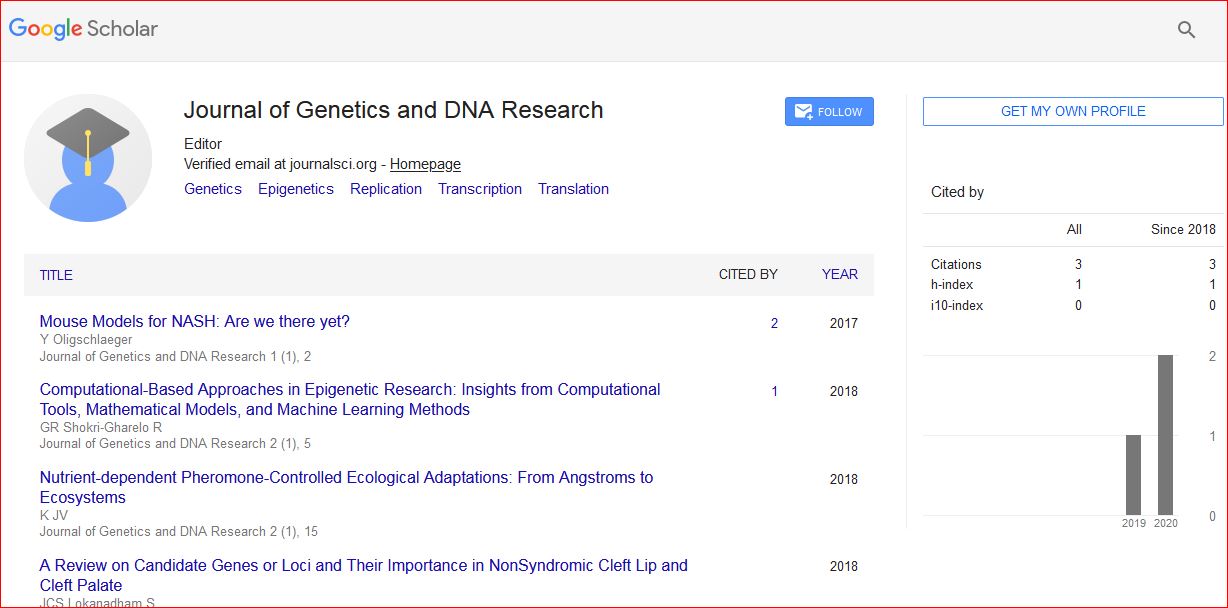
Journal of Genetics and DNA Research received 3 citations as per Google Scholar report