Perspective - (2025) Volume 13, Issue 6
Received: 03-Nov-2025, Manuscript No. economics-26-186085;
Editor assigned: 05-Nov-2025, Pre QC No. P-186085;
Reviewed: 19-Nov-2025, QC No. Q-186085;
Revised: 24-Nov-2025, Manuscript No. R-186085;
Published:
01-Dec-2025
, DOI: 10.37421/2375-4389.2025.13.558
Citation: Russo, Valentina. ”Political Instability’s Devastating
Economic Impact.” J Glob Econ 13 (2025):558.
Copyright: © 2025 Russo V. This is an open-access article distributed under the terms of the Creative Commons Attribution License, which permits unrestricted use, distribution
and reproduction in any medium, provided the original author and source are credited.
Political instability profoundly disrupts economic development by deterring foreign direct investment (FDI), hindering long-term planning, and increasing risk premiums, often leading to capital flight, reduced public service provision, and a weakened institutional framework, ultimately stifling growth and exacerbating poverty. The unpredictable nature of political transitions creates an environment where businesses struggle to operate efficiently, and governments find it difficult to implement consistent and effective development policies [1].
The impact of political uncertainty on economic growth is frequently negative, leading to decreased investment in infrastructure and human capital. When political regimes are unstable, there is a higher probability of policy reversals and expropriation, which discourages long-term investments essential for sustainable development. Furthermore, such environments tend to foster corruption and inefficient resource allocation [2].
Financial markets exhibit heightened sensitivity to political instability. Periods of unrest or uncertainty commonly result in increased volatility in exchange rates and stock markets, capital outflows, and elevated borrowing costs for both governments and businesses. This can severely restrict access to finance, which is indispensable for development projects [3].
Political instability erodes social capital and trust, elements that are fundamental for effective governance and development. A deficiency in predictable institutions and the rule of law fosters corruption and rent-seeking behavior, thereby diverting resources away from productive investments and public welfare [4].
The consequences of political instability for the education sector are considerable, often manifesting as reduced government expenditure, interruptions in schooling, and a brain drain of skilled professionals. This situation undermines human capital development, a critical catalyst for long-term economic progress [5].
Political instability serves as a significant obstacle to infrastructure development. Ambiguity concerning property rights, contract enforcement, and governmental commitment acts as a disincentive for private sector participation and public investment in crucial infrastructure projects, which are vital for economic connectivity and productivity [6].
The repercussions of conflict and political instability on health outcomes are severe. They lead to the destruction of healthcare facilities, the displacement of populations, and the disruption of essential health services, consequently increasing morbidity and mortality rates, particularly among vulnerable demographics [7].
Political instability can precipitate substantial declines in agricultural productivity due to disruptions in supply chains, insecurity in land tenure, and diminished access to inputs and markets. This directly impacts food security and the livelihoods of rural communities [8].
The presence of robust, independent institutions acts as a crucial safeguard against the adverse economic effects of political instability. Institutions that uphold the rule of law, protect property rights, and ensure contract enforcement cultivate a more predictable and appealing environment for investment and development [9].
Geopolitical risks and political instability originating in one region can generate ripple effects across the global economy. These include impacts on trade flows, commodity prices, and international financial stability, underscoring the interconnected nature of the global economic system [10].
Political instability fundamentally impedes economic development through various mechanisms, notably by discouraging foreign direct investment (FDI), complicating long-term strategic planning, and escalating risk premiums associated with economic activities. This environment frequently precipitates capital flight, diminishes the quality and availability of public services, and weakens the overall institutional framework, thereby hindering economic growth and intensifying poverty. The inherent unpredictability of political transitions creates an operational challenge for businesses and restricts the capacity of governments to implement stable and effective developmental strategies [1].
The adverse effects of political uncertainty on economic growth are pronounced, leading to a reduction in investments directed towards infrastructure development and human capital enhancement. In contexts of political instability, the likelihood of policy reversals and asset expropriation increases, which in turn deters the long-term investments that are critical for fostering sustainable development. Moreover, such unstable political climates are conducive to corruption and the inefficient allocation of resources [2].
Financial markets demonstrate a pronounced sensitivity to fluctuations and disruptions caused by political instability. Periods marked by unrest or uncertainty typically correlate with heightened volatility in currency exchange rates and stock market performance, increased capital outflows, and a rise in the cost of borrowing for both public and private entities. Such conditions can severely constrain access to essential financing for various development initiatives [3].
Political instability has a corrosive effect on social capital and the trust necessary for effective governance and development. A deficit in reliable institutions and the consistent application of the rule of law can foster environments ripe for corruption and rent-seeking activities, diverting valuable resources from productive economic pursuits and the provision of public goods [4].
The education sector experiences significant detrimental impacts from political instability. These often include cuts in governmental spending on education, disruptions to the regular functioning of educational institutions, and the emigration of skilled educational professionals. Such outcomes collectively undermine the development of human capital, which is a cornerstone of sustained economic advancement [5].
Political instability poses a substantial barrier to the progress of infrastructure development. Uncertainty surrounding the security of property rights, the reliable enforcement of contracts, and the commitment of the government to long-term projects discourages both private sector investment and public funding for critical infrastructure, which is fundamental for enhancing economic connectivity and overall productivity [6].
The consequences of conflict and political instability on public health are profound and often devastating. These situations lead to the destruction of essential healthcare facilities, the forced displacement of large populations, and the breakdown of vital health services, resulting in elevated rates of illness and death, particularly among the most vulnerable segments of society [7].
Political instability can lead to considerable reductions in agricultural output. This is often due to the disruption of supply chains, insecurity regarding land tenure, and reduced availability of essential agricultural inputs and access to markets. These issues have a direct bearing on food security and the economic well-being of rural populations [8].
The presence of strong, independent, and well-functioning institutions serves as a critical protective mechanism against the negative economic consequences stemming from political instability. Institutions that steadfastly uphold the rule of law, rigorously protect property rights, and ensure the dependable enforcement of contracts create a more stable, predictable, and ultimately more attractive environment for both domestic and international investment, as well as for broader developmental efforts [9].
Geopolitical risks and political instability within specific regions can have far-reaching and interconnected effects on global economic development. These impacts can manifest in altered trade patterns, fluctuations in global commodity prices, and challenges to international financial stability, thereby highlighting the intricate and interdependent nature of the contemporary global economy [10].
\Political instability significantly hinders economic development by deterring foreign investment, complicating planning, and increasing risks, leading to capital flight and weakened institutions. It reduces investment in infrastructure and human capital, increases corruption, and leads to policy reversals. Financial markets suffer from volatility and higher borrowing costs. Social capital and trust are eroded, while education and infrastructure development are hampered. Health outcomes worsen due to damaged facilities and disrupted services, and agricultural productivity declines, impacting food security. Strong institutions can mitigate these negative effects. Geopolitical risks also have global spillover impacts, underscoring economic interconnectedness.
None
None
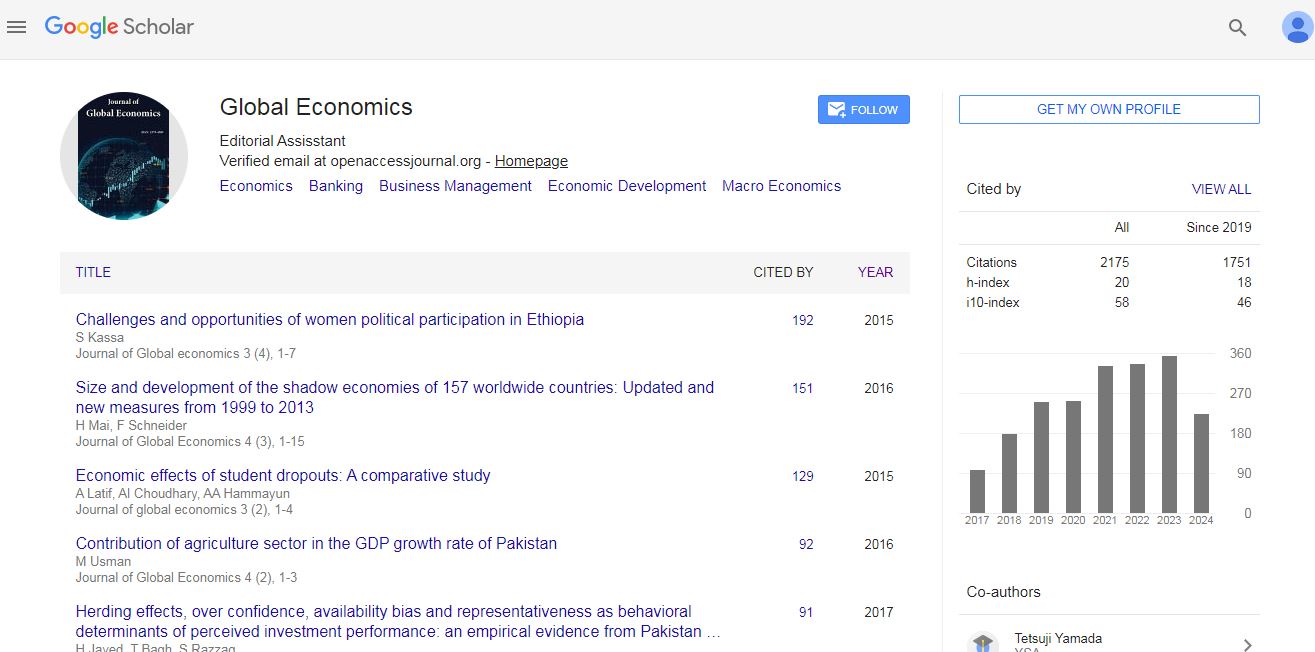
Journal of Global Economics received 2175 citations as per Google Scholar report