Brief Report - (2025) Volume 15, Issue 6
Received: 01-Dec-2025, Manuscript No. jprm-25-174597;
Editor assigned: 03-Dec-2025, Pre QC No. P-174597;
Reviewed: 17-Dec-2025, QC No. Q-174597;
Revised: 22-Dec-2025, Manuscript No. R-174597;
Published:
29-Dec-2025
, DOI: 10.37421/2161-105X.2025.15.768
Citation: Suresh, Leena K.. ”PH/PAH: Advancements, Guidelines, Future Directions.” J Pulm Respir Med 15 (2025):768.
Copyright: © 2025 Suresh K. Leena This is an open-access article distributed under the terms of the Creative Commons Attribution License, which permits unrestricted use, distribution and reproduction in any medium, provided the original author and source are credited.
The contemporary understanding and management of pulmonary hypertension (PH) are continuously refined through comprehensive guidelines and advanced research. A cornerstone in this field is the 2022 ESC/ERS guidelines, which meticulously detail updated classifications, diagnostic pathways, and robust risk stratification methodologies for PH. These guidelines emphasize a personalized approach to treatment strategies, recognizing the unique patient profiles, and highlight the indispensable role of multidisciplinary care teams in significantly improving patient outcomes. [1] Further advancing treatment modalities, targeted therapies for pulmonary arterial hypertension (PAH) are a major focus, building upon established drug classes. These include crucial prostacyclin pathway agonists, endothelin receptor antagonists, and nitric oxide (NO)-cyclic guanosine monophosphate (cGMP) pathway modulators, which have transformed patient management. The ongoing exploration into novel therapeutic targets and emerging strategies holds promise for not only alleviating symptoms but actively halting disease progression and markedly enhancing the quality of life for individuals living with PAH. [2] Unraveling the genetic landscape of PH has provided profound new insights into both inherited and idiopathic forms of the condition. This expanding knowledge underscores how genetic testing is increasingly valuable, offering critical information for precise diagnosis, predicting disease prognosis, and directly informing personalized therapeutic decisions, all stemming from a deeper understanding of specific gene mutations and their impact on disease pathophysiology. [3] A pivotal determinant of prognosis and survival in PH patients is the function and adaptive capacity of the right ventricle, along with its susceptibility to eventual failure. Consequently, current diagnostic methods are being refined to more accurately assess right ventricular health, while therapeutic strategies are specifically designed to preserve or improve its performance, recognizing its critical contribution to patient longevity. [4] Exercise, often a complex topic for PH patients, is undergoing a critical reappraisal to thoroughly evaluate its safety, potential benefits, and inherent limitations. Understanding the distinct physiological responses to physical activity in the context of PH is essential for developing carefully tailored exercise training programs aimed at improving functional capacity without exacerbating existing symptoms or risking patient well-being. [5] Beyond the conventional vasodilators, the horizon of therapeutic options for PAH is expanding rapidly with novel and emerging agents. These innovative drug classes are designed to target diverse pathways implicated in disease progression, offering considerable hope for achieving superior outcomes and potentially ushering in an era of true disease modification. [6] Effective risk stratification and the identification of key prognostic factors remain central to optimizing management in PAH. Clinicians rely on a combination of clinical, hemodynamic, and functional parameters that reliably predict disease progression and survival, providing essential tools to accurately assess individual patient risk and precisely guide the intensity and nature of their treatment regimens. [7] Modern imaging techniques are indispensable in the comprehensive evaluation of pulmonary hypertension, spanning diagnosis, severity assessment, and meticulous monitoring of treatment response, while also deepening our understanding of PH pathophysiology. Modalities such as echocardiography, cardiac Magnetic Resonance Imaging (MRI), Computed Tomography (CT), and nuclear medicine each offer unique insights, contributing to a holistic patient assessment. [8] Addressing pulmonary hypertension in pediatric populations presents distinct challenges, necessitating specialized management approaches. Current reviews and future directions in pediatric PH diagnosis and therapy emphasize the development of highly tailored strategies that account for varying etiologies and age groups, with the overarching goal of significantly improving long-term outcomes for these young patients. [9] Finally, the burgeoning field of biomarkers in pulmonary hypertension is poised to revolutionize personalized patient management. Research into various circulating and tissue-based markers continues to explore their potential to aid in earlier diagnosis, more accurate risk stratification, effective monitoring of disease progression, and precise assessment of therapeutic efficacy, ultimately driving a more individualized approach to care. [10]
Pulmonary hypertension (PH) represents a complex and progressive condition impacting the pulmonary vasculature and heart, with its management continually evolving through comprehensive guidelines and cutting-edge research. The 2022 ESC/ERS guidelines offer a fundamental framework, providing updated classification systems, streamlined diagnostic pathways, and refined risk stratification models for PH [C001]. These guidelines underscore the necessity of personalized treatment approaches and the profound impact of multidisciplinary care in improving patient outcomes, highlighting a shift towards more integrated and patient-centric strategies [C001].
A significant focus in the therapeutic landscape involves targeted therapies for pulmonary arterial hypertension (PAH). These treatments encompass established drug classes, including prostacyclin pathway agonists, endothelin receptor antagonists, and NO-cGMP pathway modulators, which have been instrumental in managing the disease. Ongoing research actively explores novel targets and innovative therapeutic strategies, aiming not only to alleviate symptoms but crucially to halt disease progression and enhance patient quality of life [C002]. Additionally, the field is rapidly advancing with the development of novel and emerging therapeutic agents that move beyond conventional vasodilators, promising improved outcomes and potentially disease modification by targeting diverse pathways involved in the condition's progression [C006].
The intricate genetic underpinnings of PH are being increasingly understood, providing new insights into both inherited and idiopathic forms of the disease. This deepening knowledge is making genetic testing an invaluable tool, capable of informing precise diagnosis, offering prognostic indicators, and directly guiding therapeutic decisions based on a clear understanding of specific gene mutations and their impact on pathophysiology [C003]. This genetic perspective complements the critical role of understanding the right ventricle's function in PH. The right ventricle's adaptation and eventual failure are key determinants of prognosis, emphasizing the importance of current diagnostic methods to assess its health and therapeutic strategies designed to preserve or improve its performance, which is vital for patient survival [C004].
For PH patients, the role of physical activity is undergoing careful re-evaluation. A critical reappraisal of exercise in pulmonary hypertension considers its safety, potential benefits, and inherent limitations. Understanding the unique physiological responses to physical activity in this context allows for the development of tailored exercise training programs designed to improve functional capacity without exacerbating symptoms [C005]. Concurrent with these considerations, effective risk stratification and the identification of key prognostic factors are paramount in PAH. Clinical, hemodynamic, and functional parameters are identified as reliable predictors of disease progression and survival, empowering clinicians to assess individual patient risk and adjust treatment intensity accordingly [C007].
Furthermore, advanced imaging techniques are indispensable in the comprehensive evaluation of PH. Modalities such as echocardiography, cardiac MRI, CT, and nuclear medicine provide crucial insights for diagnosing, assessing severity, monitoring treatment response, and furthering the understanding of PH pathophysiology [C008]. Special considerations are also given to pediatric populations, where the management of pulmonary hypertension presents unique challenges. Reviews highlight current approaches and future directions, emphasizing tailored strategies for different etiologies and age groups to improve long-term outcomes for children with PH [C009].
The emerging role of biomarkers in pulmonary hypertension promises to revolutionize personalized patient management by aiding in early diagnosis, risk stratification, monitoring disease progression, and assessing therapeutic efficacy through various circulating and tissue-based markers [C010].
The provided data comprehensively outlines current knowledge and future directions in pulmonary hypertension (PH) and pulmonary arterial hypertension (PAH) management. Recent guidelines, specifically the 2022 ESC/ERS, offer updated classifications, diagnostic pathways, risk stratification, and personalized therapeutic strategies, emphasizing multidisciplinary care for improved patient outcomes. Targeted therapies, including prostacyclin pathway agonists and endothelin receptor antagonists, continue to evolve, with ongoing research into novel targets aimed at halting disease progression and enhancing quality of life. Significant advancements in understanding the genetic underpinnings of PH are crucial for diagnosis, prognosis, and guiding therapy based on gene mutations. The right ventricle's function, adaptation, and potential failure are recognized as key prognostic indicators, driving strategies to preserve its performance. While exercise in PH requires careful reappraisal for safety and benefits, tailored programs can improve functional capacity. Emerging therapies, beyond conventional vasodilators, hold promise for disease modification. Prognostic factors and risk stratification based on clinical, hemodynamic, and functional parameters are vital for assessing individual patient risk and guiding treatment intensity. Imaging techniques like echocardiography and cardiac MRI are essential for diagnosis and monitoring. Specialized management approaches are critical for pediatric PH, focusing on tailored strategies. Finally, biomarkers are poised to revolutionize personalized patient management by aiding in early diagnosis, risk stratification, and monitoring therapeutic efficacy. This collective research drives continuous improvements in PH diagnosis and treatment across all patient demographics.
None
None
Nazzareno G, Marius MH, Marco C. "2022 ESC/ERS Guidelines for the diagnosis and treatment of pulmonary hypertension".Eur Heart J 43 (2022):3725-3841.
Indexed at, Google Scholar, Crossref
Marc H, Olivier V, Gérald S. "Targeted therapy for pulmonary arterial hypertension: current status and future perspectives".Eur Respir J 61 (2023):2200257.
Indexed at, Google Scholar, Crossref
Marion E, Olivier S, Mark TG. "Genetic landscape of pulmonary hypertension: new insights and clinical implications".Eur Respir J 56 (2020):2000578.
Indexed at, Google Scholar, Crossref
Peter T, Anke JVdM, Anton VN. "Right Ventricular Function in Pulmonary Hypertension: Clinical Implications and Therapeutic Strategies".J Am Heart Assoc 9 (2020):e017013.
Indexed at, Google Scholar, Crossref
Frans LDM, Harm JB, Anke JVdM. "Exercise in pulmonary hypertension: a critical reappraisal".Eur Respir Rev 28 (2019):190040.
Indexed at, Google Scholar, Crossref
F. Z, R. FS, R. GF. "Emerging Therapies for Pulmonary Arterial Hypertension".Am J Respir Crit Care Med 206 (2022):15-28.
Indexed at, Google Scholar, Crossref
Olivier S, Marius MH, Marc H. "Prognostic factors and risk stratification in pulmonary arterial hypertension".Eur Respir Rev 29 (2020):190141.
Indexed at, Google Scholar, Crossref
Anton VN, Anke JVdM, Harm JB. "Imaging in pulmonary hypertension: state of the art and future directions".Eur Respir J 54 (2019):1900067.
Indexed at, Google Scholar, Crossref
Steven HA, Stephen CA, Marc dP. "Management of pulmonary hypertension in children: a review of current approaches and future directions".Eur Respir J 55 (2020):1901901.
Indexed at, Google Scholar, Crossref
Frans LDM, Harm JB, Anton VN. "Biomarkers in pulmonary hypertension: current status and future perspectives".Eur Respir J 57 (2021):2003719.
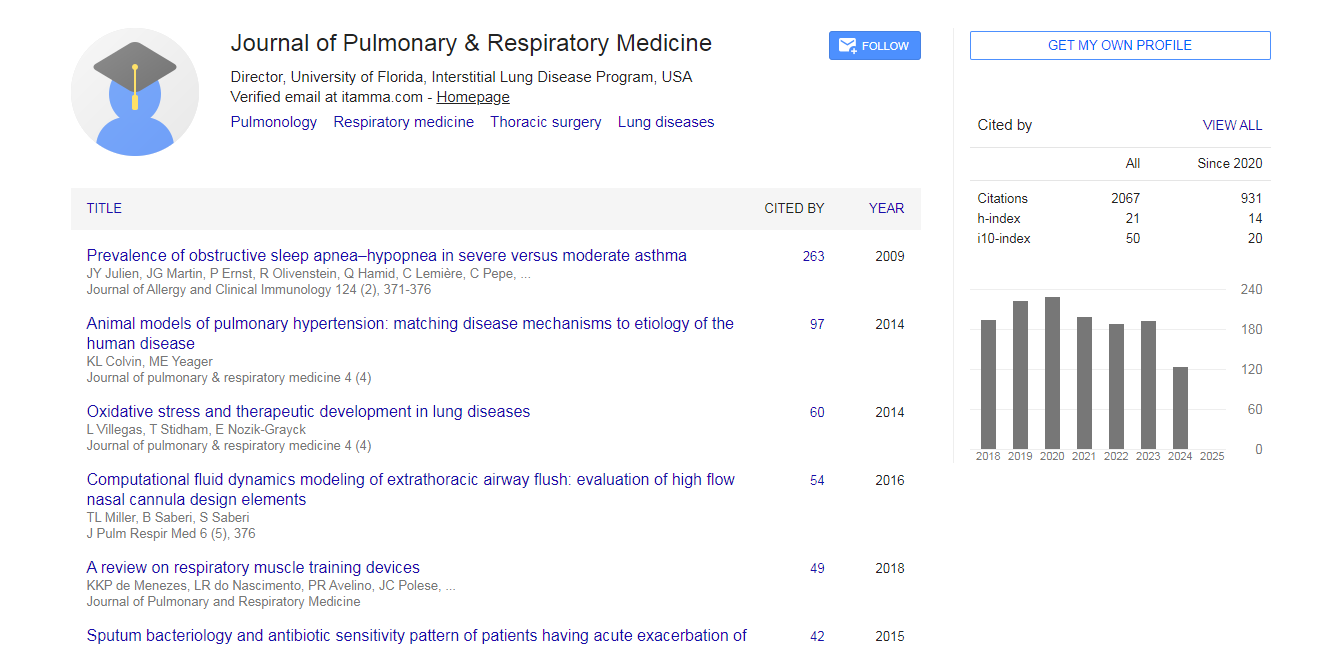
Pulmonary & Respiratory Medicine received 1690 citations as per Google Scholar report