Perspective - (2025) Volume 9, Issue 3
Received: 01-May-2025, Manuscript No. fsb-26-189949;
Editor assigned: 05-May-2025, Pre QC No. P-189949;
Reviewed: 19-May-2025, QC No. Q-189949;
Revised: 22-May-2025, Manuscript No. R-189949;
Published:
29-May-2025
, DOI: 10.37421/2577-0543.2025.9.235
Citation: Herrera, Miguel. ”Pharmacokinetic Evaluation and Bioequivalence of Oral Drugs.” J Formul Sci Bioavailab 09 (2025):235.
Copyright: © 2025 Herrera M. This is an open-access article distributed under the terms of the Creative Commons Attribution License, which permits unrestricted use, distribution and reproduction in any medium, provided the original author and source are credited.
The pharmacokinetic evaluation of bioequivalent oral dosage forms is a cornerstone of pharmaceutical development, ensuring that generic medications offer the same therapeutic efficacy as their innovator counterparts. This process critically relies on rigorous in vivo studies that compare plasma concentration-time profiles of the active pharmaceutical ingredient, with key parameters like AUC and Cmax being central to regulatory acceptance [1].
Understanding the influence of food on drug bioavailability is another vital aspect of pharmacokinetic assessment. Different food states can significantly alter drug absorption, distribution, metabolism, and excretion, thereby impacting the pharmacokinetic profile and potentially the therapeutic outcome. Standardized food effect studies are therefore crucial, particularly within the context of bioequivalence testing [2].
The advent of nanotechnology has opened new avenues for improving the pharmacokinetic profiles of challenging active pharmaceutical ingredients. Nanoformulations are designed to enhance oral absorption and prolong drug release, aiming to achieve comparable or superior bioavailability to conventional dosage forms by overcoming biological barriers [3].
Bioequivalence studies are fundamental to the approval of generic drug products. Challenges and advancements in their design and conduct, especially for modified-release dosage forms, are continually being addressed. The use of dissolution testing as a surrogate for in vivo studies is also explored when appropriate, alongside careful consideration of pharmacokinetic parameters and variabilities [4].
The validation of analytical methods is paramount in pharmacokinetic and bioequivalence studies. Essential requirements for validating bioanalytical methods used to quantify drug concentrations in biological matrices ensure the accuracy, precision, selectivity, sensitivity, and stability of the data, which is fundamental to demonstrating bioequivalence and patient safety [5].
The impact of polymorphic forms of active pharmaceutical ingredients on their pharmacokinetic behavior and bioequivalence is a critical consideration. Variations in solubility and dissolution rates among different solid-state forms can directly influence drug absorption and bioavailability, necessitating careful characterization and control [6].
Establishing bioequivalence for drugs with narrow therapeutic indices presents unique complexities. Even minor pharmacokinetic differences can lead to significant clinical consequences, requiring stringent regulatory requirements, sensitive bioanalytical methods, and carefully designed trials to ensure therapeutic equivalence [7].
The influence of excipients in oral dosage forms on drug pharmacokinetic performance is a critical aspect of formulation development. Excipients can modulate drug solubility, dissolution, and permeability, impacting absorption and necessitating careful selection to ensure consistent and predictable pharmacokinetic profiles [8].
Biowaivers, which exempt in vivo bioequivalence studies under specific conditions, are a valuable regulatory tool. These strategies, primarily for immediate-release solid oral dosage forms with rapid dissolution, rely on dissolution data and formulation similarity to predict in vivo performance and streamline generic drug approval [9].
As drug molecules and delivery systems become more complex, advanced approaches to pharmacokinetic evaluation are needed. Physiologically based pharmacokinetic (PBPK) modeling serves as a complementary tool to traditional in vivo studies, offering mechanistic insights and potentially reducing the need for extensive clinical trials by predicting drug disposition and supporting biowaiver applications [10].
The pharmacokinetic evaluation of oral dosage forms, particularly concerning bioequivalence, is a critical regulatory and developmental process. Studies focusing on comparative plasma concentration-time profiles of active pharmaceutical ingredients, assessing parameters such as AUC and Cmax, are essential for demonstrating that generic products are therapeutically equivalent to their reference listed drugs [1].
Furthermore, the role of food in drug bioavailability cannot be understated. Investigations into how different food states impact drug absorption, distribution, metabolism, and excretion are crucial for accurate pharmacokinetic assessment. Understanding these food effects is particularly important in bioequivalence studies to avoid non-bioequivalence findings due to deviations in prescribed feeding conditions [2].
Advancements in nanotechnology offer promising strategies for overcoming challenges in oral drug delivery. Nanoformulations aim to enhance the oral absorption and prolong the release of active pharmaceutical ingredients, thereby improving their pharmacokinetic profiles and achieving bioequivalence through improved disposition characteristics [3].
Bioequivalence studies, especially for modified-release dosage forms, present ongoing challenges. The exploration of advanced statistical methods for assessment and the potential use of dissolution testing as a surrogate for in vivo studies are key areas of focus, alongside careful consideration of pharmacokinetic parameters and inherent variabilities [4].
Accurate quantification of drug concentrations in biological matrices is dependent on well-validated bioanalytical methods. These methods, assessed for accuracy, precision, selectivity, sensitivity, and stability, are fundamental to generating reliable pharmacokinetic data and successfully demonstrating bioequivalence, ultimately ensuring patient safety [5].
The physical form of an active pharmaceutical ingredient, specifically its polymorphism, can significantly influence its pharmacokinetic behavior. Variations in solubility and dissolution rates between different polymorphic forms can directly affect drug absorption and bioavailability, making the characterization and control of these forms crucial for ensuring bioequivalence [6].
For drugs with narrow therapeutic indices, the establishment of bioequivalence is particularly stringent due to the potential for significant clinical consequences from even minor pharmacokinetic variations. This necessitates highly sensitive bioanalytical methods and meticulously designed clinical trials to confirm therapeutic equivalence [7].
The selection and behavior of excipients within an oral dosage form play a pivotal role in modulating drug absorption and bioavailability. These inert ingredients can influence solubility, dissolution, and permeability, making their careful characterization essential for achieving consistent pharmacokinetic profiles and successful bioequivalence [8].
Regulatory agencies utilize biowaivers as a mechanism to exempt certain immediate-release solid oral dosage forms from in vivo bioequivalence studies. This relies on robust dissolution data and evidence of formulation similarity to confidently predict in vivo performance and expedite the development of generic medications [9].
Physiologically based pharmacokinetic (PBPK) modeling is emerging as a powerful tool to complement traditional bioequivalence assessments. This approach allows for the prediction of drug disposition, evaluation of formulation changes, and support for biowaiver applications, offering a deeper, mechanistic understanding of drug behavior [10].
This collection of research explores various facets of pharmacokinetic evaluation and bioequivalence studies for oral dosage forms. It highlights the critical role of in vivo studies in demonstrating therapeutic equivalence between generic and innovator drugs, emphasizing key parameters like AUC and Cmax. The impact of food, formulation design, excipients, and polymorphism on drug bioavailability and pharmacokinetic profiles is discussed. The importance of validated bioanalytical methods and advanced techniques such as PBPK modeling are underscored. Additionally, the paper covers regulatory aspects including biowaivers and the specific challenges associated with establishing bioequivalence for drugs with narrow therapeutic indices. The overarching goal is to ensure the safety and efficacy of oral medications.
None
None
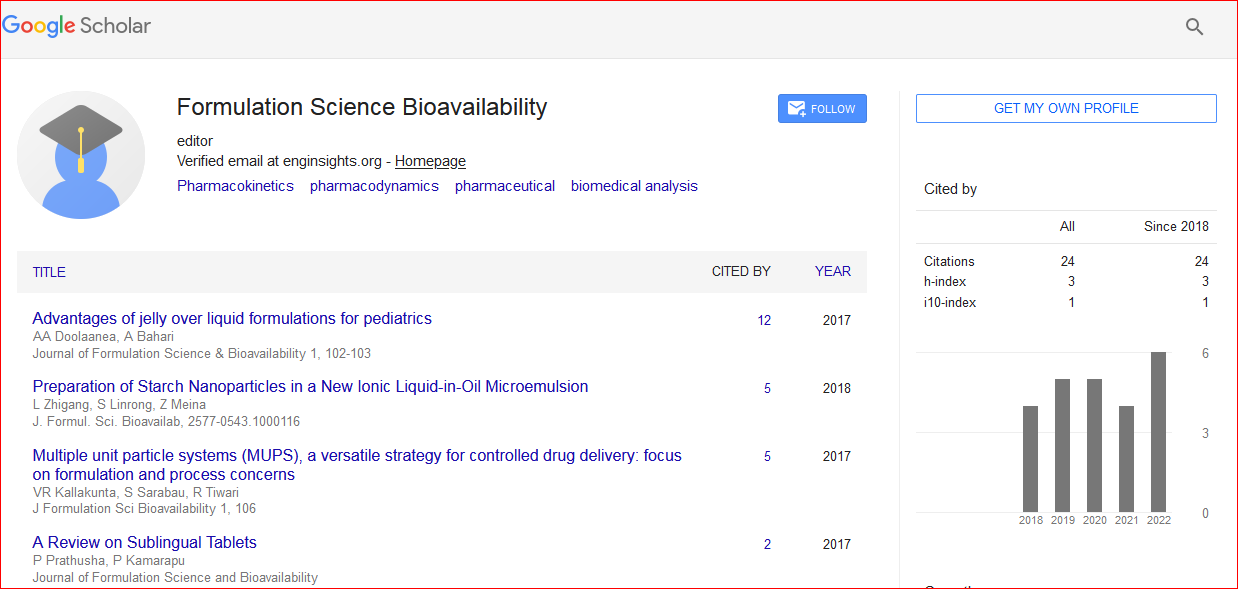
Journal of Formulation Science & Bioavailability received 23 citations as per Google Scholar report