Perspective - (2025) Volume 9, Issue 3
Received: 02-Jun-2025, Manuscript No. jgge-25-174481;
Editor assigned: 04-Jun-2025, Pre QC No. P-174481;
Reviewed: 18-Jun-2025, QC No. Q-174481;
Revised: 23-Jun-2025, Manuscript No. R-174481;
Published:
30-Jun-2025
, DOI: 10.37421/2684-4567.2025.9.183
Citation: Al-Mahdi, Farah. ”Pharmacogenomics: Personalized Medicine’s Promise and Hurdles.” J Genet Genom 09 (2025):183.
Copyright: © 2025 Al-Mahdi F. This is an open-access article distributed under the terms of the Creative Commons Attribution License, which permits unrestricted use,
distribution and reproduction in any medium, provided the original author and source are credited.
Pharmacogenomics plays a crucial role in improving drug efficacy and reducing adverse drug reactions by tailoring drug therapy to an individual's genetic makeup. This field provides a comprehensive overview of its current landscape, highlighting clinical applications, challenges in broad implementation, and promising future directions, including the integration of polygenic risk scores and advancements in pharmacogenomic testing technologies[1].
This review further delves into the current applications of pharmacogenomics within the realm of precision medicine, showcasing how genetic information can optimize drug selection and dosage. It addresses significant hurdles to widespread adoption, such as a lack of standardized clinical guidelines, critical ethical considerations, economic barriers, and the pressing need for enhanced healthcare provider education. The article also outlines clear opportunities for future growth in this vital area[2].
An updated CPIC guideline offers evidence-based recommendations for using *CYP2C19* genotype to guide clopidogrel dosing, which is a crucial antiplatelet drug. It details how specific genetic variations impact clopidogrel's efficacy and safety, offering practical guidance for clinicians to personalize therapy. This is especially important for patients undergoing percutaneous coronary intervention, aiming to improve outcomes and minimize adverse events[3].
A practical review explores the clinical utility of pharmacogenomic testing in psychiatry, a field often characterized by trial-and-error prescribing. It highlights how genetic insights can help predict an individual's response to psychotropic medications, potentially reducing the incidence of adverse drug reactions and accelerating the achievement of therapeutic goals, thereby significantly improving mental health outcomes[4].
This article discusses the transformative role of pharmacogenomics in oncology, propelling the medical community towards highly individualized cancer treatment. It illustrates how genetic variations can predict patient response to chemotherapy and targeted therapies, effectively minimize toxicity, and optimize dosing strategies. Ultimately, this contributes to more effective and safer precision cancer therapy strategies[5].
A comprehensive update on pharmacogenomics summarizes the current state of knowledge and its practical implications for clinical practice. It covers a range of drug-gene pairs with actionable guidelines, emphasizing how pharmacogenomics can personalize medication management across various therapeutic areas. The ultimate aim here is to improve patient outcomes and enhance drug safety across the board[6].
The successful implementation of pharmacogenomics in cardiovascular disease is a key focus, particularly concerning drugs like clopidogrel and statins. This work addresses the practical aspects of integrating genetic testing into clinical workflows, offering strategies for overcoming barriers to adoption, and highlighting the importance of educating healthcare providers. This demonstrates the tangible benefits of personalized medicine in improving cardiac health outcomes[7].
This paper addresses the critical issue of health disparities within pharmacogenomics, emphasizing the importance of diverse genomic data to ensure equitable benefits across all populations. It discusses how underrepresentation in genomic studies can exacerbate existing health inequalities and advocates for robust strategies to increase diversity in both research and clinical implementation. This aims to prevent widening the gap in precision medicine[8].
Another article provides an update on the challenges and opportunities shaping the field of pharmacogenomics. It identifies barriers such as the complexity of genetic data interpretation, limited clinician education, and concerns about economic viability. However, it also highlights significant opportunities in advanced sequencing technologies, improved data analytics, and the development of growing clinical guidelines that can propel pharmacogenomics into mainstream healthcare[9].
Finally, a systematic review critically examines the ethical, legal, and social implications (ELSI) arising from the integration of pharmacogenomics into clinical practice. It addresses concerns related to patient privacy, the crucial aspect of informed consent for genetic testing, the potential for discrimination, equitable access to testing, and the responsible use of genetic information, providing a comprehensive framework for navigating these complex issues[10].
Pharmacogenomics is fundamentally reshaping how medical professionals approach drug therapy, moving towards personalized interventions that significantly enhance drug efficacy and drastically reduce adverse drug reactions by aligning treatments with an individual's unique genetic profile [1]. This discipline is a cornerstone of precision medicine, utilizing genetic information to meticulously optimize drug selection and fine-tune dosages for patients, ensuring maximum therapeutic benefit with minimal side effects [2]. A thorough review of current pharmacogenomic knowledge underscores its profound and far-reaching implications for clinical practice, illustrating how personalized medication management across various therapeutic areas leads to superior patient outcomes and marked improvements in drug safety. This critical approach involves identifying specific drug-gene pairs for which increasingly actionable guidelines are available, serving as a roadmap for clinicians to adopt more effective treatment regimens [6].
The clinical utility of pharmacogenomics is strikingly evident across various medical specialties, demonstrating tangible and significant improvements in patient care. For instance, updated CPIC guidelines provide evidence-based recommendations for leveraging the *CYP2C19* genotype to guide clopidogrel dosing, an essential antiplatelet medication. This ensures highly personalized therapy, particularly for individuals undergoing percutaneous coronary intervention, with the clear objective of enhancing outcomes and mitigating adverse events [3]. In psychiatry, a field historically reliant on empirical, trial-and-error prescribing, pharmacogenomic testing offers a pragmatic and powerful tool. Genetic insights here can accurately predict an individual's response to psychotropic medications, potentially decreasing adverse drug reactions and accelerating therapeutic goal attainment, profoundly improving mental health outcomes [4]. Similarly, oncology is experiencing a transformative shift, as pharmacogenomics facilitates highly individualized cancer treatments. Genetic variations are employed to forecast patient responses to chemotherapy and targeted therapies, effectively minimizing toxicity, and optimizing dosing to forge more effective and safer precision cancer therapy strategies [5]. Furthermore, the successful integration of pharmacogenomics into cardiovascular disease management, particularly concerning widely used drugs like clopidogrel and statins, exemplifies its practical benefits through streamlined genetic testing within clinical workflows and comprehensive education for healthcare providers [7].
Despite its immense promise, the widespread implementation of pharmacogenomics is navigating a landscape filled with considerable challenges. Prominent hurdles encompass a conspicuous lack of standardized clinical guidelines, complex ethical considerations that demand careful navigation, significant economic barriers relating to testing costs and reimbursement, and an urgent, pervasive need for enhanced education among healthcare providers who must interpret and apply this genetic information [2]. The inherent complexity of interpreting vast amounts of genetic data itself poses a significant barrier, alongside persistent concerns about economic viability and the continuous requirement for more robust clinician education [9]. These multifaceted factors collectively impede the seamless integration of pharmacogenomics into mainstream healthcare delivery, necessitating the development of strategic, multi-pronged solutions to effectively bridge the chasm between cutting-edge research and routine clinical application.
Moreover, the integration of pharmacogenomics into clinical practice introduces a critical array of ethical, legal, and social implications (ELSI) that must be rigorously addressed. Primary concerns revolve around safeguarding patient privacy, ensuring robust and truly informed consent for genetic testing, mitigating the potential for genetic discrimination, and guaranteeing equitable access to testing services for all populations [10]. Addressing existing health disparities within pharmacogenomics is not just important but absolutely critical. Underrepresentation of diverse populations in genomic studies risks exacerbating existing health inequalities. Consequently, proactive strategies aimed at significantly increasing diversity in both pharmacogenomic research and its clinical implementation are indispensable to ensure that the transformative benefits of precision medicine are distributed equitably and do not inadvertently widen existing gaps in healthcare access and outcomes [8].
Looking towards the future, pharmacogenomics presents a landscape rich with significant opportunities for continued advancement and broader adoption. The field is poised for remarkable growth through ongoing innovations in pharmacogenomic testing technologies, including the sophisticated integration of polygenic risk scores, which promise even more nuanced risk assessments and treatment predictions [1]. Furthermore, breakthroughs in advanced sequencing technologies, coupled with more sophisticated data analytics, and the continuous evolution and refinement of clinical guidelines represent pivotal opportunities that are set to propel pharmacogenomics firmly into the mainstream of healthcare delivery [9]. Overcoming the identified barriers through targeted education initiatives, the development of robust and universally accepted guidelines, and a proactive approach to addressing ELSI concerns will be instrumental in ensuring that pharmacogenomics fully realizes its potential to deliver truly personalized, effective, and equitable healthcare to every patient.
Pharmacogenomics is revolutionizing healthcare by tailoring drug therapy to an individual's genetic makeup, thereby enhancing efficacy and reducing adverse reactions. This precision medicine approach optimizes drug selection and dosage across various therapeutic areas, including cardiovascular disease, psychiatry, and oncology. For example, specific guidelines leverage *CYP2C19* genotype to personalize clopidogrel dosing, improving outcomes for cardiac patients. Similarly, genetic insights help predict responses to psychotropic medications, mitigating trial-and-error prescribing in mental health, and guide individualized cancer treatments by predicting chemotherapy responses and minimizing toxicity. Despite its clear benefits, broad implementation faces significant hurdles. These include a lack of standardized clinical guidelines, complex genetic data interpretation, economic barriers, and the critical need for comprehensive healthcare provider education. Ethical, legal, and social implications are also prominent, encompassing patient privacy, informed consent, potential for discrimination, and ensuring equitable access to testing. Crucially, addressing health disparities by increasing diversity in genomic research and clinical application is essential to prevent widening existing inequalities in precision medicine. However, the future of pharmacogenomics holds considerable promise. Opportunities lie in advancements in pharmacogenomic testing technologies, the integration of polygenic risk scores, breakthroughs in advanced sequencing, improved data analytics, and the continuous development of clinical guidelines. By overcoming current challenges through focused education and robust policy development, pharmacogenomics is poised to move further into mainstream healthcare, delivering truly personalized and effective treatment strategies.
None
None
1. Kevin EC, Kelly S, Marylyn DDW. "Pharmacogenomics: Current Status and Future Perspectives".Clin Pharmacol Ther 114 (2023):693-705.
Indexed at, Google Scholar, Crossref
2. Sung-Shan L, Hung-Hsien C, Yu-Hui L. "Pharmacogenomics in precision medicine: current applications and future challenges".J Biomed Sci 29 (2022):1-15.
Indexed at, Google Scholar, Crossref
3. Julie AJ, Kevin EC, Li G. "CPIC Guideline for Clopidogrel and CYP2C19: 2022 Update".Clin Pharmacol Ther 112 (2022):22-28.
Indexed at, Google Scholar, Crossref
4. Navneet S, Debasish B, Manjari B. "Pharmacogenomics in psychiatry: a practical review of the clinical utility of psychiatric pharmacogenomic testing".Indian J Psychiatry 62 (2020):254.
Indexed at, Google Scholar, Crossref
5. Arun K, Ramya P, Ramu T. "Pharmacogenomics in Oncology: Towards Precision Cancer Therapy".Indian J Pharm Sci 86 (2024):21-27.
Indexed at, Google Scholar, Crossref
6. Mary VR, Marylyn DDW, Kelly S. "Pharmacogenomics: A Review of Current Knowledge and Implications for Clinical Practice".Pharmacotherapy 40 (2020):564-577.
Indexed at, Google Scholar, Crossref
7. Alan RS, Kevin EC, Marylyn DDW. "Implementation of Pharmacogenomics in Cardiovascular Disease".Circ Genom Precis Med 16 (2023):e003923.
Indexed at, Google Scholar, Crossref
8. Renan RW, Julie AJ, Jason HK. "Addressing Health Disparities in Pharmacogenomics".Clin Pharmacol Ther 109 (2021):1162-1175.
Indexed at, Google Scholar, Crossref
9. Bara'a A, Rawan O, Ruba A. "Challenges and opportunities in pharmacogenomics: An update".BMC Med Genomics 15 (2022):179.
Indexed at, Google Scholar, Crossref
10. Susanne BH, Jessica MO, Richard MW. "Ethical, legal, and social implications of pharmacogenomics: A systematic review".Clin Pharmacol Ther 109 (2021):346-359.
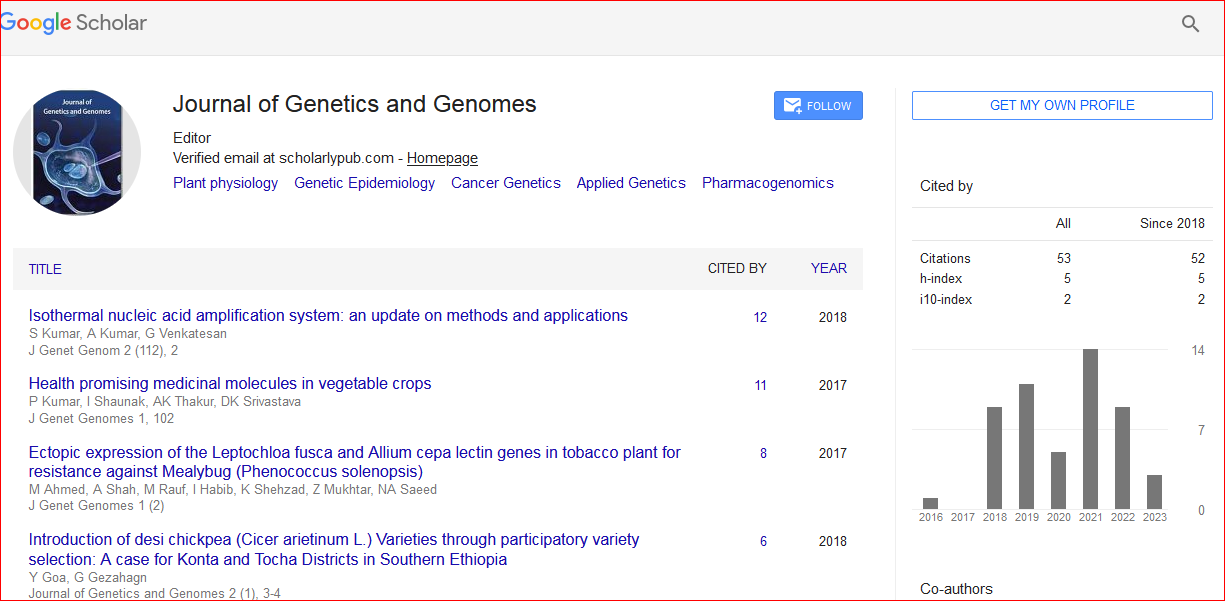
Journal of Genetics and Genomes received 65 citations as per Google Scholar report