Commentary - (2025) Volume 19, Issue 6
Received: 01-Dec-2025, Manuscript No. jmgm-26-188396;
Editor assigned: 02-Dec-2025, Pre QC No. P-188396;
Reviewed: 17-Dec-2025, QC No. Q-188396;
Revised: 22-Dec-2025, Manuscript No. R-188396;
Published:
29-Dec-2025
, DOI: 10.37421/1747-0862.2025.19.756
Citation: Nystrom, Ingrid L.. ”Personalized Medicine: Genetics, AI, and Future Healthcare.” J Mol Genet Med 19 (2025):756.
Copyright: 025 Nystrom L. Ingrid This is an open-access article distributed under the terms of the Creative Commons Attribution License, which permits unrestricted use, distribution and reproduction in any medium, provided the original author and source are credited.
Personalized medicine, a transformative paradigm in healthcare, leverages advancements in genomics to tailor medical treatments to individual patients. By understanding an individual's unique genetic makeup, it becomes possible to develop therapies that are not only more effective but also carry a reduced risk of adverse side effects, moving beyond the limitations of a one-size-fits-all approach [1].
This shift ushers in an era of precision diagnostics and targeted therapies, profoundly impacting various facets of medical science, including the development of new drugs, the prediction of disease susceptibility, and the implementation of proactive preventative strategies [2].
The integration of genetic information into routine clinical practice holds immense potential for elevating patient outcomes and fostering a more efficient and responsive healthcare system [3].
Pharmacogenomics stands as a foundational pillar of personalized medicine, providing guidance on drug selection and dosage by analyzing an individual's genetic profile. This allows for the optimization of therapeutic responses while simultaneously minimizing potential toxicity, thereby enhancing patient safety and treatment efficacy [4].
By deciphering how genetic variations influence drug metabolism and the interaction with molecular targets, pharmacogenomics enables a more precise approach to medication, moving away from generalized population data towards the specific needs of each patient [5].
The application of polygenic risk scores (PRS) is significantly enhancing our ability to predict the likelihood of developing common complex diseases. By integrating the cumulative effects of numerous genetic variants, PRS offer a more comprehensive assessment of an individual's predisposed risk, paving the way for the development of personalized preventative interventions for conditions such as cardiovascular disease and type 2 diabetes [6].
CRISPR-based gene editing technologies are at the forefront of revolutionizing therapeutic strategies for a range of genetic disorders. These technologies offer the groundbreaking potential for permanent corrections to DNA sequences, addressing the root cause of many inherited conditions. Although still in the early stages for many potential applications, the inherent precision and remarkable versatility of these tools offer hope for treating diseases that were previously considered intractable, marking a significant advancement in the field of personalized genetic medicine [7].
Whole genome sequencing (WGS) is becoming increasingly accessible, offering the capability to generate a comprehensive genetic blueprint for individuals. This rich and detailed dataset is invaluable for identifying rare genetic variants, improving the diagnostic accuracy for complex medical conditions, and fueling research into the intricate genetic underpinnings of various diseases, all of which are crucial for advancing personalized treatment strategies [8].
The integration of artificial intelligence (AI) and machine learning (ML) with vast genomic datasets is acting as a powerful accelerator for discoveries in personalized medicine. AI/ML algorithms possess the capability to analyze enormous volumes of genetic information, enabling the identification of subtle patterns, the prediction of disease risks, and the recommendation of optimal treatment pathways, thereby making complex genetic insights more actionable for healthcare professionals [9].
Liquid biopsies, which involve the analysis of circulating tumor DNA (ctDNA) found in blood samples, are fundamentally transforming the landscape of cancer diagnosis and ongoing management. This non-invasive methodology facilitates early disease detection, allows for real-time monitoring of a patient's response to treatment, and aids in the identification of mechanisms of drug resistance, all of which are critical components of delivering personalized cancer care [10].
Targeted therapies, specifically designed based on the genetic profiling of diseases, represent a cornerstone of personalized medicine. By achieving a detailed understanding of the specific molecular drivers that fuel diseases like cancer or rare genetic disorders, it becomes possible to engineer drugs that precisely target these aberrant pathways, leading to improved therapeutic efficacy and a significant reduction in unintended off-target effects [11]. The implementation of precision medicine necessitates the establishment of robust data infrastructure and sophisticated clinical decision support systems. The seamless integration of genomic data into electronic health records (EHRs) and the provision of tools that enable clinicians to effectively interpret and utilize this information are paramount for achieving widespread adoption and ensuring optimal patient care [12]. Finally, the ethical considerations that surround the use of genetic data in personalized medicine are of utmost importance. Critical issues pertaining to privacy, the security of sensitive data, ensuring equitable access to these advanced technologies, and mitigating the potential for genetic discrimination require careful and thoughtful navigation to guarantee that the profound benefits of genomic advancements are realized responsibly and equitably across all segments of society [13].
Personalized medicine, propelled by significant advancements in the field of genomics, is fundamentally reshaping the entire landscape of healthcare delivery. Its core principle lies in understanding an individual's unique genetic makeup, which then allows for the tailoring of medical treatments to achieve enhanced efficacy and a notable reduction in adverse effects. This represents a significant departure from the traditional, generalized one-size-fits-all medical model, moving towards a more precise approach encompassing precision diagnostics and highly targeted therapies. Consequently, this paradigm shift is having a profound impact on drug development, the early prediction of disease susceptibility, and the strategic implementation of preventative health measures. The comprehensive integration of genetic data into the fabric of clinical practice holds immense promise for substantially improving patient outcomes and contributing to the creation of a more efficient and effective healthcare system [1].
Pharmacogenomics plays a pivotal role as a cornerstone of personalized medicine. It provides essential guidance for the selection of appropriate drugs and the determination of optimal dosages by analyzing an individual's genetic profile. The primary objective is to optimize the therapeutic response while simultaneously minimizing the risk of toxicity, thereby ensuring better patient safety and treatment effectiveness. Understanding the intricate ways in which genetic variations influence drug metabolism and the interaction with specific molecular targets allows for a significantly more precise approach to medication management, moving beyond generalized population averages to address the unique needs of each individual patient [2].
The application of polygenic risk scores (PRS) is actively enhancing the capability for disease prediction, enabling proactive and timely interventions for individuals identified as being at higher genetic risk for common complex diseases. These include conditions such as cardiovascular disease and type 2 diabetes. PRS achieve this by integrating the combined effects of multiple genetic variants, thereby providing a more comprehensive and nuanced assessment of an individual's inherent predisposition to disease, which is crucial for developing personalized preventative strategies [3].
CRISPR-based gene editing technologies are heralding a new era in therapeutic approaches for a wide spectrum of genetic disorders. These innovative tools offer the potential for permanent corrections at the DNA level, directly addressing the root causes of inherited diseases. While many applications are still in their nascent stages of development, the remarkable precision and versatility inherent in these technologies promise to provide viable treatment options for diseases that were previously considered untreatable, signifying a monumental leap forward in the realm of personalized genetic medicine [4].
Whole genome sequencing (WGS) is becoming increasingly accessible to a broader population, providing an unprecedentedly comprehensive genetic blueprint for individuals. This data-rich resource is invaluable for the identification of rare genetic variants that might otherwise go unnoticed. Furthermore, it significantly improves diagnostic yields for complex medical conditions and fuels ongoing research into the fundamental genetic underpinnings of disease, thereby making substantial contributions to the advancement of personalized treatment strategies [6].
The integration of artificial intelligence (AI) and machine learning (ML) with vast genomic datasets is acting as a powerful catalyst for accelerating new discoveries in the field of personalized medicine. AI/ML algorithms are capable of analyzing enormous quantities of genomic data, identifying complex patterns, predicting disease risk with greater accuracy, and suggesting optimal treatment pathways. This makes intricate genetic information far more actionable and comprehensible for clinicians in their daily practice [7].
Liquid biopsies, a novel diagnostic technique that involves the analysis of circulating tumor DNA (ctDNA) present in blood samples, are revolutionizing the way cancer is diagnosed and monitored. This non-invasive approach offers significant advantages, including the potential for earlier detection of cancer, real-time tracking of a patient's response to therapy, and the identification of mechanisms that lead to treatment resistance. These capabilities are all critically important components of delivering highly personalized and effective cancer care [8].
The development of targeted therapies, which are precisely guided by the genetic profiling of diseases, is a defining characteristic of personalized medicine. By achieving a thorough understanding of the specific molecular drivers that are responsible for the progression of diseases such as cancer or rare genetic disorders, it becomes possible to design drugs that act with high specificity on these targets. This targeted action leads to substantially improved therapeutic efficacy and a marked reduction in the occurrence of undesirable off-target effects [10].
The successful implementation of precision medicine hinges on the establishment of robust data infrastructure and advanced clinical decision support systems. The critical process of integrating genomic data directly into electronic health records (EHRs) and equipping clinicians with intuitive tools to interpret and act upon this complex information is essential for ensuring widespread adoption and facilitating effective patient care across the healthcare system [9].
Crucially, the ethical considerations that arise from the use of genetic data within the context of personalized medicine are of paramount importance and demand careful attention. Issues encompassing patient privacy, the robust security of highly sensitive data, ensuring equitable access to these cutting-edge technologies, and actively preventing the potential for genetic discrimination necessitate diligent navigation. This careful approach is vital to ensure that the profound benefits derived from genomic advancements are realized in a responsible manner and that they ultimately benefit all segments of society, fostering inclusivity and trust [5].
Personalized medicine is revolutionizing healthcare by tailoring treatments based on individual genetic makeup, improving efficacy and reducing side effects. Key components include pharmacogenomics for optimizing drug therapy, polygenic risk scores for disease prediction, and CRISPR gene editing for correcting genetic defects. Whole genome sequencing provides comprehensive genetic insights, while AI and machine learning accelerate genomic data analysis. Liquid biopsies transform cancer care through early detection and monitoring. Targeted therapies offer precise disease intervention. Effective implementation requires robust data infrastructure and ethical considerations, including privacy and equitable access, to ensure responsible and beneficial advancements for all.
None
None
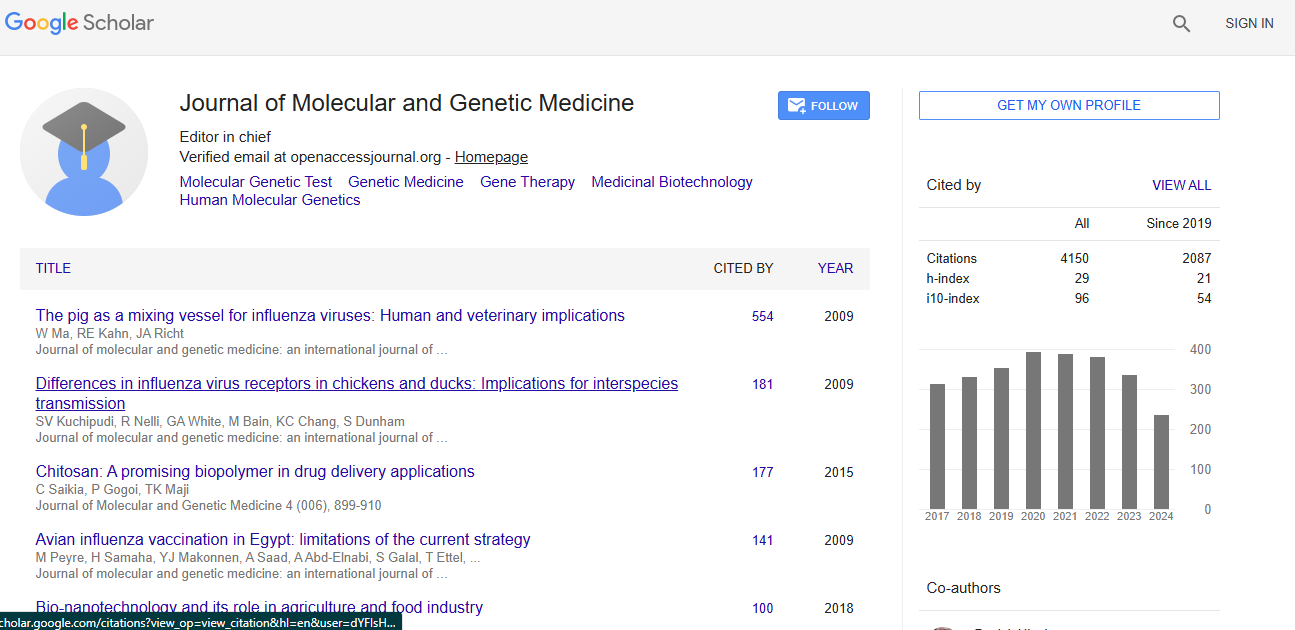
Molecular and Genetic Medicine received 3919 citations as per Google Scholar report