Brief Report - (2025) Volume 9, Issue 3
Received: 01-Jun-2025, Manuscript No. jcre-26-187194;
Editor assigned: 03-Jun-2025, Pre QC No. P-187194;
Reviewed: 17-Jun-2025, QC No. Q-187194;
Revised: 22-Jun-2025, Manuscript No. R-187194;
Published:
29-Jun-2025
, DOI: 10.37421/2795-6172.2025.9.302
Citation: Ferreira, Inês. ”Personalized Antidepressant Strategies for Major Depressive Disorder.” J Clin Res 09 (2025):302.
Copyright: © 2025 Ferreira I. This is an open-access article distributed under the terms of the Creative Commons Attribution License, which permits unrestricted use, distribution and reproduction in any medium, provided the original author and source are credited.
Major Depressive Disorder (MDD) remains a significant global health challenge, necessitating continuous research into effective treatment modalities. Comparative studies are vital for understanding the nuances of different therapeutic agents and guiding clinical practice. One such study meticulously evaluated the efficacy and tolerability of two common antidepressants, highlighting distinct profiles in symptom improvement and side effects, which are crucial for personalized patient care [1].
In cases of treatment resistance, augmentation strategies become paramount. Research has investigated the comparative effectiveness of adding specific atypical antipsychotics to standard antidepressant therapy, revealing differential impacts on remission rates and symptom severity. This underscores the importance of tailored augmentation approaches based on individual patient characteristics [2].
Real-world evidence plays a crucial role in understanding the long-term outcomes of antidepressant treatments. A large cohort study examined the sustained effectiveness and tolerability of two widely used antidepressants, revealing variations in long-term remission and adverse event reporting, suggesting that patient adherence and long-term benefits can differ [3].
Understanding the biological underpinnings of antidepressant response can lead to more precise treatment selection. Research exploring genetic variations has investigated the differential efficacy of certain antidepressants, suggesting a potential role for pharmacogenomics in optimizing treatment outcomes by guiding drug selection based on an individual's genetic makeup [4].
Meta-analyses provide a powerful tool for synthesizing evidence from multiple studies. One such analysis compared a specific antidepressant with a class of commonly prescribed drugs, indicating comparable efficacy but highlighting potential differences in side effect profiles that can influence patient choice and adherence [5].
Specific patient populations, such as young adults, may benefit from antidepressants with particular properties. A study focusing on this demographic compared an antidepressant with a selective serotonin reuptake inhibitor, suggesting a potential advantage in improving not only mood but also sleep quality, a common co-occurring issue in MDD [6].
Comorbid conditions are frequent in MDD, complicating treatment. A randomized controlled trial investigated the effects of a specific antidepressant compared to another in patients with MDD and co-occurring anxiety symptoms. The findings suggested that while both improved depressive symptoms, one agent offered superior benefits for anxiety, indicating its utility in complex presentations [7].
The duration of treatment and the trajectory of symptom improvement can vary between different antidepressant medications. A study examining a 12-week treatment period revealed differences in the speed and pattern of symptom improvement between two commonly prescribed agents, suggesting that initial response rates might differ [8].
Comprehensive comparative analyses, such as network meta-analyses, are essential for ranking various treatment options. These studies synthesize data from numerous trials to provide an overview of the efficacy and tolerability of multiple antidepressants for MDD, aiding clinicians in selecting agents with optimal risk-benefit profiles [9].
The integration of psychotherapy and pharmacotherapy is a key consideration in managing MDD. Research comparing an antidepressant with placebo in patients receiving concurrent psychotherapy demonstrated that pharmacotherapy augmentation can enhance the effectiveness of therapy, leading to improved and sustained symptom remission [10].
This comparative study meticulously examined the efficacy and tolerability of two widely prescribed antidepressants for Major Depressive Disorder (MDD). The research identified significant differences in their onset of action, response rates, and side effect profiles, offering valuable insights for clinical decision-making. Notably, one agent demonstrated a faster symptomatic improvement, while the other exhibited superior tolerability, underscoring the importance of personalized treatment strategies [1].
Investigating augmentation strategies for treatment-resistant depression, this study compared the effectiveness of adding aripiprazole versus quetiapine to standard antidepressant therapy. The findings revealed differential effects on remission rates and symptom severity, highlighting the necessity of selecting appropriate augmentation agents based on patient characteristics and specific symptom profiles [2].
This real-world study analyzed the long-term effectiveness and tolerability of escitalopram versus duloxetine in a substantial cohort of patients diagnosed with MDD. The retrospective analysis uncovered distinct patterns in sustained remission and the reporting of adverse events, suggesting that patient adherence and long-term outcomes can exhibit significant variability between these two agents [3].
Exploring the genetic determinants of antidepressant response, this research investigated the differential efficacy of fluoxetine versus venlafaxine in patients with specific genetic polymorphisms. The results indicated a potential role for pharmacogenomics in guiding antidepressant selection to optimize treatment outcomes for individuals [4].
This meta-analysis synthesized data from multiple trials comparing mirtazapine with selective serotonin reuptake inhibitors (SSRIs) for the treatment of MDD. The pooled results indicated comparable overall efficacy but highlighted potential differences in side effect profiles, particularly concerning weight gain and sedation, factors that can influence patient preference and adherence to treatment [5].
The study explored the effectiveness of agomelatine compared to sertraline in young adults diagnosed with MDD, with a specific focus on both depressive symptoms and associated sleep disturbances. The findings suggested agomelatine's potential advantage in simultaneously improving sleep quality alongside mood, which could represent a significant benefit for this particular patient demographic [6].
A randomized controlled trial compared vortioxetine with fluoxetine in patients presenting with MDD and comorbid anxiety. The results indicated that while both treatments effectively improved depressive symptoms, vortioxetine demonstrated potentially superior benefits for anxiety symptoms, suggesting its particular utility in comorbid presentations of these conditions [7].
Examining the impact of treatment duration, this study compared the effectiveness of bupropion versus sertraline over a 12-week period in patients diagnosed with MDD. The findings revealed notable differences in the trajectory of symptom improvement, with bupropion exhibiting a potentially steeper initial response in certain individuals within the study cohort [8].
This network meta-analysis systematically compared the efficacy and tolerability of various antidepressants, including escitalopram and paroxetine, for the management of MDD. The comprehensive analysis provided a ranking of treatments based on multiple outcome measures, thereby aiding in the selection of agents with optimal risk-benefit profiles for clinical use [9].
The study focused on the impact of concurrent psychotherapy and pharmacotherapy, comparing escitalopram with a placebo in patients with MDD who were also receiving cognitive behavioral therapy. The results suggested that pharmacotherapy augmentation could significantly enhance the effectiveness of psychotherapy, leading to more rapid and sustained symptom remission in patients [10].
This collection of research explores various aspects of treating Major Depressive Disorder (MDD), focusing on comparative studies of different antidepressant medications. Studies highlight differences in efficacy, tolerability, onset of action, and side effect profiles among agents like vortioxetine, sertraline, escitalopram, duloxetine, fluoxetine, venlafaxine, bupropion, and mirtazapine. Augmentation strategies using agents like aripiprazole and quetiapine are also examined for treatment-resistant depression. The impact of genetic polymorphisms on treatment response is investigated, suggesting the potential of pharmacogenomics. Furthermore, the benefits of combining psychotherapy with pharmacotherapy are explored, alongside the importance of considering specific patient populations, comorbidities like anxiety, and treatment duration. Overall, the research emphasizes the need for personalized treatment approaches in MDD based on individual patient characteristics and treatment goals.
None
None
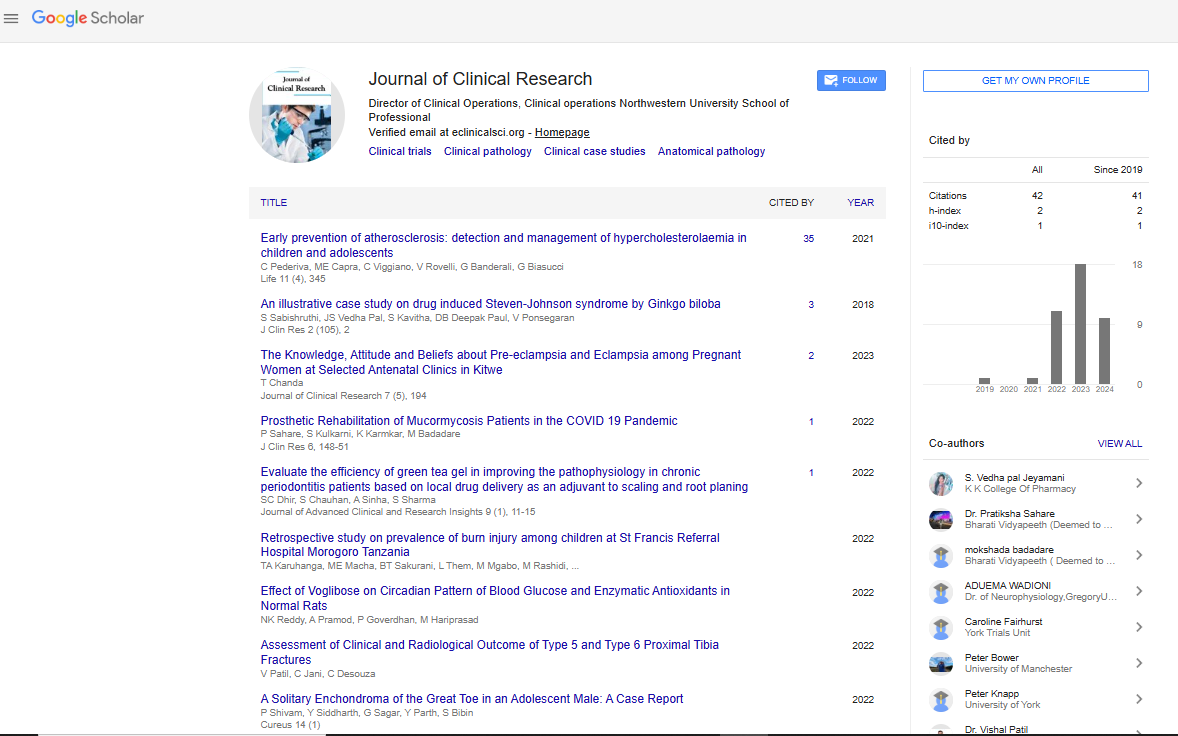
Journal of Clinical Research received 11 citations as per Google Scholar report