Perspective - (2025) Volume 16, Issue 4
Received: 02-Jul-2025, Manuscript No. jch-26-178775;
Editor assigned: 04-Jul-2025, Pre QC No. P-178775;
Reviewed: 17-Jul-2025, QC No. Q-178775;
Revised: 24-Jul-2025, Manuscript No. R-178775;
Published:
30-Jul-2025
, DOI: 10.37421/2157-7099.2025.16.808
Citation: Schuster, Anika R.. ”Pediatric Tumors: Cytology, Histology, and Advanced Diagnostics.” J Cytol Histol 16 (2025):808.
Copyright: © 2025 Schuster R. Anika This is an open-access article distributed under the terms of the Creative Commons Attribution License, which permits unrestricted use, distribution and reproduction in any medium, provided the original author and source are credited.
The field of pediatric oncology relies heavily on precise diagnostic techniques to ensure optimal patient outcomes. Cytological and histological evaluations form the bedrock of this process, providing crucial morphological data that guides treatment strategies and prognostic assessments. Recent advancements have further refined these methods, allowing for more accurate differentiation of various pediatric malignancies [1].
The accurate classification of pediatric neuroblastic tumors, a common group of tumors in childhood, has seen significant evolution. Immunohistochemistry plays a pivotal role in distinguishing subtypes such as neuroblastoma, ganglioneuroblastoma, and ganglioneuroma, thereby informing therapeutic decisions and predicting disease behavior [2].
Bone and soft tissue sarcomas represent another critical area in pediatric oncology. Understanding their specific cytomorphological features is essential for diagnosis, and this knowledge is augmented by ancillary techniques that aid in resolving diagnostic ambiguities. Early and accurate identification is paramount for effective management [3].
Pediatric germ cell tumors encompass a diverse range of neoplasms arising from germ cells. Histopathological and cytological examination is key to identifying the specific subtype, such as dysgerminomas, yolk sac tumors, teratomas, and embryonal carcinomas, which have distinct clinical behaviors and treatment responses [4].
The integration of advanced technologies is revolutionizing the analysis of pediatric tumor histology. Digital pathology and artificial intelligence offer enhanced capabilities for improving diagnostic accuracy, efficiency, and consistency in evaluating complex microscopic patterns [5].
Central nervous system tumors in children present unique diagnostic challenges. Cytopathology of cerebrospinal fluid and tissue samples provides vital information for the initial diagnosis and intraoperative management of conditions like medulloblastoma, ependymoma, and astrocytoma [6].
Pediatric hematolymphoid neoplasms, including lymphomas and leukemias, require meticulous histopathological assessment. The latest classification systems emphasize the integration of morphological, molecular, and genetic findings for accurate subtyping and risk stratification, which is crucial for personalized treatment [7].
Liver tumors in pediatric patients, such as hepatoblastoma and hepatocellular carcinoma, necessitate careful cytological evaluation. Differentiating these from metastatic disease or benign conditions can be challenging, underscoring the importance of ancillary diagnostic tests [8].
Wilms tumors, the most prevalent pediatric kidney malignancy, are characterized by distinct histological subtypes that carry significant prognostic implications. Molecular markers are increasingly utilized to refine diagnosis and predict treatment response, contributing to improved patient care [9].
Rare pediatric tumors, though infrequent, pose diagnostic complexities. Recognizing unusual cytological and histological patterns, coupled with a comprehensive diagnostic approach and collaborative efforts, is vital for achieving optimal patient management and outcomes [10].
The diagnostic landscape of pediatric tumors is multifaceted, with cytological and histological assessments serving as fundamental pillars for accurate identification and management. Comprehensive reviews highlight the critical importance of integrating morphological data with emerging molecular findings to navigate the complexities of pediatric oncology and achieve precise prognostication. Distinguishing benign from malignant lesions, characterizing cellular architecture for subtype identification, and recognizing prognostic markers are key objectives [1].
Within the spectrum of neuroblastic tumors, immunohistochemistry has become indispensable. Specific antibody panels facilitate the differentiation of neuroblastoma, ganglioneuroblastoma, and ganglioneuroma, providing essential prognostic insights. The continuous exploration of novel markers promises further enhancements in diagnostic precision for these challenging tumors [2].
Pediatric bone and soft tissue sarcomas demand rigorous cytomorphological analysis. Detailed characterization of characteristic microscopic features aids in diagnosing entities like osteosarcoma, Ewing sarcoma, and rhabdomyosarcoma, while also addressing potential diagnostic pitfalls. The judicious use of ancillary techniques, including flow cytometry and molecular diagnostics, is instrumental in resolving complex cases [3].
The histopathological and cytological evaluation of pediatric germ cell tumors is crucial for their classification into distinct subtypes such as dysgerminomas, yolk sac tumors, teratomas, and embryonal carcinomas. Understanding their specific origins and cytological appearances is paramount for establishing appropriate differential diagnoses and guiding effective therapeutic strategies [4].
Transformative advancements in digital pathology and artificial intelligence are enhancing the analysis of pediatric tumor histology. These cutting-edge tools offer the potential to significantly improve diagnostic accuracy, streamline workflows, and ensure greater consistency in the interpretation of microscopic specimens, particularly for automated detection and grading [5].
The cytopathology of pediatric central nervous system tumors, encompassing entities like medulloblastoma, ependymoma, and astrocytoma, relies on the meticulous examination of cytomorphological findings in cerebrospinal fluid and tissue samples. Cytopathology plays a critical role in initial diagnosis and intraoperative consultation, guiding critical management decisions [6].
Histopathological assessment of pediatric hematolymphoid neoplasms, guided by the latest WHO classifications, is essential for understanding lymphomas and leukemias. The integration of molecular and genetic findings with morphological patterns is now a cornerstone for accurate subtyping and risk stratification, enabling tailored therapeutic approaches [7].
Cytological diagnosis of pediatric liver tumors, including hepatoblastoma and hepatocellular carcinoma, presents diagnostic challenges, particularly in distinguishing them from metastatic lesions or benign conditions. The utility of ancillary tests is consistently reviewed to bolster diagnostic accuracy in these cases [8].
Histological subtyping of Wilms tumors, a common pediatric kidney malignancy, is critical for prognostication. Detailed classification into subtypes such as nephroblastoma, anaplastic, and cystic forms, along with the role of molecular markers, aids in refining diagnosis and predicting treatment response [9].
Rare pediatric tumors, a heterogeneous group that can include endocrine neoplasms and unusual soft tissue tumors, require specialized diagnostic acumen. Recognizing atypical patterns and adopting a comprehensive approach, often necessitating collaboration between pathologists and clinicians, is key to ensuring optimal patient care for these less common malignancies [10].
This collection of articles focuses on the cytological and histological diagnosis of pediatric tumors. It covers a wide range of tumor types, including common and rare entities, neuroblastic tumors, bone and soft tissue sarcomas, germ cell tumors, central nervous system tumors, hematolymphoid neoplasms, liver tumors, and Wilms tumors. The reviews emphasize the importance of integrating morphological data with advanced techniques such as immunohistochemistry, molecular diagnostics, digital pathology, and artificial intelligence for accurate classification, prognostication, and treatment. Challenges in diagnosis and the role of ancillary tests are highlighted, underscoring the need for a comprehensive approach in pediatric oncology.
None
None
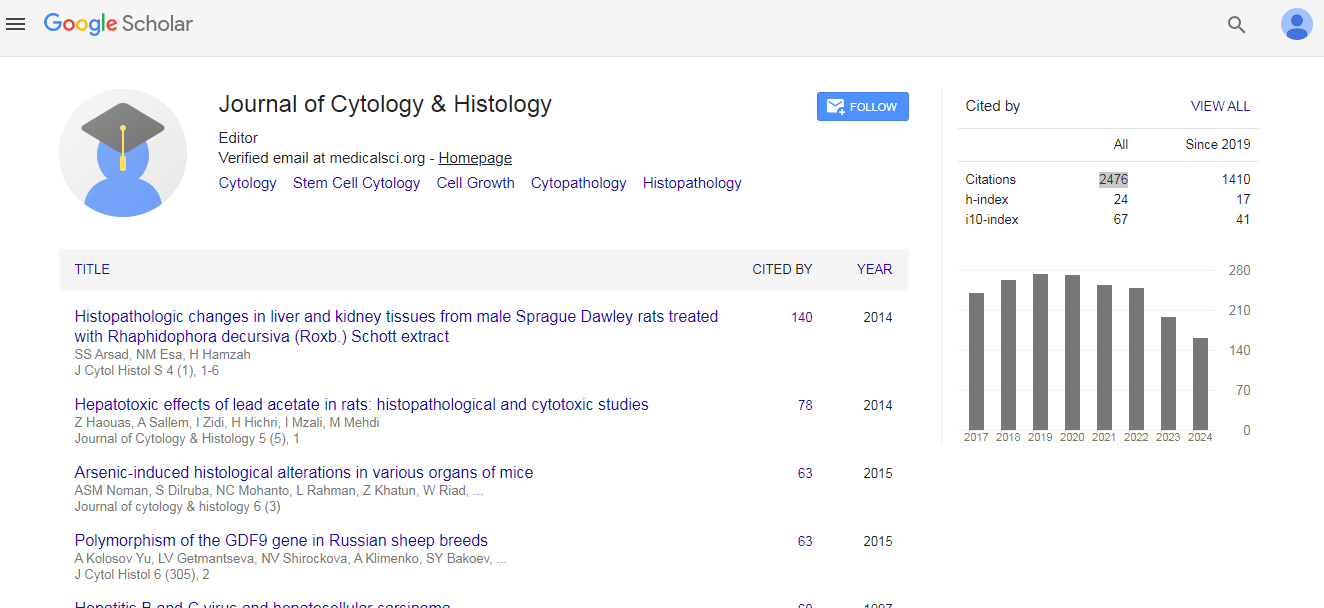
Journal of Cytology & Histology received 2476 citations as per Google Scholar report