Short Communication - (2025) Volume 14, Issue 5
Received: 01-Oct-2025, Manuscript No. jnc-25-173974;
Editor assigned: 03-Oct-2025, Pre QC No. P-173974;
Reviewed: 17-Oct-2025, QC No. Q-173974;
Revised: 22-Oct-2025, Manuscript No. R-173974;
Published:
29-Oct-2025
, DOI: 10.37421/2167-1168.2025.14.725
Citation: Fernandes, Lucia. ”Pediatric Nursing: Comprehensive Care for Children and Families.” J Nurs Care 14 (2025):725.
Copyright: © 2025 Fernandes L. This is an open-access article distributed under the terms of the Creative Commons Attribution License, which permits unrestricted use, distribution and reproduction in any medium, provided the original author and source are credited.
Pediatric nursing is a dynamic and essential field, continuously evolving to meet the complex health needs of children and their families. Across various care settings, a focus on comprehensive, patient-centered approaches is paramount. For instance, the effective management of acute pain in pediatric patients is not a task for a single discipline; rather, it critically relies on a multidisciplinary approach. What this really means is that achieving effective pain relief in children requires a coordinated effort from nurses, doctors, and other specialists, all collaborating to develop comprehensive, child-specific care plans tailored to individual needs[1].
This collaborative spirit extends to critical care environments, where integrating family-centered care proves indispensable. Here's the thing: successful implementation of such care hinges significantly on improving communication channels between healthcare providers and families, offering tailored education that empowers families, and fostering supportive environments that ultimately lead to better outcomes for critically ill children[2].
The practice of pediatric nursing has also adapted to global health challenges and technological advancements. The COVID-19 pandemic spurred a widespread adoption of telehealth in pediatric care, demonstrating its potential to significantly improve access to services and maintain continuity of care for many young patients. While its benefits are clear, there are still specific barriers that need addressing for future growth and to enhance its overall effectiveness in pediatric nursing practice[3].
Beyond technological shifts, nurses frequently support families navigating long-term health challenges. This is evident in the significant challenges and unmet needs experienced by parents caring for children with chronic conditions. What we learn here is that robust nursing support, easily accessible educational resources, and tailored psychological interventions are crucial to bolster parental coping mechanisms and ensure their overall well-being alongside their childâ??s care[4].
Pediatric nurses are increasingly recognized for their vital contributions to specialized areas of child health. This includes mental health care, where a systematic review synthesizes findings on pediatric nurses' knowledge, attitudes, and practices regarding mental health care for children and adolescents. It reveals existing knowledge gaps that need attention but also highlights positive attitudes, indicating a clear need for targeted education and training to empower nurses in effectively addressing the intricate landscape of youth mental health[5].
In urgent care scenarios, the role of emergency nurses is absolutely critical, particularly in the rapid identification and initial management of pediatric sepsis. What this really means is that ongoing education, clear, standardized protocols, and regular simulation training are essential tools for improving outcomes in this life-threatening condition, where swift action makes all the difference[6].
Furthermore, nurses play a pivotal public health role in addressing issues like parental vaccine hesitancy. Let's break it down: nurses are key in providing clear, evidence-based education, addressing specific parental concerns with empathy, and building essential trust to boost childhood vaccination rates and support broader public health efforts[7].
The scope of pediatric nursing extends to highly specialized care for the most vulnerable. For instance, developmental care programs for premature infants have been thoroughly evaluated, with findings from a systematic review and meta-analysis demonstrating clear improvements in both physiological stability and neurodevelopmental outcomes. This evidence powerfully reinforces the indispensable role of specialized nursing interventions in neonatal intensive care units, where such programs are vital for long-term health[8].
Moreover, pediatric nurses are stepping up to tackle pressing public health concerns like childhood obesity. This scoping review outlines the expanding responsibilities of pediatric nurses in this area. What this really means is that nurses are uniquely positioned to deliver essential education on healthy lifestyles, support practical lifestyle modifications within families, and advocate for comprehensive health strategies to combat this growing public health challenge effectively[9].
Finally, providing compassionate end-of-life care is another profound aspect of pediatric nursing. A systematic review assessing pediatric nurses' knowledge, attitudes, and perceived barriers regarding palliative care for children points to a clear need for improved education and more accessible resources. Addressing these obstacles is paramount to ultimately enhancing their ability to provide compassionate, dignified, and supportive end-of-life care for pediatric patients and their grieving families, ensuring comfort and respect during challenging times[10].
Effective pediatric care hinges on comprehensive and coordinated efforts, recognizing the multifaceted needs of young patients and their families. A multidisciplinary approach is critical in managing acute pain for children, demanding a synchronized effort from nurses, doctors, and various specialists. This collaboration focuses on developing comprehensive, child-specific care plans to ensure effective pain relief and overall well-being for pediatric patients [1]. Integrating family-centered care in pediatric critical care settings is equally vital; its successful implementation relies heavily on improving communication channels, providing tailored educational resources for families, and fostering supportive environments. These elements are paramount to achieving better outcomes for critically ill children and their loved ones [2].
The evolving landscape of pediatric care embraces new modalities and addresses significant contemporary challenges. The widespread adoption of telehealth in pediatric care during the COVID-19 pandemic, for example, notably improved access to healthcare services and ensured continuity of care for many. However, there are still specific barriers that need proactive addressing to facilitate future growth and enhance the overall effectiveness of telehealth within pediatric nursing practice [3]. Moreover, parents caring for children with chronic conditions frequently experience significant challenges and unmet needs, navigating complex medical landscapes. Providing robust nursing support, easily accessible educational resources, and tailored psychological interventions is crucial, not just for the childâ??s care but also for bolstering parental coping mechanisms and their overall well-being [4].
Nurses, as frontline healthcare providers, play a pivotal role across various specialized domains within pediatrics. In mental health care for children and adolescents, pediatric nurses often display positive attitudes, yet findings reveal existing knowledge gaps regarding best practices. This indicates a clear and pressing need for targeted education and specialized training programs designed to empower nurses in effectively addressing the intricate challenges of youth mental health [5]. Similarly, in high-stakes emergency settings, nurses are indispensable for the rapid identification and initial management of pediatric sepsis. What this really means is that ongoing education, clear, standardized protocols, and regular simulation training are absolutely essential for improving outcomes in this life-threatening condition, where every minute counts [6]. Nurses are also instrumental in broader public health initiatives, playing a pivotal role in addressing parental vaccine hesitancy. Here's the thing: they achieve this by providing clear, evidence-based education, patiently addressing specific parental concerns, and diligently building trust within communities to boost childhood vaccination rates and support vital public health efforts [7].
Specialized nursing interventions significantly impact vulnerable populations and contribute to addressing broader public health challenges. Developmental care programs tailored for premature infants, for instance, have demonstrated clear and measurable improvements in both physiological stability and neurodevelopmental outcomes. This powerfully reinforces the indispensable role of specialized nursing interventions within neonatal intensive care units, where delicate care makes a profound difference [8]. Beyond this, the responsibilities of pediatric nurses are expanding to proactively tackle growing public health issues like childhood obesity. What this really means is that nurses are uniquely positioned to deliver essential education on healthy lifestyles, support practical modifications in family routines, and advocate for comprehensive health strategies to combat this pervasive and increasing public health challenge effectively [9].
Finally, providing compassionate end-of-life care for children and their families is another critical, yet often emotionally demanding, area of pediatric nursing. Systematic reviews assessing pediatric nurses' knowledge, attitudes, and perceived barriers regarding palliative care for children consistently point to a clear need for improved education and more accessible resources. Addressing these obstacles is paramount to ultimately enhancing nurses' ability to provide truly compassionate, dignified, and supportive end-of-life care for pediatric patients and their grieving families [10].
Pediatric nursing encompasses a broad spectrum of specialized care, integrating diverse approaches to address the complex needs of children and their families. Effective pain management in pediatric patients, for example, demands a coordinated, multidisciplinary effort involving nurses, doctors, and other specialists, focusing on comprehensive, child-specific care plans. Similarly, implementing family-centered care in critical settings is vital, hinging on improved communication, tailored education, and supportive environments for critically ill children. The landscape of pediatric care has also seen significant shifts, with telehealth emerging as a crucial tool during the COVID-19 pandemic, improving access and continuity, despite existing barriers that still need attention. Nurses play an indispensable role in various areas, from supporting parents of children with chronic conditions by providing robust nursing support, educational resources, and psychological interventions, to addressing youth mental health by bridging knowledge gaps through targeted education and training. Their expertise is also critical in emergency situations, particularly in the early recognition and management of pediatric sepsis, where ongoing education and simulation training are paramount. Beyond direct care, nurses are key in public health initiatives, such as combating parental vaccine hesitancy by providing clear education and building trust. Furthermore, their specialized interventions in neonatal intensive care units significantly improve physiological stability and neurodevelopmental outcomes for premature infants through developmental care programs. The expanding responsibilities of pediatric nurses also include tackling childhood obesity through education, promoting healthy lifestyles, and advocating for comprehensive health strategies. Lastly, enhancing palliative care for children requires addressing nurses' knowledge gaps and resource limitations through improved education, ensuring compassionate end-of-life support for patients and their families.
None
None
1. Aya AK, Ahmed A, Mohamed E. "Multidisciplinary approach to acute pain management in children: A narrative review.".J Pediatr Nurs 60 (2021):23-30.
Indexed at, Google Scholar, Crossref
2. Saeedeh E, Zohreh V, Bahram B. "Implementing family-centered care in pediatric critical care: A qualitative study.".J Pediatr Nurs 59 (2021):162-168.
Indexed at, Google Scholar, Crossref
3. Sheetal R, Sumaiyah K, Uroosa K. "Use of Telehealth in Pediatric Care During the COVID-19 Pandemic: A Scoping Review.".J Pediatr Nurs 64 (2022):24-34.
Indexed at, Google Scholar, Crossref
4. Zahra K, Mohammad AC, Soroor J. "Challenges and Needs of Parents of Children with Chronic Conditions: A Qualitative Study.".J Pediatr Nurs 68 (2023):e144-e150.
Indexed at, Google Scholar, Crossref
5. Xiujuan H, Hui Z, Jing W. "Nurses' knowledge, attitudes, and practices toward mental health care for children and adolescents: A systematic review.".J Pediatr Nurs 73 (2023):1-9.
Indexed at, Google Scholar, Crossref
6. Kathleen EJ, Alison H, Kristine F. "Early recognition and management of pediatric sepsis by emergency nurses: A qualitative study.".J Pediatr Nurs 52 (2020):64-69.
Indexed at, Google Scholar, Crossref
7. Mariam A, Zahraa H, Sara A. "Parental vaccine hesitancy and nurses' role: A systematic review.".J Pediatr Nurs 57 (2021):1-9.
Indexed at, Google Scholar, Crossref
8. Jing C, Yan L, Xin W. "Effectiveness of a developmental care program on physiological and neurodevelopmental outcomes in premature infants: A systematic review and meta-analysis.".J Pediatr Nurs 65 (2022):1-10.
Indexed at, Google Scholar, Crossref
9. Laura PS, Melissa AJ, Rebecca KD. "Pediatric Nurses' Role in Addressing Childhood Obesity: A Scoping Review.".J Pediatr Nurs 76 (2024):e1-e7.
Indexed at, Google Scholar, Crossref
10. Fatemeh G, Sima M, Mohammad AC. "Pediatric nurses' knowledge, attitudes, and perceived barriers toward palliative care for children: A systematic review.".J Pediatr Nurs 66 (2022):223-231.
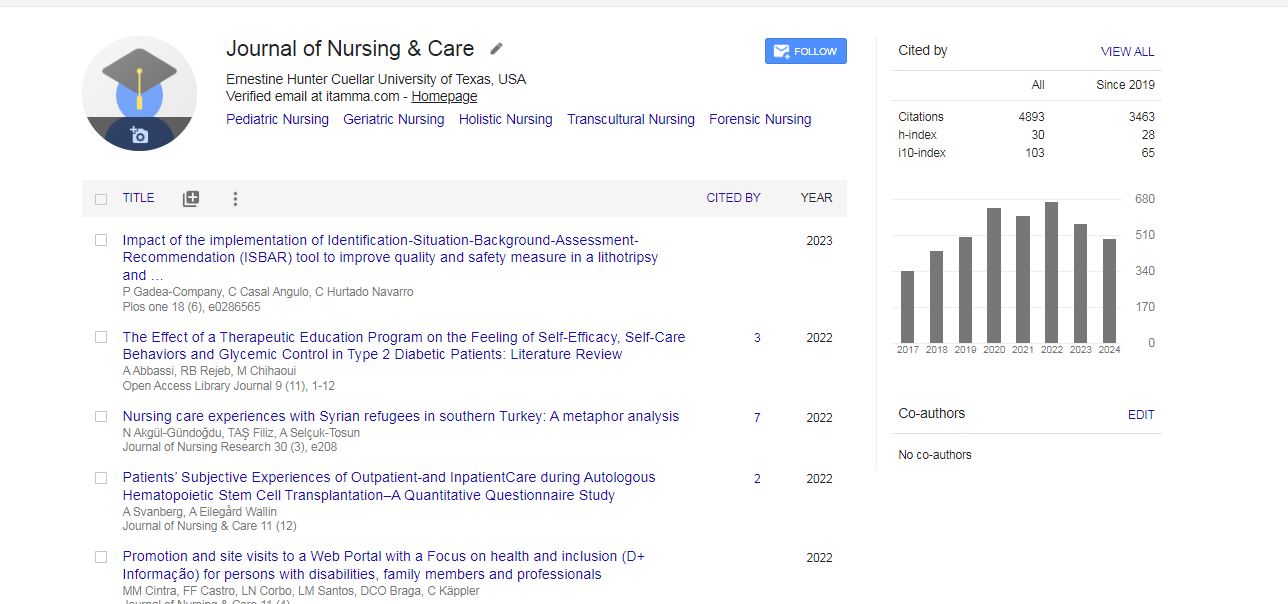
Journal of Nursing & Care received 4230 citations as per Google Scholar report