Brief Report - (2025) Volume 10, Issue 3
Received: 01-May-2025, Manuscript No. JPNM-26-185780;
Editor assigned: 03-May-2025, Pre QC No. P-185780;
Reviewed: 19-May-2025, QC No. Q-185780;
Revised: 22-May-2025, Manuscript No. R-185780;
Published:
29-May-2025
, DOI: 10.37421/2472-100X.2025.10.342
Citation: Fischer, Amelia. "Pediatric Epilepsy: Diagnosis, Treatment, and Outcomes." J Pediatr Neurol Med 10 (2025):342.
Copyright: © 2025 Fischer A. This is an open-access article distributed under the terms of the Creative Commons Attribution License, which permits unrestricted use, distribution and reproduction in any medium, provided the original author and source are credited.
The timely and precise diagnosis of pediatric epilepsy is a cornerstone of effective management, profoundly influencing long-term neurodevelopmental trajectories. This guide underscores the critical diagnostic modalities employed, commencing with comprehensive history taking and a thorough neurological examination, followed by the judicious selection of neuroimaging and electroencephalography (EEG) studies. Management paradigms are anchored in pharmacotherapy, with careful consideration given to seizure type, the specific epilepsy syndrome, and individual patient characteristics, aiming to mitigate adverse effects and enhance overall quality of life. Furthermore, surgical interventions and specialized dietary therapies are explored for cases that prove resistant to conventional treatment [1].
Significant advancements in EEG interpretation, particularly through the application of long-term monitoring and sophisticated signal processing techniques, have markedly improved diagnostic accuracy in complex pediatric epilepsy cases. A deep understanding of diverse EEG patterns is indispensable for accurate syndrome classification and the selection of targeted therapeutic strategies. This review meticulously details the current best practices for both the acquisition and interpretation of EEG data in the pediatric epilepsy context [2].
Neuroimaging, with magnetic resonance imaging (MRI) at its forefront, plays an indispensable role in identifying underlying structural causes of pediatric epilepsy. Detailed analysis of brain MRI scans, incorporating advanced sequences, can reveal subtle abnormalities that are crucial for guiding diagnosis and informing treatment planning, especially in cases of focal epilepsies. This article provides an in-depth discussion of the indications for and interpretation of neuroimaging in the diagnostic workup of childhood epilepsy [3].
The pharmacological management of pediatric epilepsy necessitates a nuanced approach, taking into account the specific seizure type, the diagnosed epilepsy syndrome, and the patient's age. The advent of newer antiepileptic drugs (AEDs) has broadened therapeutic options, offering agents with varied mechanisms of action and distinct side effect profiles. This review presents an updated overview of contemporary AEDs and promising emerging therapies for pediatric epilepsy [4].
Epilepsy surgery represents a significant therapeutic avenue for children experiencing refractory focal epilepsy that is unresponsive to pharmacological interventions. The pre-surgical evaluation process, which includes detailed EEG and neuroimaging, is paramount for identifying suitable candidates and meticulously planning the surgical resection. This article delves into the outcomes and inherent challenges associated with epilepsy surgery in pediatric populations [5].
Modified dietary therapies, most notably the ketogenic diet, have gained prominence as effective adjunctive treatments for pediatric epilepsy that is resistant to conventional drug therapies. A thorough understanding of the underlying mechanisms, practical implementation strategies, and diligent monitoring protocols is essential for the successful application of these diets. This review synthesizes the existing evidence and practical considerations pertaining to dietary therapies in the management of pediatric epilepsy [6].
Genetic testing has emerged as an increasingly vital tool in the diagnostic armamentarium for pediatric epilepsy, particularly in cases of early-onset and severe epilepsies where specific genetic mutations are known to be implicated. Identifying the precise genetic etiology can profoundly influence prognosis, guide treatment decisions, and facilitate comprehensive genetic counseling. This paper examines the rapidly evolving landscape of genetic testing within the field of pediatric epilepsy [7].
The management of status epilepticus in children demands prompt and aggressive intervention to avert potential neurological damage. This updated guideline offers crucial recommendations for the pharmacological management of pediatric status epilepticus, emphasizing the imperative of timely benzodiazepine administration followed by appropriate subsequent treatment options [8].
Neurodevelopmental outcomes in children diagnosed with epilepsy are intrinsically linked to the effectiveness of seizure control, the underlying etiology of the epilepsy, and the chosen treatment modality. Early diagnosis coupled with optimal management strategies are critical for maximizing cognitive and behavioral development. This study meticulously investigates the long-term neurodevelopmental trajectory observed in a cohort of children newly diagnosed with epilepsy [9].
The transition of care from pediatric to adult epilepsy services represents a pivotal juncture that requires meticulous planning to ensure seamless continuity of care and sustained optimal management for young adults living with epilepsy. This article delineates the best practices for facilitating a successful transition process, aiming to maintain therapeutic efficacy and improve patient outcomes [10].
The journey of managing pediatric epilepsy begins with the fundamental need for early and accurate diagnosis, a process that significantly shapes the long-term neurodevelopmental outcomes for affected children. Key diagnostic pillars include meticulous history taking, a comprehensive neurological examination, and the strategic application of neuroimaging and electroencephalography (EEG) to elucidate the underlying nature of the epilepsy. Treatment strategies are primarily centered on pharmacotherapy, where the choice of medication is carefully tailored to the seizure type, epilepsy syndrome, and individual patient factors, with a persistent focus on minimizing side effects and enhancing the overall quality of life. For cases refractory to medication, surgical interventions and specialized dietary therapies offer alternative management pathways [1].
Contemporary EEG interpretation has been revolutionized by innovations such as long-term monitoring and advanced signal processing, leading to a substantial increase in diagnostic yield for challenging pediatric epilepsy presentations. Mastering the subtleties of various EEG patterns is essential for accurate classification of epilepsy syndromes and the effective selection of targeted treatments. This review consolidates current best practices for both the acquisition and interpretation of EEG in the context of pediatric epilepsy [2].
Within the diagnostic process, neuroimaging, particularly MRI, holds a preeminent position in identifying structural anomalies that serve as the etiology for pediatric epilepsy. The detailed scrutiny of brain MRI, including the utilization of advanced imaging sequences, can uncover subtle brain abnormalities that are instrumental in guiding diagnostic conclusions and formulating treatment plans, especially for focal epilepsies. This article comprehensively examines the indications for and the interpretation of neuroimaging studies in the comprehensive evaluation of childhood epilepsy [3].
Pharmacological interventions for pediatric epilepsy demand a highly individualized approach, meticulously considering the specific seizure type, the defined epilepsy syndrome, and the patient's developmental stage. The ongoing development of novel antiepileptic drugs (AEDs) has expanded the therapeutic arsenal, offering medications with diverse mechanisms of action and distinct pharmacological profiles. This review provides an up-to-date synopsis of current AEDs and highlights emerging therapeutic agents for pediatric epilepsy [4].
For children whose focal epilepsy remains intractable despite optimal pharmacological management, surgical intervention presents a viable and often effective treatment option. The pre-surgical assessment phase, encompassing detailed EEG studies and sophisticated neuroimaging, is critically important for identifying suitable surgical candidates and for precise planning of the resection. This article scrutinizes the outcomes achieved and the inherent challenges encountered in the surgical management of pediatric epilepsy [5].
Dietary interventions, exemplified by the ketogenic diet and other modified dietary approaches, have emerged as significant adjunctive treatments for pediatric epilepsy that is resistant to medication. A thorough grasp of the underlying mechanisms, the practicalities of implementation, and rigorous monitoring protocols are paramount for the successful and safe application of these diets. This review synthesizes the available evidence and addresses key practical considerations for employing dietary therapies in pediatric epilepsy management [6].
Genetic testing is progressively assuming a more central role in the diagnostic evaluation of pediatric epilepsy, particularly in early-onset and severe forms where specific genetic mutations are frequently implicated. The identification of a genetic cause can provide critical insights into prognosis, inform treatment selection, and aid in providing essential genetic counseling to families. This paper explores the continuously expanding scope of genetic testing within the domain of pediatric epilepsy [7].
The acute management of status epilepticus in children necessitates immediate and robust intervention to mitigate the risk of lasting neurological sequelae. This guideline update offers evidence-based recommendations for the pharmacological management of pediatric status epilepticus, emphasizing the critical importance of prompt benzodiazepine administration and the subsequent selection of appropriate therapeutic agents [8].
Long-term neurodevelopmental outcomes in children with epilepsy are intricately influenced by a complex interplay of factors, including the efficacy of seizure control, the underlying etiology of the epilepsy, and the therapeutic strategies employed. Early diagnosis and the implementation of optimal management plans are pivotal for maximizing the potential for positive cognitive and behavioral development. This study presents an examination of the long-term neurodevelopmental trajectory observed in a cohort of children newly diagnosed with epilepsy [9].
The transition of epilepsy care from pediatric to adult services marks a crucial phase for adolescents and young adults, requiring careful and systematic planning to ensure uninterrupted continuity of care and sustained optimal management. This article outlines essential best practices designed to facilitate a smooth and successful transition process, thereby enhancing long-term outcomes for this vulnerable patient population [10].
This collection of research highlights key aspects of pediatric epilepsy management. It emphasizes the critical role of early and accurate diagnosis through methods like detailed history, neurological exams, neuroimaging, and EEG. Treatment approaches encompass pharmacotherapy tailored to individual needs, with considerations for seizure type and epilepsy syndrome, as well as alternative strategies like surgery and dietary therapies for refractory cases. Advances in EEG interpretation and neuroimaging are improving diagnostic yields. Genetic testing is becoming increasingly important for identifying specific causes and guiding treatment. Managing acute emergencies like status epilepticus requires prompt intervention. The long-term neurodevelopmental outcomes are significantly influenced by early diagnosis and effective management. Finally, a smooth transition of care from pediatric to adult services is vital for continued optimal management of young adults with epilepsy.
None
None
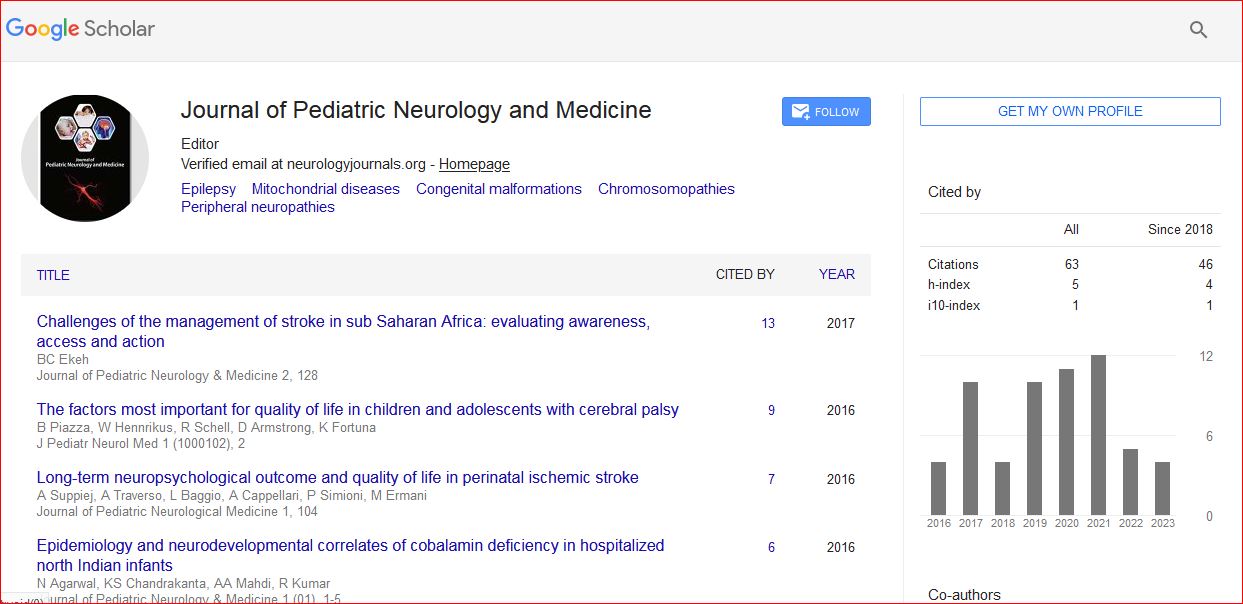
Journal of Pediatric Neurology and Medicine received 68 citations as per Google Scholar report