Opinion - (2025) Volume 13, Issue 6
Received: 01-Dec-2025, Manuscript No. jcdd-25-177698;
Editor assigned: 03-Dec-2025, Pre QC No. P-177698;
Reviewed: 17-Dec-2025, QC No. Q-177698;
Revised: 22-Dec-2025, Manuscript No. R-177698;
Published:
29-Dec-2025
, DOI: 10.37421/2329-9517.2025.13.704
Citation: Carlos Mendes. "Pediatric Cardiology: Advancements
in Personalized Care." J Cardiovasc Dis Diagn 13 (2025):704.
Copyright: © 2025 M. Carlos This is an open-access article distributed under the terms of the Creative Commons Attribution License, which permits unrestricted use,
distribution and reproduction in any medium, provided the original author and source are credited.
Recent advancements have significantly improved the diagnosis and treatment of congenital heart disease in pediatric patients. This includes sophisticated prenatal diagnostic methods, cutting-edge non-invasive imaging techniques, and refined surgical procedures. The focus is increasingly on personalized medicine, aiming for better long-term outcomes for these young patients [1].
Moving to specific cardiac conditions, current and developing treatments for pediatric cardiomyopathy represent a vital area of research. This includes exploring genetic therapies, advanced management strategies for heart failure, and the integral role of mechanical circulatory support, all of which are designed to enhance patient outcomes [2].
The field of fetal cardiac interventions continues to evolve, offering new hope for severe congenital heart defects detected before birth. Discussions focus on their efficacy in improving outcomes and outlining future research directions necessary to further refine these intricate procedures [3].
Addressing arrhythmias in children with congenital heart disease remains a complex challenge. Understanding common types, identifying risk factors, and implementing effective therapeutic strategies, such as antiarrhythmic medications and interventional electrophysiology, are crucial for comprehensive care in this population [4].
Updated guidance on the management of pediatric pulmonary hypertension is essential. This includes improved diagnostic approaches, meticulous risk stratification, and a growing array of targeted therapies, all directed at enhancing both outcomes and the long-term quality of life for affected children [5].
Advanced imaging modalities play a critical role in pediatric and congenital heart disease. Techniques like cardiovascular MRI and CT are indispensable for detailed anatomical assessment, precise functional evaluation, and informing clinical decisions throughout a patient's entire life [6].
Pediatric heart transplantation has seen considerable progress, with advancements in patient selection, immunosuppression protocols, and post-transplant care leading to improved survival rates. Despite these gains, ongoing challenges such as allograft vasculopathy and late complications persist, prompting continued research into future directions for even better long-term outcomes [7].
For patients with single ventricle heart disease, understanding the long-term outcomes following the Fontan operation is paramount. A systematic review of this complex procedure highlights survival rates and addresses common complications, including protein-losing enteropathy and liver disease, alongside the broader aspects of quality of life for these patients [8].
The genetic underpinnings of congenital heart disease are increasingly understood. This involves identifying key genes and pathways, leveraging genomic testing for diagnosis and risk assessment, and applying these insights to genetic counseling and personalized patient management [9].
A significant and emerging challenge in pediatric cardiology is cardio-oncology, particularly for childhood cancer survivors. This area focuses on the cardiotoxic effects of various cancer treatments, the development of effective screening strategies, and management approaches to mitigate long-term cardiovascular complications and ultimately improve quality of life for this vulnerable group [10].
The contemporary landscape of pediatric cardiology is marked by considerable progress across diagnostics, therapeutic interventions, and long-term patient care. Recent reviews underscore significant advancements in both the diagnosis and treatment of congenital heart disease (CHD) in children. This includes the development of more precise prenatal diagnostic techniques, sophisticated non-invasive imaging modalities like cardiovascular Magnetic Resonance Imaging (MRI) and Computed Tomography (CT) for detailed anatomical assessment and functional evaluation, and the continuous refinement of surgical techniques [1, 6]. The overarching goal remains the implementation of personalized medicine, which aims to markedly improve the long-term outcomes for pediatric patients.
Complementing these diagnostic and interventional strides, an updated understanding of the genetic underpinnings of CHD is proving invaluable. Research elucidates key genes and pathways involved, while genomic testing offers powerful tools for diagnosis and risk assessment, directly impacting genetic counseling and allowing for highly personalized patient management strategies [9]. These foundational insights inform much of the targeted care approaches seen today.
Specific therapeutic innovations are transforming the management of various pediatric cardiac conditions. For instance, new and developing treatments for pediatric cardiomyopathy are being explored, encompassing innovative genetic therapies, advanced management protocols for heart failure, and the strategic deployment of mechanical circulatory support. These combined efforts are focused on delivering improved outcomes for children with this complex disease [2]. Furthermore, the evolving landscape of fetal cardiac interventions presents a beacon of hope for severe congenital heart defects identified prenatally. These interventions are meticulously examined for their role in enhancing outcomes, with ongoing research dedicated to refining these intricate procedures and expanding their applicability [3]. Beyond structural issues, the management of pediatric pulmonary hypertension has received updated guidance, advocating for more precise diagnostic approaches, robust risk stratification, and an expanding array of targeted therapies designed to significantly improve both short-term health and long-term quality of life for affected children [5].
Addressing the complexities of conditions like arrhythmias in children with congenital heart disease requires a multifaceted approach. This involves a thorough exploration of common arrhythmia types, identification of associated risk factors, and the implementation of advanced therapeutic strategies. These range from antiarrhythmic drugs to sophisticated interventional electrophysiology techniques, all essential for navigating the inherent complexities of care in this vulnerable patient population [4]. For children with single ventricle heart disease, particularly those undergoing the Fontan operation, understanding long-term outcomes is critical. A systematic review reveals crucial data on survival rates and highlights common, often severe, complications such as protein-losing enteropathy and liver disease. This research also addresses the broader impact on the quality of life experienced by these patients, underscoring the need for continued vigilance and supportive care [8].
Advancements also extend to the realm of pediatric heart transplantation. Recent updates reveal improved survival rates attributable to refined patient selection processes, more effective immunosuppression regimens, and enhanced post-transplant care protocols. However, significant challenges persist, including allograft vasculopathy and other late complications, which necessitate ongoing research to achieve even better long-term outcomes and sustained success [7]. An increasingly recognized and significant challenge is presented by cardio-oncology in childhood cancer survivors. This growing subspecialty addresses the cardiotoxic effects stemming from various cancer treatments, detailing effective screening strategies, and outlining management approaches specifically designed to mitigate long-term cardiovascular complications. The goal here is clear: to significantly improve the quality of life for these individuals, ensuring that their cardiac health is paramount in their ongoing survivorship [10]. This comprehensive perspective illustrates a dynamic and proactive approach to pediatric cardiac care.
The current landscape of pediatric cardiology reflects significant progress in diagnosing and treating various heart conditions in children. Advancements in congenital heart disease (CHD) management include sophisticated prenatal diagnosis, non-invasive imaging, and refined surgical techniques, emphasizing personalized medicine for improved long-term outcomes. Genetic insights into CHD further aid in diagnosis, risk assessment, and counseling. Therapeutic innovations are transforming care for pediatric cardiomyopathy, incorporating genetic therapies, advanced heart failure management, and mechanical circulatory support. Fetal cardiac interventions are evolving, showing promise for severe congenital defects, while updated strategies address pediatric pulmonary hypertension through improved diagnostics and targeted therapies. Specialized care is crucial for managing arrhythmias in children with CHD, considering risk factors and interventional electrophysiology. Long-term outcomes for complex procedures like the Fontan operation for single ventricle heart disease are systematically reviewed, highlighting survival and common complications. Pediatric heart transplantation has seen better survival rates due to advances in patient selection and post-transplant care, though challenges like allograft vasculopathy remain. A growing area of concern is cardio-oncology, focusing on mitigating cardiotoxic effects in childhood cancer survivors to enhance their long-term cardiovascular health and quality of life. Overall, the field is moving towards more precise, personalized, and comprehensive care for pediatric heart patients, addressing both inherited conditions and treatment-induced complications.
Indexed at, Google Scholar, Crossref
Indexed at, Google Scholar, Crossref
Indexed at, Google Scholar, Crossref
Indexed at, Google Scholar, Crossref
Indexed at, Google Scholar, Crossref
Indexed at, Google Scholar, Crossref
Indexed at, Google Scholar, Crossref
Indexed at, Google Scholar, Crossref
Indexed at, Google Scholar, Crossref
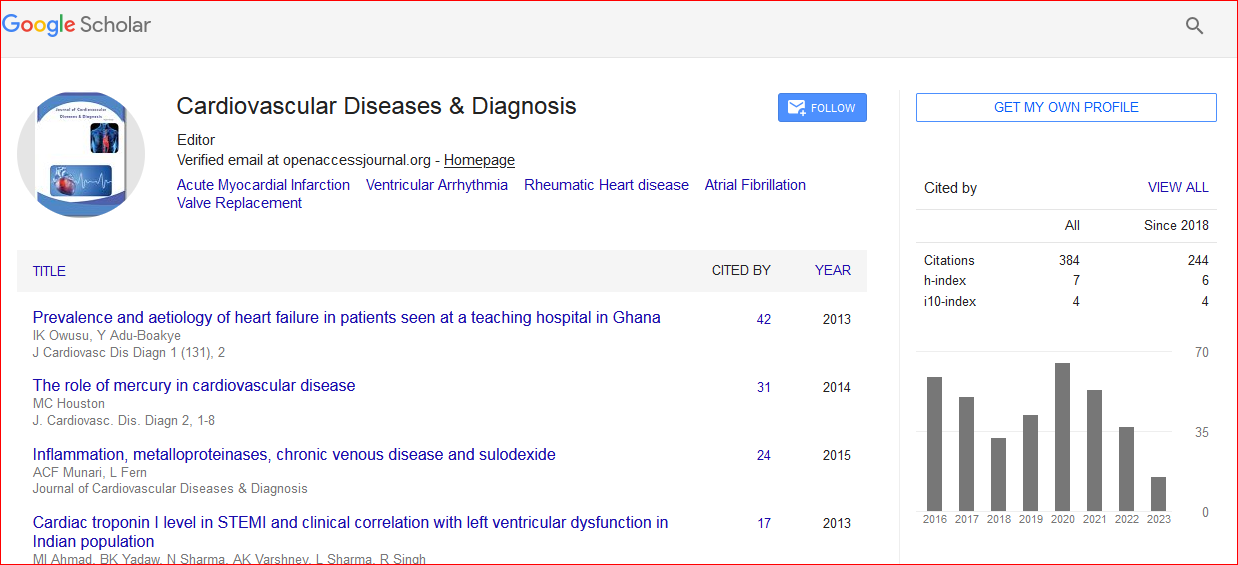
Cardiovascular Diseases & Diagnosis received 427 citations as per Google Scholar report