Perspective - (2025) Volume 10, Issue 3
Received: 02-Jun-2026, Manuscript No. jcct-26-183217;
Editor assigned: 04-Jun-2025, Pre QC No. P-183217;
Reviewed: 18-Jun-2025, QC No. Q-183217;
Revised: 23-Jun-2025, Manuscript No. R-183217;
Published:
30-Jun-2025
, DOI: 10.37421/2577-0535.2025.9.315
Citation: Ribeiro, Ana. ”Patient-Reported Outcomes: Enhancing Cancer Care and Trials.” J Cancer Clin Trials 10 (2025):315.
Copyright: © 2025 Ribeiro A. This is an open-access article distributed under the terms of the Creative Commons Attribution License, which permits unrestricted use, distribution and reproduction in any medium, provided the original author and source are credited.
Patient-reported outcomes (PROs) are fundamental to understanding the patient experience in cancer clinical trials, offering vital insights into symptoms, functional status, and overall quality of life. Their integration into trial designs provides a more comprehensive view of treatment efficacy, extending beyond traditional clinical endpoints to embrace a more patient-centered approach and inform treatment decisions and drug development. [1] Implementing PROs effectively in clinical trials necessitates meticulous planning concerning data collection methodologies, the timing of assessments, and the selection of appropriate PRO instruments. This involves addressing the inherent challenges and adopting best practices for integrating PRO data to ensure its quality and comparability across diverse studies. [2] The evolving role of PROs is particularly significant in the context of advanced cancer therapeutics such as targeted therapies and immunotherapies. These data offer a nuanced understanding of treatment-related side effects and their impact on patients' daily lives, often capturing experiences that clinician-reported assessments may miss. [3] The adoption of electronic PRO (ePRO) systems presents numerous advantages for cancer clinical trials, including real-time data collection, reduced patient and study staff burden, and enhanced data accuracy. Exploring the implementation of these systems is crucial for optimizing trial efficiency and data quality. [4] Regulatory bodies such as the FDA and EMA are increasingly recognizing the value of PROs, establishing guidelines and frameworks for their use in clinical trials. This growing recognition underscores the importance of PROs as valid endpoints in submissions for drug approval. [5] PRO data play a critical role in assessing treatment toxicity from the patient's perspective. By identifying and quantifying patient-reported symptoms, PROs can highlight toxicities that might be overlooked in standard clinical evaluations, thereby enabling the development of more effective supportive care strategies. [6] In adaptive clinical trials, where treatment regimens can be modified based on accumulating data, PROs offer a valuable component. Real-time PRO data can inform adaptive trial designs, facilitating more responsive and efficient patient care strategies that are tailored to individual patient experiences. [7] The development and rigorous validation of PRO instruments are paramount to their successful application in oncology research. Utilizing psychometrically sound measures ensures that the collected PRO data accurately reflect the patient's experience and are reliable for both research and clinical decision-making. [8] Integrating PRO data into existing clinical workflows and research databases, such as electronic health records (EHRs) and clinical trial management systems (CTMS), presents challenges. Strategies for data interoperability are essential to ensure that PRO data can be seamlessly integrated, thereby enhancing its utility in both research and routine clinical practice. [9] Beyond measuring symptoms and quality of life, PRO data are demonstrating prognostic value in cancer patients. This research explores how PROs can be utilized to predict treatment response and survival, complementing traditional biomarkers and clinical factors in providing a more complete picture of patient outcomes. [10]
Patient-reported outcomes (PROs) are indispensable for capturing the subjective experience of individuals participating in cancer clinical trials, offering critical insights into symptom burden, functional capacity, and overall quality of life. The incorporation of PROs allows for a more holistic evaluation of treatment effectiveness, moving beyond conventional clinical markers to foster patient-centered care and guide therapeutic strategies and pharmaceutical development. [1] The successful implementation of PROs within the complex framework of clinical trials hinges on careful consideration of data collection mechanisms, the optimal timing for data acquisition, and the precise selection of PRO instruments tailored to specific research questions. This article underscores the critical need to address the challenges and adhere to best practices in PRO data integration to ensure the robustness and comparability of findings across different research endeavors. [2] In the contemporary landscape of cancer treatment, particularly with the advent of targeted therapies and immunotherapies, PROs are increasingly central to evaluating treatment benefit and toxicity. These data provide a granular understanding of treatment-related adverse events and their tangible impact on a patient's daily functioning, aspects that may not be fully elucidated through clinician-based assessments alone. [3] The utilization of electronic PRO (ePRO) systems in cancer clinical trials offers significant advantages, including the capacity for real-time data capture, a reduction in the logistical and temporal demands placed on both patients and study personnel, and an improvement in the overall accuracy of collected data. An examination of ePRO implementation strategies is vital for enhancing trial efficiency and data integrity. [4] Regulatory agencies worldwide, including the U.S. Food and Drug Administration (FDA) and the European Medicines Agency (EMA), are actively shaping the landscape for PROs in clinical research. Their evolving guidelines highlight the growing acceptance of PROs as legitimate endpoints and specify the requirements for their inclusion in regulatory submissions for new drug approvals. [5] PROs are instrumental in elucidating the patient's experience of treatment-related toxicity in oncology. By providing a direct voice to patients regarding their symptoms, PROs can identify and quantify adverse effects that might otherwise be underrecognized in standard clinical evaluations, thereby informing the development of more effective and patient-aligned supportive care interventions. [6] The application of PROs within the dynamic context of adaptive clinical trials is an area of growing interest. These trials allow for modifications to treatment protocols based on emerging data, and real-time PRO information can be strategically integrated to inform these adaptive designs, promoting more agile and responsive patient care. [7] The development and validation of robust PRO measures are foundational to their reliable application in cancer research. Employing instruments that possess strong psychometric properties ensures that the resulting PRO data accurately represent the patient's lived experience and possess the necessary reliability for both research purposes and clinical decision-making. [8] Facilitating the seamless integration of PRO data into existing clinical information systems, such as electronic health records (EHRs) and clinical trial management systems (CTMS), presents a notable challenge. Developing effective strategies for data interoperability is crucial for maximizing the utility of PRO data across the spectrum of research and clinical practice. [9] Emerging research is exploring the prognostic potential of PRO data in cancer patients, investigating its ability to predict treatment response and overall survival. This work suggests that PROs can serve as valuable prognostic indicators, augmenting traditional clinical and molecular biomarkers in offering a more comprehensive understanding of patient trajectories and outcomes. [10]
Patient-reported outcomes (PROs) are crucial in cancer clinical trials, providing insights into symptoms, function, and quality of life, thereby enhancing patient-centered care and informing treatment decisions. Effective implementation requires careful planning of data collection, timing, and instrument selection, along with adherence to best practices. PROs are increasingly important in evaluating the benefits and toxicities of targeted therapies and immunotherapies, capturing patient experiences not always evident in clinician assessments. Electronic PRO (ePRO) systems offer advantages like real-time data collection and improved accuracy. Regulatory bodies recognize PROs as valid endpoints. PRO data also help understand treatment toxicity and can inform adaptive trial designs. Developing and validating PRO instruments is essential for reliable data. Integrating PRO data into electronic health records and clinical trial management systems is a challenge. Furthermore, PROs are showing prognostic value in predicting treatment response and survival.
None
None
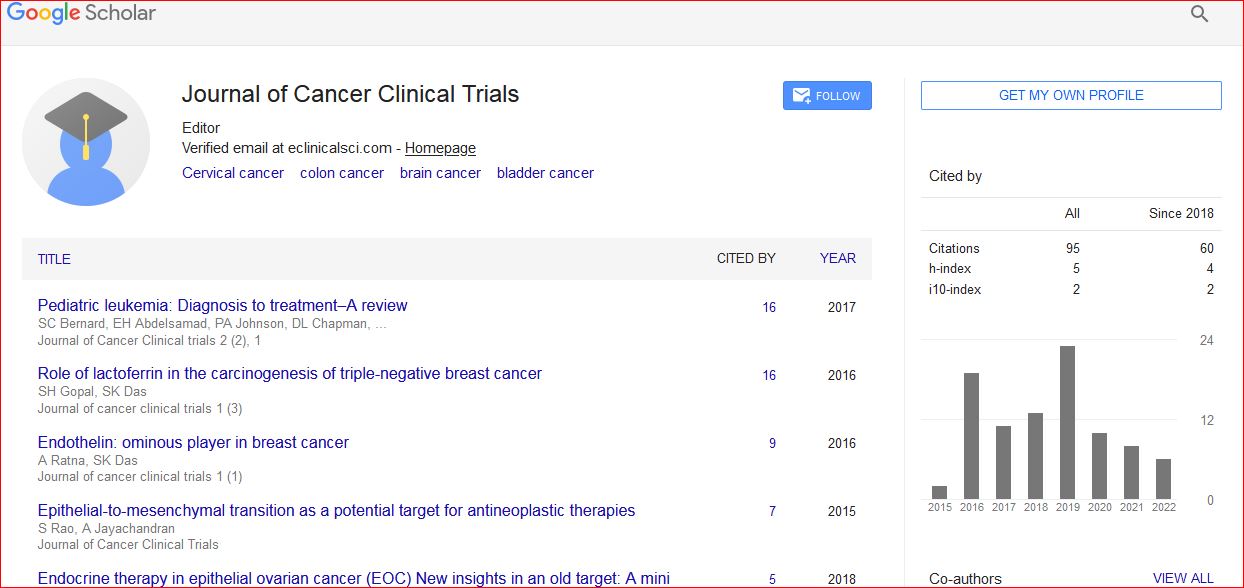
Journal of Cancer Clinical Trials received 95 citations as per Google Scholar report