Short Communication - (2025) Volume 10, Issue 4
Received: 01-Aug-2025, Manuscript No. jcct-26-183228;
Editor assigned: 04-Aug-2025, Pre QC No. P-183228;
Reviewed: 18-Aug-2025, QC No. Q-183228;
Revised: 23-Aug-2025, Manuscript No. R-183228;
Published:
29-Aug-2025
, DOI: 10.37421/2577-0535.2025.9.326
Citation: Maseko, Lindiwe. ”Patient Outcomes, Quality Of Life In Cancer Research.” J Cancer Clin Trials 10 (2025):326.
Copyright: © 2025 Maseko L. This is an open-access article distributed under the terms of the Creative Commons Attribution License, which permits unrestricted use, distribution and reproduction in any medium, provided the original author and source are credited.
The integration of patient-reported outcomes (PROs) into cancer clinical research is a rapidly evolving area, fundamentally shifting the focus from purely clinical endpoints to a more holistic understanding of the patient experience. This paradigm shift acknowledges that the true impact of cancer treatments extends beyond survival rates and encompasses quality of life, symptom burden, and functional well-being. As such, the methodologies for collecting, analyzing, and interpreting PRO data are crucial for deriving meaningful insights that can inform clinical practice and improve patient care. This review aims to explore the current landscape of PRO integration in oncology trials, highlighting key developments, challenges, and future directions. The increasing recognition of quality-of-life (QoL) measures is paramount in understanding the comprehensive effect of cancer therapies, moving beyond traditional survival metrics [1].
Methodological considerations for assessing health-related quality of life (HRQoL) in advanced cancer, particularly in clinical trials, are essential for capturing the nuances of patient experiences throughout treatment [2].
The impact of specific treatments, such as immunotherapy, on the quality of life of cancer patients is a growing area of investigation, underscoring the need to monitor and manage treatment-related side effects that affect daily functioning and emotional well-being [3].
The advent of digital health technologies presents new opportunities for capturing QoL outcomes in real-time within cancer clinical trials, promising to enhance data accuracy and reduce participant burden [4].
Furthermore, the sequencing of treatments in advanced cancers can significantly influence patient well-being and functional status, emphasizing the importance of individualized treatment plans that prioritize QoL alongside clinical efficacy [5].
The role of survivorship care plans in improving the quality of life for cancer survivors is also being increasingly recognized, as these plans can empower patients and alleviate anxiety through comprehensive follow-up recommendations [6].
Even in early-phase cancer clinical trials, where the primary focus is on safety and dose escalation, assessing QoL is feasible and valuable, providing early signals that can inform later-stage trial design and identify potential patient-reported benefits or burdens of investigational agents [7].
The challenge of missing data in QoL assessments within cancer trials is a significant concern, necessitating robust statistical methods and transparent reporting to ensure the reliability of findings [8].
The integration of palliative care into active cancer treatment has demonstrated a positive impact on patient quality of life, improving symptom management and reducing psychological distress [9].
Understanding patient preferences for various QoL outcomes is critical for making informed treatment decisions, as patients may prioritize functional well-being and symptom control over extended survival when faced with significant treatment toxicity [10].
The landscape of cancer clinical research is undergoing a significant transformation with the growing emphasis on patient-reported outcomes (PROs), particularly quality of life (QoL). This integration moves beyond traditional survival metrics to encompass the patient's lived experience, symptom burden, and functional status. The incorporation of PROs into clinical trials allows for a more comprehensive evaluation of treatment efficacy and patient well-being. The growing recognition of QoL measures is crucial for understanding the true impact of cancer therapies, offering insights beyond survival statistics [1].
Methodological rigor in assessing health-related quality of life (HRQoL) within advanced cancer clinical trials is paramount to accurately capture the patient experience throughout various treatment regimens and across diverse patient populations [2].
The specific effects of novel therapies, such as immunotherapy, on the QoL of cancer patients are under scrutiny, highlighting the need to proactively address side effects that impact daily life and emotional health [3].
Digital health technologies, including mobile applications and wearable devices, are emerging as powerful tools for real-time QoL data collection in cancer trials, aiming to enhance data precision and minimize participant burden through innovative approaches [4].
The strategic sequencing of therapeutic interventions in metastatic cancer critically influences patient well-being and functional capacity, underscoring the necessity for personalized treatment plans that balance QoL considerations with clinical effectiveness [5].
Survivorship care plans are increasingly recognized for their potential to enhance the QoL of cancer survivors by providing clear guidance on treatment history and follow-up care, thereby empowering patients and mitigating anxiety [6].
The feasibility and value of incorporating QoL assessments even in early-phase cancer trials are becoming apparent, as these early signals can significantly inform the design of subsequent trials and identify potential patient-reported benefits or drawbacks of new agents [7].
Addressing the complexities of missing data in QoL assessments within cancer trials is a critical challenge, requiring sophisticated statistical imputation methods and transparent reporting practices to ensure the validity and reliability of study conclusions [8].
The early integration of palliative care services into active cancer treatment regimens has been shown to markedly improve patient QoL by enhancing symptom management and alleviating psychological distress [9].
Understanding and incorporating patient preferences for QoL outcomes into treatment decision-making processes are essential, as patients often prioritize functional well-being and symptom control over prolonged survival when confronting treatments with substantial toxicity [10].
This collection of research highlights the increasing importance of patient-reported outcomes (PROs) and quality of life (QoL) in cancer clinical research. Studies emphasize the need for standardized methodologies in collecting and analyzing PRO data, exploring the impact of various cancer treatments on QoL, and the challenges associated with data collection and interpretation. Digital health technologies and early palliative care integration are identified as promising avenues for improving QoL assessment and patient care. The research underscores the importance of considering patient preferences and ensuring robust data handling to generate meaningful insights that can inform treatment decisions and enhance the overall patient experience in oncology.
None
None
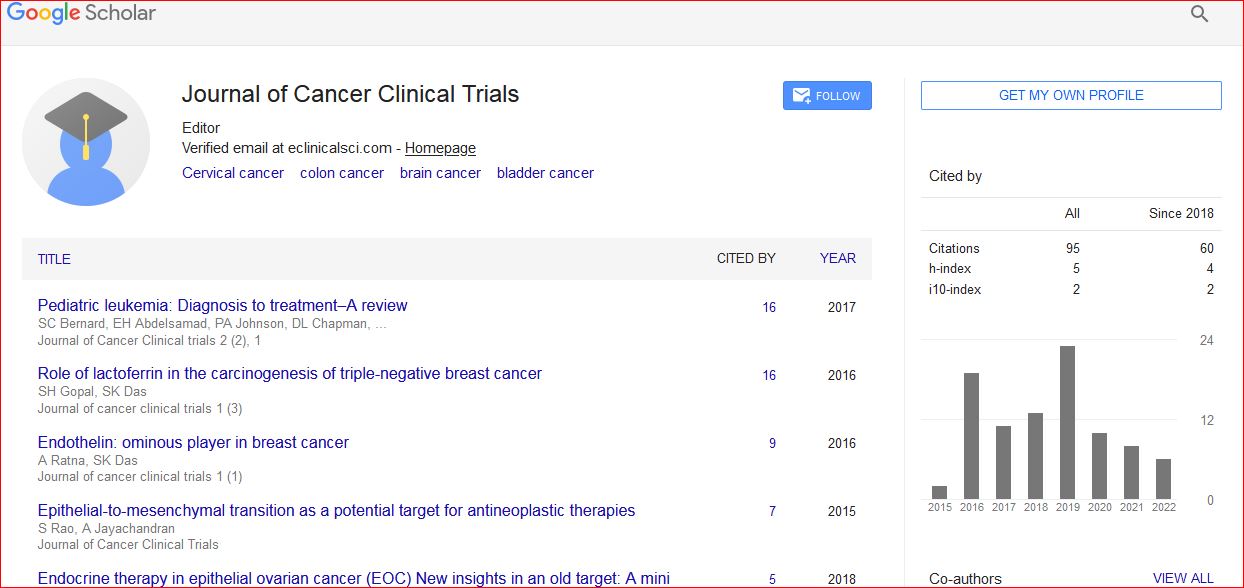
Journal of Cancer Clinical Trials received 95 citations as per Google Scholar report