Opinion - (2025) Volume 10, Issue 6
Received: 02-Nov-2025, Manuscript No. apn-26-179361;
Editor assigned: 04-Nov-2025, Pre QC No. P-179361;
Reviewed: 16-Nov-2025, QC No. Q-179361;
Revised: 23-Nov-2025, Manuscript No. R-179361;
Published:
30-Nov-2025
, DOI: 10.37421/2573-0347.2025.10.465
Citation: Martinez, Sofia. âPathophysiology: Nurses Empowered for Better Patient Care.â J Adv Practice Nurs 10 (2025):465.
Copyright: © 2025 Martinez S. This is an open-access article distributed under the terms of the Creative Commons Attribution License, which permits unrestricted use,
distribution and reproduction in any medium, provided the original author and source are credited.
Advanced pathophysiology serves as a foundational pillar for nurses, illuminating the underlying mechanisms of patient conditions and empowering them to conduct more precise assessments and implement targeted interventions. This in-depth comprehension is essential for effective patient education, enabling nurses to bridge the gap between scientific understanding and clinical application. By anticipating potential complications and critically evaluating research, nurses equipped with this knowledge can strongly advocate for evidence-based practices, which ultimately leads to improved patient outcomes and enhanced professional autonomy [1].
Applying advanced pathophysiology in nursing practice involves a critical recognition of how subtle cellular and molecular alterations manifest as observable signs and symptoms in patients. This profound understanding permits nurses to move beyond mere symptom management, enabling them to address the root causes of disease processes directly. Consequently, this leads to the development of more personalized and significantly more effective patient care plans tailored to individual needs [2].
Nurses who possess a robust grasp of advanced pathophysiology are demonstrably better equipped to identify even the most subtle cues that may indicate patient deterioration. This early recognition is crucial for timely intervention, potentially preventing severe adverse events and safeguarding patient well-being. Such a proactive approach is unequivocally a hallmark of high-quality nursing care in any clinical setting [3].
A comprehensive understanding of the complex interplay between various physiological systems during disease progression allows nurses to deliver substantially more effective patient education. By elucidating conditions in terms of underlying cellular mechanisms and functional impairments, nurses can empower patients to actively manage their health and improve adherence to prescribed treatment regimens [4].
The application of advanced pathophysiology principles is absolutely instrumental in the development and implementation of evidence-based nursing interventions. By thoroughly understanding the mechanisms of action for different treatments, nurses can engage in a critical appraisal of scientific literature and subsequently implement the most effective and scientifically supported strategies for their patients' care [5].
Advanced pathophysiology significantly informs nurses' capacity to critically analyze diagnostic results within the broader context of a patient's overall clinical condition. This analytical capability allows for a more holistic and nuanced interpretation of laboratory and diagnostic data, which is essential for making more informed and judicious clinical judgments [6].
Understanding the specific pathophysiology associated with chronic diseases is of paramount importance for nurses who manage long-term patient care. This specialized knowledge facilitates proactive symptom management, diligent prevention of disease exacerbations, and ultimately contributes to an improved quality of life for individuals grappling with ongoing health challenges [7].
Advanced pathophysiology actively fosters a critical thinking approach within the nursing profession, empowering nurses to rigorously question existing assumptions, meticulously evaluate the efficacy of interventions, and dynamically adapt patient care plans based on a deep and nuanced understanding of underlying biological processes [8].
Applying core pathophysiology principles to the realm of pharmacology enables nurses to gain a more profound understanding of drug mechanisms of action. This knowledge is vital for accurately predicting potential adverse side effects and optimizing therapeutic outcomes, thereby ensuring safer and more effective medication administration for all patients [9].
Finally, the integration of advanced pathophysiology concepts into both nursing curricula and everyday clinical practice is absolutely essential for cultivating highly competent healthcare professionals. This integration ensures that nurses are exceptionally well-prepared to deliver patient-centered, evidence-based care and to make significant contributions to the ongoing advancement of the nursing profession as a whole [10].
Advanced pathophysiology plays a pivotal role in enhancing nursing practice by providing the essential 'why' behind patient conditions, thereby enabling more precise assessments. This deeper knowledge empowers nurses to move beyond superficial symptom management to a more profound understanding of disease processes, allowing for the implementation of highly targeted and effective interventions. Furthermore, this scientific grounding is crucial for effective patient education, equipping nurses with the ability to clearly explain complex conditions and foster patient engagement in their own care. The capacity to anticipate potential complications, critically evaluate emerging research, and advocate for evidence-based practice are direct outcomes of a strong grasp of advanced pathophysiology, collectively contributing to improved patient outcomes and a stronger professional standing [1].
The practical application of advanced pathophysiology in nursing necessitates a keen ability to recognize how cellular and molecular changes translate into observable clinical signs and symptoms. This sophisticated understanding allows nurses to transcend the limitations of merely managing symptoms, enabling them to address the underlying disease processes directly. This shift in focus leads to the development and delivery of more personalized, effective, and patient-specific care plans, significantly enhancing the quality of care provided [2].
Nurses who cultivate a thorough understanding of advanced pathophysiology are demonstrably better positioned to identify subtle indicators of patient deterioration. This heightened observational skill is critical for facilitating early intervention, a key factor in potentially preventing serious adverse events and improving patient safety. This proactive approach is not merely beneficial but is fundamentally a hallmark of exemplary nursing care across all specialties [3].
Understanding the intricate web of physiological systems and their dysfunctions during disease development allows nurses to significantly enhance their patient education strategies. By articulating disease processes in terms of fundamental cellular mechanisms and functional impairments, nurses can empower patients with the knowledge and confidence to better manage their own health and adhere more consistently to prescribed treatment regimens [4].
The application of advanced pathophysiology is indispensable for the development and sustained implementation of evidence-based nursing interventions. By possessing a clear understanding of the specific mechanisms of action for various therapeutic treatments, nurses are empowered to critically appraise the scientific literature and confidently implement the most effective, scientifically validated strategies for their patients' benefit [5].
Advanced pathophysiology provides nurses with the critical lens needed to analyze diagnostic results. This analysis is performed not in isolation but within the comprehensive context of the patient's overall condition. This holistic approach to data interpretation leads to more accurate and informed clinical judgments, which are crucial for effective patient management [6].
For nurses managing patients with chronic diseases, a deep understanding of their specific pathophysiology is absolutely paramount. This specialized knowledge enables proactive symptom control, effective prevention of disease exacerbations, and ultimately contributes to a markedly improved quality of life for individuals living with long-term health challenges [7].
Advanced pathophysiology is instrumental in cultivating a robust critical thinking capacity among nurses. This intellectual development empowers them to question established assumptions, meticulously evaluate the effectiveness of different interventions, and intelligently adapt patient care strategies based on a profound understanding of the underlying biological processes driving the illness [8].
By applying pathophysiology principles directly to pharmacology, nurses gain a comprehensive understanding of how medications work at a fundamental level. This insight is essential for accurately predicting potential side effects and optimizing therapeutic responses, thereby ensuring safer and more effective medication administration for all patient populations [9].
In conclusion, the thoughtful integration of advanced pathophysiology into nursing education and practice is not merely advantageous but is essential for developing highly competent and adaptable healthcare professionals. This comprehensive understanding equips nurses to provide exemplary patient-centered, evidence-based care and to actively contribute to the continuous advancement of the nursing profession itself [10].
Advanced pathophysiology is crucial for nurses, enabling precise assessments, targeted interventions, and effective patient education by explaining the 'why' behind conditions. This knowledge empowers nurses to anticipate complications, critically evaluate research, and advocate for evidence-based practice, improving patient outcomes and autonomy. Understanding cellular and molecular changes allows nurses to address underlying disease processes for personalized care. A strong grasp of pathophysiology aids in early detection of patient deterioration, preventing adverse events. It enhances patient education by explaining conditions through cellular mechanisms, leading to better health management and treatment adherence. This knowledge is vital for developing evidence-based interventions and critically appraising literature. Nurses can analyze diagnostic results holistically for informed clinical judgments. Understanding chronic disease pathophysiology facilitates proactive management and improved quality of life. It fosters critical thinking, enabling nurses to question assumptions, evaluate interventions, and adapt care based on biological processes. Pathophysiology informs pharmacology, leading to safer and more effective medication administration. Integrating this knowledge into nursing education and practice develops competent professionals capable of providing excellent patient-centered, evidence-based care.
None
None
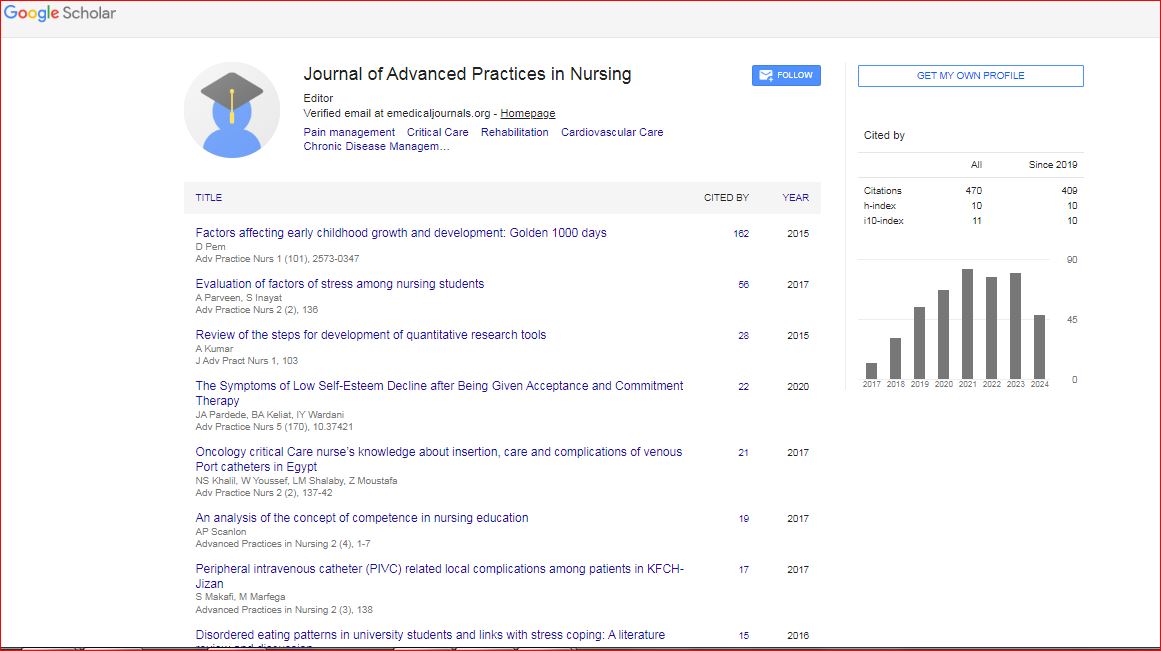
Journal of Advanced Practices in Nursing received 410 citations as per Google Scholar report