Commentary - (2025) Volume 17, Issue 4
Received: 01-Jul-2025, Manuscript No. jcst-25-174950;
Editor assigned: 03-Jul-2025, Pre QC No. P-174950;
Reviewed: 17-Jul-2025, QC No. Q-174950;
Revised: 22-Jul-2025, Manuscript No. R-174950;
Published:
29-Jul-2025
, DOI: 10.37421/1948-5956.2025.17.713
Citation: Miller, David. ”PARP Inhibitors: Revolution, Resistance,
Future Strategies.” J Cancer Sci Ther 17 (2025):713.
Copyright: © 2025 Miller D. This is an open-access article distributed under the terms of the Creative Commons Attribution License, which permits unrestricted use, distribution
and reproduction in any medium, provided the original author and source are credited.
PARP inhibitors have transformed the treatment landscape for breast cancer, particularly in patients with germline BRCA mutations or other homologous recombination deficiency (HRD) [1].
The PRIMA study demonstrated that niraparib maintenance therapy significantly improved progression-free survival in patients with newly diagnosed advanced ovarian cancer, regardless of BRCA mutation status or homologous recombination deficiency [2].
Olaparib has shown significant clinical benefit in metastatic castration-resistant prostate cancer, particularly in patients with DNA repair gene alterations, including BRCA1/2 mutations [3].
Despite the efficacy of PARP inhibitors, resistance invariably emerges [4].
Combining PARP inhibitors with other targeted agents, like WEE1 inhibitors, represents a promising strategy to enhance anti-tumor activity and overcome resistance, especially in ovarian cancer [5].
PARP inhibitors induce synthetic lethality in cells with homologous recombination deficiencies, leading to genomic instability and cell death [6].
This study demonstrated the efficacy of olaparib in metastatic castration-resistant prostate cancer patients with a broader range of DNA repair gene mutations beyond BRCA1/2 [7].
Effective management of adverse events is key to optimizing patient outcomes and maintaining treatment adherence with PARP inhibitors [8].
Combining PARP inhibitors with immunotherapy is an emerging strategy to enhance anti-tumor responses [9].
Understanding the mechanisms of PARP inhibitor resistance in ovarian cancer is critical for improving patient outcomes [10].
PARP inhibitors have significantly advanced the treatment landscape for various cancers, fundamentally changing therapeutic approaches [1]. Their efficacy is particularly notable in breast cancer, especially for patients identified with germline BRCA mutations or other forms of homologous recombination deficiency (HRD) [1]. This class of drugs works by inducing synthetic lethality in cancer cells that exhibit homologous recombination deficiencies, a process that ultimately leads to genomic instability and programmed cell death [6]. Early successes include niraparib maintenance therapy for newly diagnosed advanced ovarian cancer patients, which has shown a marked improvement in progression-free survival. This benefit extends regardless of the patient's BRCA mutation status or homologous recombination deficiency, positioning niraparib as a valuable first-line maintenance option for a wider patient population [2].
Beyond ovarian cancer, PARP inhibitors have demonstrated substantial clinical utility in metastatic castration-resistant prostate cancer. Olaparib, for instance, has brought significant patient benefits, particularly in those with specific DNA repair gene alterations, including BRCA1/2 mutations [3]. Further research has expanded this understanding, showing olaparib's efficacy in prostate cancer patients with an even broader spectrum of DNA repair gene mutations, moving beyond just BRCA1/2 [7]. This emphasizes the growing importance of comprehensive molecular characterization of tumors. Such detailed genomic testing is crucial for accurately identifying patients who are most likely to respond positively to PARP inhibitor therapy, thereby driving the paradigm shift towards precision medicine in prostate cancer management [3, 7].
Despite the demonstrated efficacy of PARP inhibitors, the emergence of resistance remains a significant clinical challenge [4]. A thorough understanding of their mechanisms of action is vital, as it underpins how these agents impact cellular genome integrity and informs strategies for their optimal use and overcoming resistance [6]. This resistance arises through several primary mechanisms. These include the restoration of homologous recombination, changes in PARP trapping modulation, and increased drug efflux from cancer cells [4]. In ovarian cancer, specifically, the pathways to resistance are multifaceted, encompassing the development of secondary mutations, epigenetic modifications, and the activation of alternative DNA repair mechanisms [10]. These insights are crucial for developing future therapeutic approaches [10].
To circumvent resistance and enhance anti-tumor activity, researchers are actively exploring novel combination therapies. Developing these strategies, including next-generation PARP inhibitors, is crucial for extending patient benefit [4]. One promising approach involves combining PARP inhibitors with other targeted agents, such as WEE1 inhibitors. An example includes the investigation of talazoparib alongside adavosertib, aiming to leverage synthetic lethality in ovarian cancer through pathways distinct from traditional DNA repair [5]. Furthermore, PARP inhibition can beneficially modulate the tumor microenvironment, increase the presentation of neoantigens, and sensitize tumors to immune checkpoint blockade, providing a compelling rationale for conducting combination trials in various cancer types [9].
As PARP inhibitor therapies become more widespread, the effective management of associated adverse events is paramount. This is key to optimizing patient outcomes and ensuring consistent treatment adherence [8]. Comprehensive analyses have reviewed common toxicities linked to PARP inhibitors in conditions like ovarian cancer. They also provide practical strategies for dose modifications and robust supportive care [8]. Proactive and informed management of these events is critical, allowing patients to continue therapy and derive the maximum possible benefit from these life-extending treatments [8].
PARP inhibitors have revolutionized the treatment of several cancers, particularly in patients presenting with homologous recombination deficiencies, such as germline BRCA mutations in breast, ovarian, and metastatic castration-resistant prostate cancers. These therapies exert their effect by inducing synthetic lethality in cancer cells, targeting their compromised DNA repair mechanisms. Clinical trials have consistently shown their ability to significantly improve progression-free survival and overall patient outcomes. The utility of genomic testing is crucial, as it enables the identification of specific DNA repair gene alterations, guiding personalized treatment decisions and expanding the benefits to a wider patient population. However, the development of acquired resistance remains a significant hurdle. This resistance is driven by various mechanisms, including the restoration of homologous recombination capabilities, modulation of PARP trapping, increased drug efflux, secondary mutations, and epigenetic changes within tumor cells. To combat resistance and enhance therapeutic efficacy, innovative strategies are under active investigation. These include the development of next-generation PARP inhibitors and combination therapies with other targeted agents, such as WEE1 inhibitors or immunotherapies, which aim to exploit synthetic lethality and modulate the tumor microenvironment. Effective management of adverse events and thoughtful dose modifications are also vital to maintain treatment adherence and ensure patients achieve the maximum possible therapeutic benefit from these essential drugs.
Indexed at, Google Scholar, Crossref
Indexed at, Google Scholar, Crossref
Indexed at, Google Scholar, Crossref
Indexed at, Google Scholar, Crossref
Indexed at, Google Scholar, Crossref
Indexed at, Google Scholar, Crossref
Indexed at, Google Scholar, Crossref
Indexed at, Google Scholar, Crossref
Indexed at, Google Scholar, Crossref
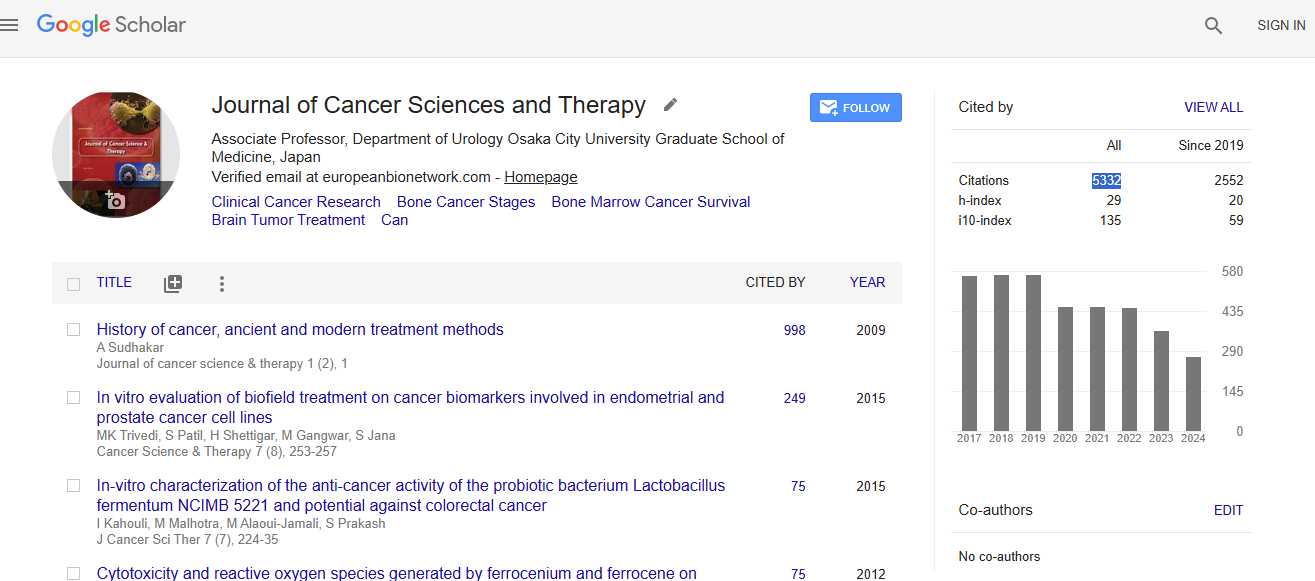
Cancer Science & Therapy received 5332 citations as per Google Scholar report