Opinion - (2025) Volume 11, Issue 3
Received: 02-Jun-2025, Manuscript No. abp-25-173821;
Editor assigned: 04-Jun-2025, Pre QC No. P-173821;
Reviewed: 18-Jun-2025, QC No. Q-173821;
Revised: 23-Jun-2025, Manuscript No. R-173821;
Published:
30-Jun-2025
, DOI: 10.37421/2472-0496.2025.11.324
Citation: Calloway, Ethan. ”Parenting Stress: Dynamics, Impacts, and Solutions.” Abnorm Behav Psychol 11 (2025):324.
Copyright: © 2025 Calloway E. This is an open-access article distributed under the terms of the Creative Commons Attribution License, which permits unrestricted use, distribution and reproduction in any medium, provided the original author and source are credited.
Parenting, while rewarding, presents significant challenges, and parenting stress is a pervasive issue with far-reaching consequences for both parents and children. The landscape of parental well-being is complex, influenced by a myriad of factors, and its decline often has a profound ripple effect on the younger generation's mental health. This critical area of study has seen substantial focus, particularly concerning the identification of stressors, their impact, and potential mitigating strategies. One major contributing factor highlighted in recent research is the COVID-19 pandemic, which caused a significant increase in parenting stress directly affecting children's mental health [1].
This period exacerbated parental psychological distress due to unprecedented challenges, underscoring the urgent need for targeted support systems for families in crisis [1].
Beyond global crises, parenting stress is deeply intertwined with parental mental health issues, demonstrating a clear bidirectional relationship where conditions like depression or anxiety increase parental stress, which then impacts parenting capacity [7].
This forms a challenging cycle that necessitates comprehensive understanding [7].
Socio-demographic factors like age, education, and household income are significant predictors of parenting stress, especially among parents of preschool children, with economic strain and limited resources often amplifying distress [2].
The challenges are further compounded for parents raising children with specific needs. A strong link exists between parental stress and increased mental health problems in children and adolescents diagnosed with autism spectrum disorder (ASD) [3].
Raising a child with ASD places substantial psychological burdens on parents, emphasizing the need for tailored interventions for both parent and child [3].
Similarly, parents of children with neurodevelopmental disorders frequently face significant challenges in coping with parenting stress [4].
Moreover, parents of children with chronic illnesses report significantly higher levels of parenting stress, grappling with continuous care demands, emotional toll, and financial strain [10].
This burden highlights the critical need for specialized support for these families [10].
Even for parents of adolescents, stress is influenced by a complex interplay of child-related factors, parental characteristics, and environmental stressors, indicating that interventions must be multifaceted [5].
Prolonged parenting stress can lead to parental burnout, particularly intensified during periods of crisis like the COVID-19 pandemic [6].
This state is often characterized by emotional exhaustion, depersonalization, and a reduced sense of accomplishment, stemming from increased caregiving demands and limited resources [6].
During the pandemic, financial insecurity, social isolation, and children's behavioral issues were identified as significant risk factors for parental stress [9].
Conversely, protective factors play a crucial role. Robust social support, effective coping strategies, and access to mental health services acted as buffers against stress, highlighting the importance of community and resilience in unprecedented times [9].
Social support and resilience are also crucial protective factors for parents of children with neurodevelopmental disorders, suggesting that fostering strong community ties and individual coping strategies can significantly alleviate the family burden [4].
Recognizing the widespread nature and profound impact of parenting stress, various interventions have been explored. Mindfulness-based interventions, for example, have proven effective in reducing parenting stress, providing parents with valuable tools to manage emotional responses and improve self-regulation [8].
These practices ultimately enhance overall well-being and parenting capacity [8].
The cumulative evidence underscores the necessity for comprehensive support systems that consider the diverse factors contributing to parenting stress, from socio-demographic challenges to specific child-related conditions and parental mental health, ensuring a holistic approach to family well-being.
Parenting stress is a pervasive and complex issue, deeply influencing the well-being of families worldwide. A significant body of research reveals its widespread impact and the multifaceted factors contributing to its prevalence. For instance, the COVID-19 pandemic led to a substantial surge in parenting stress, directly correlating with adverse effects on children's mental health. This highlights how parental psychological distress, intensified by unforeseen challenges, can profoundly ripple through the younger generation, necessitating urgent support for families [1]. Furthermore, a clear bidirectional relationship exists between parenting stress and parental mental health issues; parents struggling with conditions like depression or anxiety are more prone to higher stress levels, which in turn compromises their parenting effectiveness [7]. This creates a challenging cycle that requires careful attention.
The sources of parenting stress are diverse, spanning socio-demographic, child-related, and environmental factors. Socio-demographic elements such as age, education, and household income are strong predictors of stress among parents, particularly those with preschool-aged children. Economic strain and limited resources are often significant amplifiers of parental distress, underscoring the vital role of broader societal support in fostering family well-being [2]. When considering specific child characteristics, the burden on parents can increase dramatically. Parents of children and adolescents with autism spectrum disorder (ASD) consistently report heightened stress, which correlates with increased mental health problems in their children. The unique demands of raising a child with ASD place considerable psychological weight on parents, emphasizing the necessity for interventions specifically tailored to support both parent and child [3]. Similarly, families navigating neurodevelopmental disorders often experience significant parenting stress, further exacerbated by the continuous care requirements [4].
Beyond inherent child conditions, chronic illnesses in children represent another major source of parental burden. Parents of children with chronic illnesses face significantly elevated levels of parenting stress, grappling with ongoing care demands, emotional strain, and often substantial financial pressures associated with managing their child's condition. This situation demands specialized support systems tailored to these families' unique circumstances [10]. Moreover, parenting stress among parents of adolescents is influenced by an intricate combination of adolescent behavior, parental traits, and external environmental stressors. This complex interplay means that effective interventions must be multifaceted, addressing a spectrum of issues from adolescent development to parental mental health and available social resources [5].
The intensity of parenting stress, especially during times of crisis, can escalate to parental burnout. A notable example is the COVID-19 pandemic, where prolonged stress, coupled with amplified caregiving responsibilities and resource limitations, often pushed parents toward emotional exhaustion, depersonalization, and a diminished sense of accomplishment [6]. During this period, risk factors like financial insecurity, social isolation, and children's behavioral issues were particularly prominent contributors to parental stress [9]. Recognizing these challenges, researchers have identified crucial protective factors and interventions. Social support, alongside individual resilience and access to mental health services, acts as a vital buffer against parental stress [4, 9]. These elements highlight the importance of community connections and personal coping strategies in mitigating the pressures faced by families, particularly those dealing with neurodevelopmental disorders [4].
Addressing parenting stress effectively requires a range of supportive measures. Mindfulness-based interventions, for instance, have shown considerable efficacy in reducing parenting stress. Practices such as meditation and conscious awareness equip parents with valuable tools for managing emotional responses, improving self-regulation, and ultimately enhancing their overall well-being and parenting capacity [8]. The overarching message from current research points to the critical need for comprehensive, integrated approaches that acknowledge the diverse origins and expressions of parenting stress. By fostering community ties, bolstering individual coping mechanisms, and providing targeted therapeutic and practical support, it is possible to alleviate the burden on parents and promote healthier developmental outcomes for children.
Parenting stress has emerged as a critical concern, with recent research highlighting its significant impact on family well-being. The COVID-19 pandemic, for instance, led to a substantial increase in parental psychological distress, profoundly affecting children's mental health [1]. This distress is not isolated; it intertwines with parental mental health issues like depression and anxiety, creating a challenging bidirectional cycle that impairs effective parenting [7]. Various factors predict and exacerbate parenting stress. Socio-demographic elements, including age, education, and household income, are key predictors, particularly for parents of preschool children, with economic strain often amplifying distress [2]. For families raising children with specific needs, the burden is particularly heavy. Parents of children with autism spectrum disorder (ASD) face unique challenges that contribute to increased mental health problems in their children [3]. Similarly, parents of children with neurodevelopmental disorders or chronic illnesses experience significantly higher stress levels due to continuous care demands, emotional toll, and financial strain [4, 10]. Even for parents of adolescents, stress is influenced by a complex interplay of child-related factors, parental characteristics, and environmental stressors, necessitating multifaceted interventions [5]. The pandemic also brought unique risk factors like financial insecurity, social isolation, and children's behavioral issues, often pushing parents towards burnout characterized by emotional exhaustion and a reduced sense of accomplishment [6, 9]. However, protective factors and effective interventions exist. Social support, resilience, and access to mental health services are crucial in mitigating stress [4, 9]. Mindfulness-based interventions, specifically, have proven effective in reducing parenting stress, offering tools for emotional management and improved self-regulation [8]. Ultimately, understanding these complex dynamics is key to developing targeted support systems for families.
None
None
1. Mengqi Z, Tingxuan C, Xinyi L. "Parenting stress and children's mental health during the COVID-19 pandemic: A systematic review and meta-analysis".Eur Child Adolesc Psychiatry 33 (2024):301-316.
Indexed at, Google Scholar, Crossref
2. Sumaya L, Leezane J, Boitumelo S. "Parenting Stress and Its Correlates Among Parents of Preschool Children in South Africa".J Child Fam Stud 32 (2023):1612-1627.
Indexed at, Google Scholar, Crossref
3. Jing Z, Yi Z, Hongqiang H. "The relationship between parental stress and mental health problems in children and adolescents with autism spectrum disorder: a systematic review and meta-analysis".Eur Child Adolesc Psychiatry 32 (2023):843-855.
Indexed at, Google Scholar, Crossref
4. Yujie L, Minxia L, Yanan L. "Parenting stress, social support, and resilience: A study of parents of children with neurodevelopmental disorders".J Psychiatr Res 166 (2023):219-225.
Indexed at, Google Scholar, Crossref
5. Manisha S, Sanchita S, Poonam K. "Parenting Stress Among Parents of Adolescents: A Systematic Review".Indian J Pediatr 90 (2023):74-80.
Indexed at, Google Scholar, Crossref
6. Elena MG, Natalia SV, Dmitry AZ. "The Relationship Between Parenting Stress and Parental Burnout During the COVID-19 Pandemic: A Scoping Review".Front Psychol 13 (2022):908122.
Indexed at, Google Scholar, Crossref
7. Charlotte AEMvD, Marlou CLdV, Nicole JHMvdP. "Parenting Stress in the Context of Parental Mental Health: A Systematic Review and Meta-Analysis".J Clin Med 11 (2022):4096.
Indexed at, Google Scholar, Crossref
8. Emma SW, Claire BG, Claire LSL. "Mindfulness-Based Interventions for Parenting Stress: A Systematic Review and Meta-Analysis".J Child Fam Stud 30 (2021):442-458.
Indexed at, Google Scholar, Crossref
9. Mariya TP, Boriana GS, Mariya IA. "Parental Stress During the COVID-19 Pandemic: A Systematic Review of the Risk and Protective Factors".Children (Basel) 8 (2021):868.
Indexed at, Google Scholar, Crossref
10. Zhihong L, Yanjun T, Jian L. "Parenting stress and associated factors among parents of children with chronic illnesses: A systematic review and meta-analysis".J Adv Nurs 76 (2020):2883-2900.
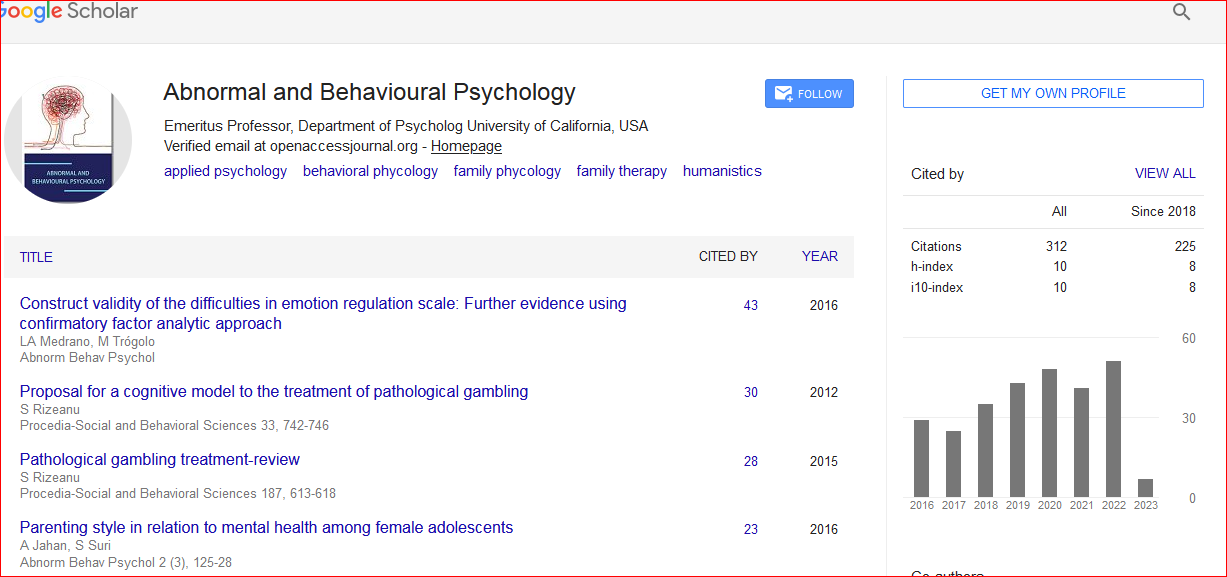
Abnormal and Behavioural Psychology received 361 citations as per Google Scholar report