Short Communication - (2025) Volume 16, Issue 3
Received: 02-Jun-2025, Manuscript No. jvst-26-188008;
Editor assigned: 04-Jun-2025, Pre QC No. P-188008;
Reviewed: 18-Jun-2025, QC No. Q-188008;
Revised: 23-Jun-2025, Manuscript No. R-188008;
Published:
30-Jun-2025
, DOI: 10.37421/2157-7579.2025.16.298
Citation: Novak, Peter. ”Parasitic Challenges in Sheep, Goats:
Integrated Management.” J Vet Sci Techno 16 (2025):298.
Copyright: © 2025 Novak P. This is an open-access article distributed under the terms of the Creative Commons Attribution License, which permits unrestricted use, distribution
and reproduction in any medium, provided the original author and source are credited.
Gastrointestinal nematodes represent a substantial and persistent threat to the health and productivity of small ruminant populations globally. These parasites inflict significant economic damage through reduced growth rates, decreased wool and meat production, and increased mortality, necessitating robust control strategies. The pervasive nature of these infections underscores the critical need for comprehensive understanding and effective management approaches in both sheep and goats. [1]
The intricate life cycles of these nematodes often involve intermediate hosts or free-living larval stages, making eradication challenging and continuous exposure a reality for grazing animals. Pathogenesis varies depending on the specific nematode species, but common effects include damage to the gastrointestinal lining, leading to malabsorption of nutrients and impaired immune function. [2] The development of resistance to widely used anthelmintic drugs is a major impediment to effective parasite control, compromising treatment efficacy and exacerbating economic losses. This resistance often arises from overuse or misuse of these drugs, making monitoring and strategic implementation paramount. [3] Research into novel control methods is crucial to combat the growing challenge of anthelmintic resistance. This includes exploring alternative drug classes, management practices, and biological control agents that can offer sustainable solutions without contributing to resistance. [4] Beyond direct physiological damage, parasitic infections can profoundly impact the immune system of ruminants. This dysregulation can leave animals more susceptible to other diseases and hinder their ability to mount an effective response against the parasites themselves, creating a vicious cycle. [5] While gastrointestinal nematodes are a primary concern, other parasitic infections, such as tapeworms, also pose significant risks to small ruminants. These infections can lead to reduced nutrient absorption, poor growth, and increased susceptibility to secondary infections. [6] Accurate and timely diagnosis is fundamental to effective parasite management. Serological diagnostic methods offer a promising avenue for monitoring herd health, detecting infections, and evaluating the effectiveness of treatment regimens without the need for fecal egg counts alone. [7] The exploration of natural compounds, such as plant-derived extracts, presents an exciting frontier in parasite control. These phytochemicals may offer anthelmintic properties with potentially lower risks of resistance development and improved animal safety compared to synthetic drugs. [8] The economic ramifications of parasitic infestations are substantial, impacting farm profitability through reduced productivity and increased veterinary costs. Quantifying these losses highlights the return on investment for implementing effective parasite control programs. [9] Furthermore, specific parasitic diseases like coccidiosis, particularly in young goats, demand targeted diagnostic, treatment, and prevention strategies to ensure the health and viability of youngstock, which are crucial for herd replacement and overall farm success. [10]The significant impact of gastrointestinal nematodes on sheep and goats encompasses their complex pathogenesis, a spectrum of clinical manifestations, and substantial economic losses incurred by producers. Effective parasite control strategies are therefore of paramount importance, integrating anthelmintic treatments, judicious grazing management, and the ongoing exploration of novel control methodologies to address current challenges and future directions in the field. [1]
Studies investigating the prevalence and patterns of anthelmintic resistance in key nematode species, such as Haemonchus contortus, within small ruminant populations are essential. The findings emphasize the urgent need for systematic resistance monitoring and the diligent implementation of integrated parasite management programs to preserve the dwindling efficacy of available anthelmintics and mitigate further resistance development. [2] Research focused on evaluating the efficacy of various anthelmintic drug classes against common parasitic infections in goats provides critical data. This evidence is vital for guiding informed treatment choices, preventing the emergence and spread of drug resistance, and underscoring the importance of strategic deworming protocols tailored to specific regional parasite burdens and drug susceptibility patterns. [3] The potential of novel anthelmintic strategies, such as the use of copper oxide wire particles (COWP), is being explored as a sustainable approach to combatting infections like Haemonchus contortus in sheep. These investigations aim to identify alternative or supplementary methods that can reduce reliance on conventional anthelmintics and contribute to more environmentally friendly parasite control. [4] Understanding the profound impact of parasitic infections on the immune response and overall health of goats is crucial for proactive management. This knowledge highlights the necessity for early diagnosis and prompt intervention to mitigate the long-term health consequences, including compromised immunity and reduced productivity, that can result from parasitic burdens. [5] The epidemiology of various parasitic infections, including tapeworm species like Moniezia spp. in lambs, is a critical area of study. Identifying specific risk factors associated with these infections allows for the development and proposal of targeted management strategies aimed at reducing their prevalence and the associated morbidity within lamb populations. [6] Reviews focusing on the application and utility of serological diagnostic methods for identifying parasitic infections in sheep and goats are valuable. These methods offer potential advantages for comprehensive herd health monitoring and for accurately evaluating the effectiveness of different treatment regimens, contributing to more precise parasite control efforts. [7] The potential of naturally derived compounds, specifically plant-derived extracts and their phytochemical constituents, as anthelmintics for small ruminants is an area of growing interest. Research in this domain explores their efficacy and safety profiles, seeking viable alternatives to synthetic drugs that may contribute to more sustainable and resistance-mitigating parasite control strategies. [8] An examination of the economic impact of parasitic infestations on sheep production systems quantifies the financial losses stemming from reduced growth rates, diminished wool production, and increased mortality. This analysis serves to underscore the critical importance of implementing effective parasite control measures to ensure the overall profitability and sustainability of sheep farming operations. [9] Discussions surrounding the management of specific parasitic diseases, such as coccidiosis in young goats, address the prevalent challenges and effective strategies for diagnosis, treatment, and prevention. This focus is essential for safeguarding the health and productivity of vulnerable young animals, a cornerstone of successful goat farming. [10]This collection of research highlights the multifaceted challenges posed by parasitic infections in sheep and goats. Gastrointestinal nematodes are a primary concern, causing significant economic losses and necessitating effective control strategies. Anthelmintic resistance is a growing threat, driving research into novel approaches like copper oxide wire particles and plant-derived compounds. The impact on animal health, particularly immune function, underscores the need for early diagnosis, with serological methods showing promise. Other parasites, like tapeworms and coccidia, also require specific management. Overall, the data emphasizes the critical role of integrated parasite management, strategic deworming, and ongoing research for sustainable livestock production.
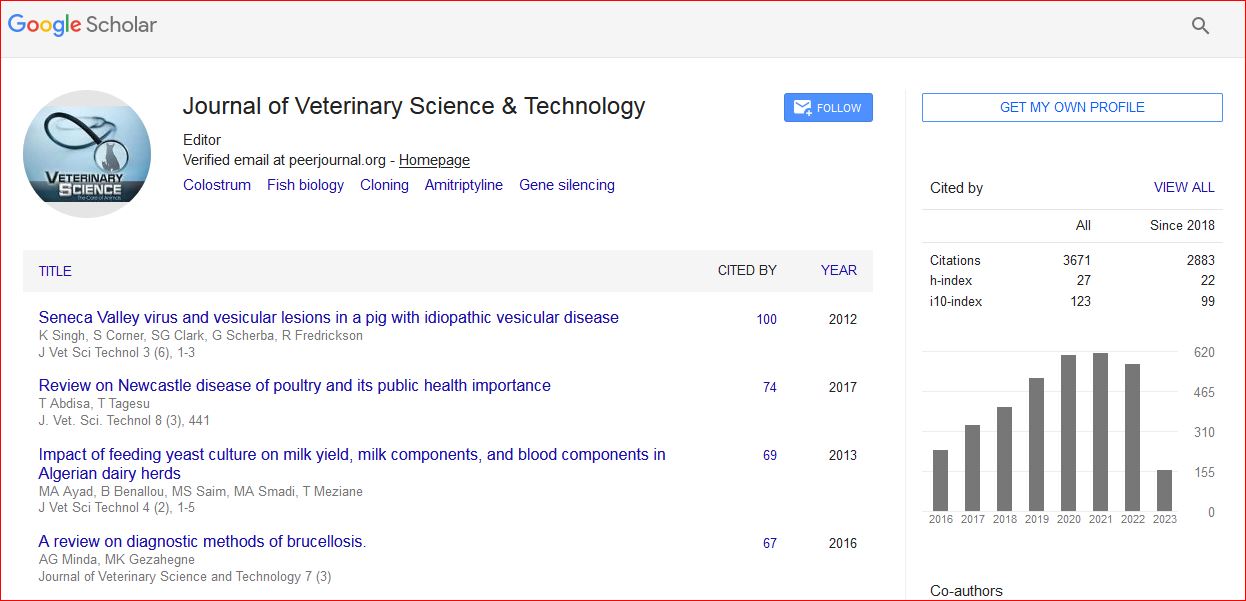
Veterinary Science & Technology received 4472 citations as per Google Scholar report