Brief Report - (2026) Volume 16, Issue 1
Received: 01-Jan-2026, Manuscript No. jccr-26-188947;
Editor assigned: 05-Jan-2026, Pre QC No. P-188947;
Reviewed: 19-Jan-2026, QC No. Q-188947;
Revised: 22-Jan-2026, Manuscript No. R-188947;
Published:
29-Jan-2026
, DOI: 10.37421/2165-7920.2026.16.1700
Citation: Verma, Ayaan. ”Paraneoplastic Cerebellar Degeneration: Diagnosis and Management.” J Clin Case Rep 16 (2026):1700.
Copyright: © 2026 Verma A. This is an open-access article distributed under the terms of the Creative Commons Attribution License, which permits unrestricted use, distribution and reproduction in any medium, provided the original author and source are credited.
Paraneoplastic cerebellar degeneration (PCD) is a rare neurological disorder characterized by the subacute or chronic onset of cerebellar dysfunction, typically presenting as ataxia [1].
This devastating condition arises from an autoimmune response triggered by an underlying malignancy, where antibodies produced against tumor antigens cross-react with neuronal components, particularly in the cerebellum [2].
The clinical presentation of PCD can be highly variable, but progressive ataxia is often the most prominent and debilitating symptom, significantly impacting a patient's quality of life [1].
Recognizing PCD requires a high index of suspicion, especially in patients experiencing rapid neurological deterioration without an obvious cause [1].
The underlying malignancy is often occult at the time of neurological symptom onset, making timely diagnosis and treatment challenging [2].
Autoantibodies play a crucial role in confirming the diagnosis and can sometimes guide the search for the associated cancer [3].
The diagnostic workup for suspected PCD involves a comprehensive approach, including neurological examination, neuroimaging, cerebrospinal fluid analysis, and extensive serological testing for specific autoantibodies [2, 3]. The identification of antibodies such as anti-Yo, anti-Hu, and anti-CV2/CRMP5 is strongly associated with PCD and can provide valuable prognostic information [2].
Managing PCD necessitates a multidisciplinary approach, integrating neurology and oncology expertise [4].
Treatment strategies aim to suppress the autoimmune response and address the underlying malignancy, which can sometimes lead to stabilization or even improvement of neurological symptoms [4].
The heterogeneity of PCD is a significant aspect of the disease, with varying clinical manifestations and associations with different types of cancers [5].
This variability underscores the importance of a thorough oncological investigation to identify the primary tumor, which is essential for effective management [5].
Immunotherapies have emerged as a cornerstone in the treatment of PCD and other paraneoplastic neurological syndromes (PNS) [6].
Clinical trials are actively investigating the efficacy and safety of various immunomodulatory agents, such as intravenous immunoglobulin (IVIg) and rituximab, to halt or reverse the autoimmune-mediated neuronal damage [6].
Understanding the genetic and immunological underpinnings of PCD is crucial for unraveling its pathogenesis [7].
Research into the molecular mechanisms and the role of specific genetic predispositions, such as human leukocyte antigen (HLA) types, is shedding light on disease susceptibility and potential therapeutic targets [7].
Specific antibody subtypes, like anti-Ma2 antibodies, are associated with distinct clinical syndromes and tumor types [8].
In men, anti-Ma2-associated PCD is often linked to testicular germ cell tumors, while in women, it can be associated with ovarian teratomas, highlighting the importance of targeted antibody testing for precise diagnosis [8].
Neuroimaging plays a vital role in the diagnostic process of PCD, with magnetic resonance imaging (MRI) revealing characteristic findings such as cerebellar atrophy [9].
Advanced imaging techniques may also aid in differentiating PCD from other neurological disorders and monitoring disease progression [9].
The diagnostic journey for patients with PCD can be protracted and fraught with challenges, often referred to as a 'diagnostic odyssey' [10].
Early recognition and a systematic investigative approach are paramount to minimize diagnostic delays and initiate timely therapeutic interventions [10].
Paraneoplastic cerebellar degeneration (PCD) is primarily characterized by the rapid progression of ataxia, often serving as the initial neurological manifestation [1].
This condition necessitates a high index of suspicion in patients presenting with acute or subacute neurological deterioration, especially when ataxia is the predominant symptom, enabling prompt diagnosis and management [1].
The clinical spectrum of paraneoplastic neurological syndromes (PNS), with a particular focus on PCD, presents significant diagnostic challenges [2].
PCD frequently displays a strong association with specific autoantibodies, including anti-Yo, anti-Hu, and anti-CV2/CRMP5, which hold implications for both diagnosis and prognosis [2].
A high index of suspicion is crucial given the potential for treatable underlying malignancies [2].
A systematic review highlights the critical diagnostic yield of autoantibody testing in individuals with suspected PCD [3].
Specific antibodies such as anti-Yo, anti-Hu, and anti-CV2/CRMP5 are instrumental in confirming the diagnosis and guiding oncological investigations [3].
These antibodies also offer prognostic value and inform therapeutic strategies [3].
The management of PCD falls under the broader umbrella of paraneoplastic neurological syndromes (PNS) and demands a multidisciplinary approach involving neurologists and oncologists [4].
Treatment modalities encompass immunotherapy, plasma exchange, and tumor-specific interventions, all aimed at halting or potentially reversing neurological damage [4].
Paraneoplastic cerebellar degeneration exhibits considerable heterogeneity, frequently being the inaugural sign of an undetected cancer [5].
Consequently, exhaustive oncological investigations are of paramount importance to identify the underlying malignancy [5].
The frequency of various cancers associated with PCD and the diagnostic methods employed for their detection are key areas of study [5].
A phase II clinical trial investigates the efficacy and safety of diverse immunotherapies for patients with PNS, including PCD [6].
This trial evaluates response rates and safety profiles of treatments like intravenous immunoglobulin (IVIg) and rituximab, providing guidance for clinical decision-making in these complex cases [6].
The genetic and immunological factors contributing to PCD are extensively reviewed, focusing on the autoimmune attack on Purkinje cells and the influence of specific human leukocyte antigen (HLA) types on disease susceptibility [7].
Emerging therapeutic targets are also discussed within this context [7].
Specific subtypes of PCD, such as that associated with anti-Ma2 antibodies, present with distinct clinical features, typical age of onset, and common tumor associations, including testicular germ cell tumors in men and ovarian teratomas in women [8].
Targeted antibody testing is emphasized for accurate diagnosis and management of these cases [8].
Neuroimaging plays a pivotal role in the diagnosis and management of PNS, including PCD [9].
Characteristic MRI findings, such as cerebellar atrophy, are detailed, and the utility of imaging in differentiating PNS from other neurological disorders is explored, including advanced imaging techniques [9].
Patients with PNS, particularly PCD, often experience a prolonged 'diagnostic odyssey' due to broad differential diagnoses and subtle initial symptoms [10].
Increased clinician awareness and a systematic investigative approach are advocated to overcome diagnostic challenges and facilitate timely interventions [10].
Paraneoplastic cerebellar degeneration (PCD) is a neurological disorder characterized by progressive ataxia, often the initial symptom, caused by an autoimmune response to an underlying malignancy. Early suspicion is crucial for timely diagnosis and management. Diagnostic approaches include neurological examination, neuroimaging, CSF analysis, and autoantibody testing, with specific antibodies like anti-Yo and anti-Hu guiding diagnosis and prognosis. Treatment involves a multidisciplinary approach combining immunotherapy and addressing the underlying cancer. PCD exhibits heterogeneity, with various associated cancers and distinct antibody subtypes influencing presentation and management. Neuroimaging, particularly MRI, aids in diagnosis and monitoring. The diagnostic process can be challenging and lengthy, emphasizing the need for increased clinician awareness and systematic investigation.
None
None
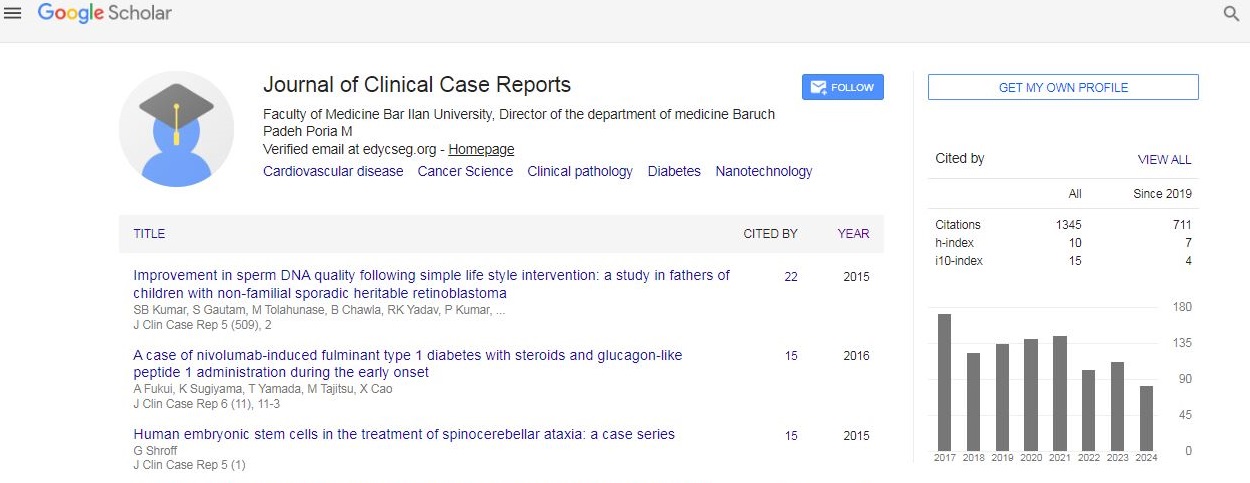
Journal of Clinical Case Reports received 1345 citations as per Google Scholar report