Brief Report - (2025) Volume 18, Issue 3
Received: 30-Apr-2025, Manuscript No. jscb-25-176384;
Editor assigned: 02-May-2025, Pre QC No. P-176384;
Reviewed: 16-May-2025, QC No. Q-176384;
Revised: 23-May-2025, Manuscript No. R-176384;
Published:
30-May-2025
, DOI: 10.37421/0974-7230.2025.18.581
Citation: Nanduri, Aarav. ”Parallel Computing: Performance, Applications, Optimization.” J Comput Sci Syst Biol 18 (2025):581.
Copyright: © 2025 Nanduri A. This is an open-access article distributed under the terms of the Creative Commons Attribution License, which permits unrestricted use, distribution and reproduction in any medium, provided the original author and source are credited.
Parallel computing forms the bedrock of modern computational science, enabling researchers to tackle problems of immense scale and complexity that would be intractable for sequential processing. Its application spans numerous disciplines, driving advancements in areas ranging from fundamental scientific research to complex engineering simulations. The continuous demand for higher performance necessitates ongoing innovation in parallel architectures, algorithms, and resource management strategies. Optimizing resource utilization is a perennial challenge in parallel and distributed systems. A survey on load balancing algorithms in parallel and distributed computing highlights methods for efficient resource allocation and system performance. It details various static and dynamic approaches, analyzing their advantages and limitations in diverse computational scenarios. Researchers consistently emphasize the difficulties in achieving optimal load distribution within increasingly complex and heterogeneous computing environments [1].
Relatedly, comprehensive resource management techniques in parallel computing environments are crucial for system efficiency. A survey reviews strategies to optimize central processing unit (CPU), memory, and input/output (I/O) resources to enhance overall performance, efficiency, and fairness. It underscores the challenges posed by dynamic workloads and heterogeneous architectures, suggesting future research directions for this vital area [5].
Understanding and predicting the performance of parallel applications is critical for effective system operation. One study explores the use of Deep Learning (DL) models for predicting the performance of parallel scientific applications. Neural networks show remarkable accuracy in forecasting execution times, providing invaluable insights for optimizing resource allocation and scheduling on High-Performance Computing (HPC) systems. This advanced approach reduces the need for extensive empirical testing when managing complex workloads [2].
To further this, understanding the models themselves is paramount. A comparative study investigates different parallel computing models and their effectiveness across various scientific applications. The analysis delves into the performance characteristics and scalability of widely used models such as Message Passing Interface (MPI) and Open Multi-Processing (OpenMP), alongside hybrid approaches. This work offers guidance for selecting the most suitable model for specific computational problems and hardware architectures [6].
Parallel computing has profound implications for specialized domains, significantly accelerating computationally intensive tasks. In bioinformatics, parallel techniques are specifically tailored to process massive biological datasets, speeding up critical tasks like genome sequencing, protein structure prediction, and phylogenetic analysis. This review highlights various parallel algorithms and frameworks that boost the efficiency of these demanding applications [3].
For complex physical simulations, hybrid parallel computing offers a powerful solution. Research investigating its use for large-scale lattice-Boltzmann simulations, essential for fluid dynamics and complex systems modeling, reveals how combining different parallel paradigms markedly enhances computational efficiency and scalability. This allows for more detailed and extensive simulations than achievable with traditional sequential methods [4].
Medical imaging also benefits immensely from parallel computing. Solutions for inverse problems, common in this field, leverage parallel algorithms to significantly reduce computational time. This enables faster and more accurate image reconstruction, noise reduction, and parameter estimation, directly improving diagnostic tools in clinical settings [7].
Beyond traditional scientific computing, parallel paradigms are revolutionizing emerging fields like Artificial Intelligence (AI). A review examines the intersection of parallel computing and machine learning, emphasizing how parallelization strategies are crucial for accelerating both the training and inference phases of complex machine learning models. It discusses distributed frameworks, Graphics Processing Unit (GPU) computing, and various parallel algorithms that allow machine learning to handle larger datasets and more sophisticated models, propelling advancements in AI [9].
The drive for sustainable computing has brought energy efficiency to the forefront. A survey delves into techniques and challenges associated with energy-efficient parallel computing, exploring approaches to minimize power consumption in parallel systems. These range from hardware-level optimizations to algorithm-level modifications, highlighting the increasing importance of energy efficiency for sustainable High-Performance Computing (HPC) given the escalating demand for computational power [8].
Looking ahead, parallel computing is set to continue accelerating scientific discovery. A paper discusses current trends and future prospects, underlining how parallel architectures and programming models are indispensable for simulations, data analysis, and modeling across diverse scientific domains. This continuous evolution is necessary to meet the ever-increasing demands of modern scientific research [10].
The landscape of parallel computing is diverse, addressing a spectrum of challenges from resource optimization to performance prediction. A key area involves load balancing, which is critical for distributing tasks efficiently across multiple processors or nodes in parallel and distributed systems. Without effective load balancing, even the most powerful hardware can underperform, leading to wasted resources and slower execution times. The complexities of dynamic workloads and heterogeneous architectures constantly introduce new hurdles for optimal distribution [1].
In High-Performance Computing (HPC), predicting application performance is vital for efficient scheduling and resource allocation. Deep Learning (DL) models are increasingly employed to accurately forecast execution times for parallel scientific applications, minimizing the need for extensive trial-and-error testing. This predictive capability allows system administrators and researchers to make informed decisions about resource provisioning, ensuring applications run optimally [2]. Complementing this, comprehensive resource management techniques are essential. These techniques focus on optimizing CPU, memory, and I/O resources, aiming to improve overall system performance, fairness, and efficiency. The ongoing challenges include managing the variability of workloads and adapting to constantly evolving hardware configurations [5].
Parallel computing proves indispensable for specialized scientific domains. In bioinformatics, for instance, parallelization strategies are tailored to handle immense biological datasets, accelerating crucial processes such as genome sequencing, protein structure prediction, and phylogenetic analysis. These techniques, including specific algorithms and frameworks, dramatically reduce the computational burden, allowing for faster scientific breakthroughs [3]. Similarly, complex simulations like large-scale lattice-Boltzmann modeling, fundamental to fluid dynamics and other intricate systems, benefit significantly from hybrid parallel computing. Combining different parallel paradigms enhances both computational efficiency and scalability, enabling more detailed and comprehensive simulations that would be impossible with traditional methods alone [4].
Choosing the right parallel computing model is crucial for maximizing performance in scientific applications. A comparative study evaluates models such as Message Passing Interface (MPI) and Open Multi-Processing (OpenMP), alongside hybrid approaches, to determine their effectiveness for various computational problems. This research provides essential insights for developers and scientists in selecting the most appropriate parallel programming paradigm for their specific hardware and application needs [6]. In medical imaging, parallel computing offers transformative solutions for inverse problems, accelerating image reconstruction, noise reduction, and parameter estimation. This leads to faster and more precise diagnostic tools, directly enhancing patient care [7]. Furthermore, the growing energy consumption of HPC systems has made energy-efficient parallel computing a critical research area. Techniques span hardware optimizations and algorithmic adjustments, all aimed at minimizing power usage without sacrificing performance, contributing to more sustainable computing practices [8].
The synergy between parallel computing and Artificial Intelligence (AI) is rapidly advancing both fields. Parallelization strategies are fundamental for accelerating the training and inference phases of sophisticated machine learning models. Distributed frameworks and Graphics Processing Unit (GPU) computing are vital tools that enable machine learning to process larger datasets and employ more complex models, driving the cutting edge of AI development [9]. Looking ahead, parallel computing is an indispensable engine for scientific discovery, continuously evolving to meet the escalating demands of modern research. It underpins crucial activities like simulations, data analysis, and modeling across all scientific domains, from fundamental physics to advanced biology, promising further breakthroughs as its capabilities expand [10].
Parallel computing is a cornerstone of modern high-performance systems, essential for tackling complex computational problems across diverse scientific and engineering domains. A survey highlights the importance of load balancing algorithms in parallel and distributed computing, crucial for optimizing resource utilization and system performance by discussing static and dynamic approaches [1]. Deep Learning (DL) models offer a promising avenue for predicting the performance of parallel scientific applications, accurately forecasting execution times to optimize resource allocation and scheduling on High-Performance Computing (HPC) systems without extensive empirical testing [2]. For bioinformatics, parallel computing techniques accelerate the processing of massive biological datasets, speeding up tasks like genome sequencing, protein structure prediction, and phylogenetic analysis through various algorithms and frameworks [3]. Hybrid parallel computing proves effective for large-scale lattice-Boltzmann simulations, enhancing computational efficiency and scalability for fluid dynamics and complex systems modeling by combining different parallel paradigms [4]. Resource management in parallel computing environments is comprehensively reviewed, covering strategies for optimizing CPU, memory, and I/O resources to improve performance, efficiency, and fairness, addressing challenges in dynamic workloads and heterogeneous architectures [5]. A comparative study of parallel computing models, including Message Passing Interface (MPI), Open Multi-Processing (OpenMP), and hybrid approaches, provides insights into their effectiveness for various scientific applications, guiding the choice of suitable models for specific problems and hardware architectures [6]. Parallel computing solutions significantly reduce computational time for inverse problems in medical imaging, enabling faster and more accurate diagnostic tools through image reconstruction, noise reduction, and parameter estimation [7]. Energy-efficient parallel computing is also a critical area, with research exploring techniques from hardware to algorithm levels to minimize power consumption in parallel systems, underscoring its importance for sustainable High-Performance Computing (HPC) given the escalating demand for computational power [8]. The intersection of parallel computing and machine learning reveals how parallelization strategies accelerate the training and inference of complex models, utilizing distributed frameworks and Graphics Processing Unit (GPU) computing to handle larger datasets and drive Artificial Intelligence (AI) advancements [9]. Lastly, parallel computing continues to drive scientific discovery by accelerating simulations, data analysis, and modeling across diverse domains, reflecting its continuous evolution to meet escalating research demands [10].
None
None
Muhammad AWMZA, Rehan U, Rizwan I. "A survey on load balancing algorithms in parallel and distributed computing".The J Supercomput 79 (2023):1746–1781.
Indexed at, Google Scholar, Crossref
Syed HH, Hira H, Kashif AM. "Deep learning for performance prediction of parallel scientific applications".Parallel Comput 111 (2022):102919.
Indexed at, Google Scholar, Crossref
F. AA, M. AA, N. NA. "A review of parallel computing techniques for bioinformatics applications".J King Saud Univ - Comput Inf Sci 35 (2023):1-13.
Indexed at, Google Scholar, Crossref
P. KP, R. KM, A. KM. "Hybrid parallel computing for large-scale lattice-Boltzmann simulations".Parallel Comput 108 (2021):102851.
Indexed at, Google Scholar, Crossref
A. MHA, R. U, R. I. "Resource management in parallel computing: A survey of techniques and challenges".The J Supercomput 78 (2022):17872-17904.
Indexed at, Google Scholar, Crossref
Atul KP, Sarvesh SC, V. S. "A comparative study of parallel computing models for scientific applications".J King Saud Univ - Comput Inf Sci 34 (2022):1007-1017.
Indexed at, Google Scholar, Crossref
A. KS, S. CJ, M. KS. "Parallel computing solutions for inverse problems in medical imaging".J Parallel Distrib Comput 139 (2020):115-126.
Indexed at, Google Scholar, Crossref
Byung-Sik K, Sang-Wook L, Dong-Hyun K. "Energy-efficient parallel computing: A survey of techniques and challenges".IEEE Access 7 (2019):147575-147590.
Indexed at, Google Scholar, Crossref
M. ZH, S. AK, A. R. "Parallel Computing for Machine Learning: A Review".The J Supercomput 78 (2022):790-820.
Indexed at, Google Scholar, Crossref
Syed HH, Kashif AM, Hira H. "Parallel Computing for Accelerating Scientific Discovery: Current Trends and Future Prospects".Parallel Comput 118 (2023):103070.
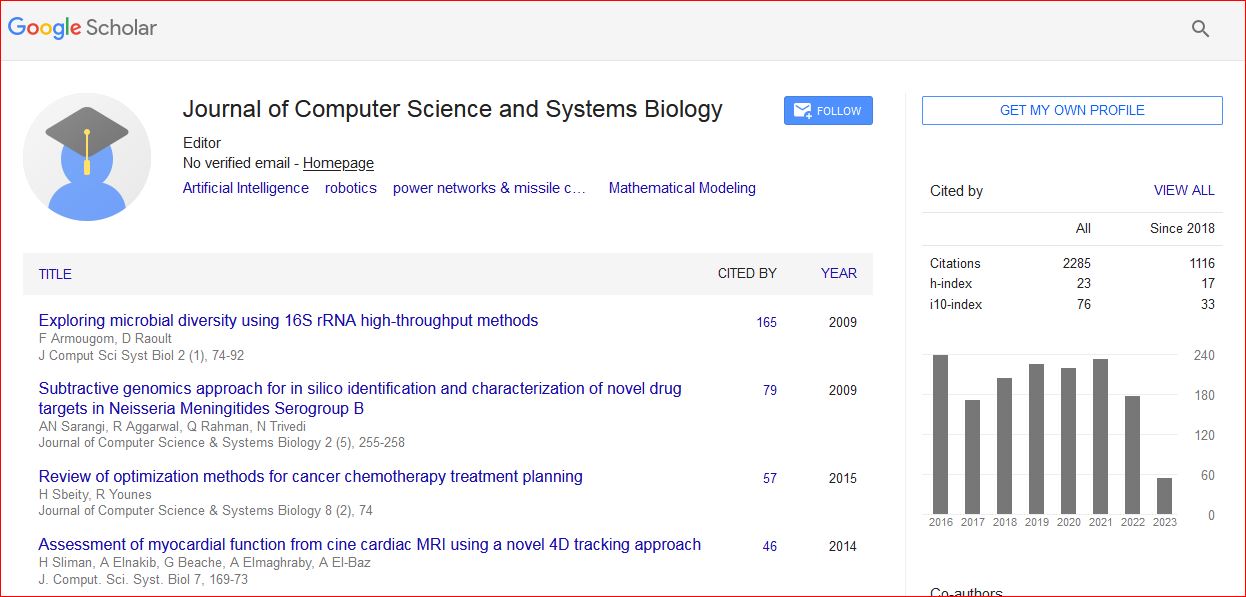
Journal of Computer Science & Systems Biology received 2279 citations as per Google Scholar report