Commentary - (2025) Volume 11, Issue 4
Received: 03-Aug-2025, Manuscript No. abp-25-173837;
Editor assigned: 05-Aug-2025, Pre QC No. P-173837;
Reviewed: 19-Aug-2025, QC No. Q-173837;
Revised: 25-Aug-2025, Manuscript No. R-173837;
Published:
30-Aug-2025
, DOI: 10.37421/2472-0496.2025.11.337
Citation: Nakamura, Ryohei. ”Palliative Care: Comprehensive Support, Global Imperative.” Abnorm Behav Psychol 11 (2025):337.
Copyright: © 2025 Nakamura R. This is an open-access article distributed under the terms of the Creative Commons Attribution License, which permits unrestricted use, distribution and reproduction in any medium, provided the original author and source are credited.
Early integration of palliative care significantly improves the quality of life and symptom management for patients with advanced cancer. This approach also supports their families by addressing emotional and psychosocial needs. Studies highlight that integrating palliative care concurrently with active cancer treatment can lead to better patient outcomes, including improved mood, communication, and potentially even survival in certain contexts, underscoring its crucial role in comprehensive oncology care[1].
Providing palliative care for older adults requires a specialized approach, considering the prevalence of multimorbidity, geriatric syndromes, and unique psychosocial needs. It emphasizes patient-centered care, robust advance care planning, and effective communication to honor patient preferences and autonomy. This targeted care aims to alleviate suffering and enhance the well-being of older adults living with serious illnesses, focusing on their specific context and values[2].
Pediatric palliative care offers comprehensive support to children with life-limiting illnesses and their families, addressing physical, emotional, social, and spiritual dimensions of care. It aims to improve quality of life, manage symptoms effectively, and provide grief and bereavement support. The field is continuously advancing, with global efforts focused on increasing access to specialized services and integrating care from diagnosis onward to ensure the best possible outcomes for these vulnerable patients[3].
Interprofessional education in palliative care is vital for equipping diverse healthcare professionals with the skills and knowledge needed for collaborative practice. This review emphasizes that effective educational programs, which foster teamwork and shared understanding, are essential for enhancing the delivery of holistic care. Investing in such training improves communication, coordination, and the overall quality of care provided to patients and their families facing serious illness[4].
Spiritual care is a fundamental component of comprehensive palliative medicine, addressing the existential concerns, values, and beliefs of patients and their families. This systematic review highlights that integrating spiritual assessments and providing tailored support can significantly improve patients' quality of life, reduce spiritual distress, and offer a sense of peace. It underscores the importance of a multidisciplinary approach, often involving trained chaplains, to meet these profound human needs[5].
The early integration of palliative care for patients with advanced cancer consistently demonstrates significant benefits. This systematic review and meta-analysis confirm that receiving palliative care concurrently with active oncology treatment leads to improved quality of life, reduced symptom burden, and greater patient satisfaction. The evidence strongly supports this model of care as a standard practice to optimize outcomes for individuals navigating serious illness[6].
Effective communication is a cornerstone of high-quality palliative care, particularly when navigating complex discussions about prognosis, treatment options, and end-of-life wishes. This systematic review highlights that specialized communication skills training for clinicians significantly enhances their ability to engage in these sensitive conversations. Such training leads to improved patient and family satisfaction, reduced distress, and better alignment of care with patient values and preferences[7].
Ethical considerations are paramount in palliative care, influencing every decision from informed consent and advance directives to the withdrawal of life-sustaining treatments. This article underscores the importance of upholding patient autonomy, beneficence, and non-maleficence while navigating complex moral dilemmas. A strong ethical framework, coupled with open and compassionate dialogue among patients, families, and the care team, is essential for providing care that respects individual values and promotes dignity[8].
Home-based palliative care provides a preferred care setting for many patients nearing the end of life, significantly improving symptom management and reducing hospitalizations. This systematic review and meta-analysis confirm its effectiveness in enhancing overall quality of life and supporting patients to remain in their familiar environments. It highlights the critical need for robust community-based palliative care services to ensure equitable access and optimize patient-centered outcomes[9].
Global access to palliative care remains profoundly uneven, with substantial disparities in provision and development across different countries. This observational study highlights the urgent necessity for increased global investment, strategic policy integration, and expanded capacity-building initiatives, particularly in low- and middle-income regions. Enhancing access to essential palliative care services is not just a healthcare priority, it is fundamental to achieving universal health coverage and ensuring dignity for all individuals facing serious illness worldwide[10].
Palliative care is a multidisciplinary approach providing comprehensive support to individuals facing serious illnesses and their families. Its early integration, particularly for patients with advanced cancer, demonstrably improves the quality of life, effectively manages symptoms, and addresses emotional and psychosocial needs [1, 6]. Studies confirm that integrating palliative care concurrently with active cancer treatment yields superior patient outcomes, including improved mood, communication, and in some contexts, even extended survival, establishing its crucial role in comprehensive oncology care [1, 6]. Beyond cancer, palliative care requires a specialized approach for older adults, acknowledging the prevalence of multimorbidity, geriatric syndromes, and unique psychosocial needs. This tailored care emphasizes patient-centered planning, robust advance care directives, and clear communication to honor individual preferences and autonomy, ultimately alleviating suffering and enhancing well-being [2]. Pediatric palliative care similarly offers vital comprehensive support to children with life-limiting illnesses and their families, focusing on physical, emotional, social, and spiritual dimensions. It aims to improve quality of life, ensure effective symptom management, and provide essential grief and bereavement support. The field continues to advance globally, striving to increase access to specialized services and integrate care from the point of diagnosis onward [3].
Effective delivery of palliative care relies heavily on skilled healthcare professionals. Interprofessional education is thus crucial for equipping diverse practitioners with the necessary skills and knowledge for collaborative practice [4]. Educational programs that foster teamwork and shared understanding are essential for enhancing the provision of holistic care, leading to improved communication, better coordination, and an elevated quality of care for patients and their families confronting serious illness [4]. Complementing clinical skills, spiritual care is a fundamental component of comprehensive palliative medicine. It addresses the profound existential concerns, values, and beliefs of patients and their families. Systematic reviews highlight that integrating spiritual assessments and providing individualized support can significantly enhance patients' quality of life, reduce spiritual distress, and instill a sense of peace. This often involves a multidisciplinary approach, with trained chaplains playing a key role in meeting these deep human needs [5].
Communication is undeniably a cornerstone of high-quality palliative care, especially when navigating complex and sensitive discussions concerning prognosis, various treatment options, and crucial end-of-life wishes [7]. Dedicated communication skills training for clinicians has been shown to significantly improve their aptitude for engaging in these difficult conversations. Such training directly contributes to enhanced patient and family satisfaction, decreased distress, and a better alignment of care with patient values and preferences [7]. Furthermore, ethical considerations underpin every decision in palliative care, from obtaining informed consent and establishing advance directives to the complex decisions surrounding the withdrawal of life-sustaining treatments [8]. Upholding principles of patient autonomy, beneficence, and non-maleficence is paramount while navigating these moral dilemmas. A robust ethical framework, coupled with open and compassionate dialogue among patients, families, and the entire care team, is essential for delivering care that truly respects individual values and promotes dignity throughout the illness trajectory [8].
The setting of care also plays a significant role in palliative outcomes. Home-based palliative care, for instance, is often the preferred choice for many patients nearing the end of life. This model has been consistently shown to significantly improve symptom management and reduce the necessity for hospitalizations [9]. A systematic review and meta-analysis confirmed its effectiveness in enhancing overall quality of life and enabling patients to remain in their familiar, comforting environments. This evidence underscores the critical need for robust community-based palliative care services to ensure equitable access and optimize patient-centered outcomes [9]. Despite the proven benefits and diverse applications of palliative care, global access remains profoundly uneven, marked by substantial disparities in provision and development across different countries and regions [10]. Observational studies highlight an urgent need for increased global investment, strategic policy integration, and expanded capacity-building initiatives, particularly within low- and middle-income regions. Enhancing access to these essential services is not just a healthcare priority; it is fundamental to achieving universal health coverage and ensuring dignity for all individuals worldwide who are confronting serious illness [10].
Palliative care offers essential, comprehensive support for patients with serious illnesses and their families, significantly improving quality of life and symptom management. Early integration of this care alongside active treatments, particularly for advanced cancer patients, leads to better patient outcomes, including improved mood, communication, and sometimes even survival. Specialized approaches cater to diverse populations like older adults, addressing multimorbidity and emphasizing patient-centered planning, and children with life-limiting conditions, providing physical, emotional, and spiritual support from diagnosis onward. Effective palliative care relies on key elements such as interprofessional education, which equips healthcare professionals with collaborative skills, enhancing teamwork and communication. Spiritual care is a fundamental component, addressing existential concerns, reducing distress, and offering peace, often with the support of chaplains. Proficient communication skills are paramount for clinicians to navigate sensitive discussions about prognosis and end-of-life wishes, leading to greater patient and family satisfaction. Ethical considerations, encompassing patient autonomy and beneficence, are central to guiding complex decisions and promoting dignity. Home-based palliative care models prove effective in improving symptom control and reducing hospitalizations, allowing patients to remain in familiar environments. Despite these advancements and proven efficacy, global access remains profoundly uneven. This disparity necessitates urgent increased investment, strategic policy integration, and capacity-building initiatives, especially in low- and middle-income regions, to achieve universal health coverage and ensure dignity for all individuals worldwide facing serious illness.
None
None
1. Jennifer ST, Joseph AG, Vicki AJ. "Palliative Care for Patients With Cancer".J Clin Oncol 41 (2023):688-695.
Indexed at, Google Scholar, Crossref
2. V. JP, N. CN, J. EF. "Palliative Care for Older Adults".Med Clin North Am 105 (2021):755-772.
Indexed at, Google Scholar, Crossref
3. Pamela SH, Joanne W, Ann G. "Pediatric Palliative Care: A Global Perspective on Progress and Future Directions".J Pain Symptom Manage 60 (2020):614-627.
Indexed at, Google Scholar, Crossref
4. T. F, K. GL, J. PL. "Interprofessional Palliative Care Education: A Systematic Review".J Palliat Med 23 (2020):414-427.
Indexed at, Google Scholar, Crossref
5. Tracy AB, Michael JB, Andrea CE. "Spiritual Care in Palliative Medicine: A Systematic Review of the Literature".J Palliat Med 23 (2020):207-219.
Indexed at, Google Scholar, Crossref
6. Camilla Z, Jennifer ST, Joseph AG. "Early Palliative Care for Patients with Advanced Cancer: A Systematic Review and Meta-analysis".J Clin Oncol 40 (2022):2917-2928.
Indexed at, Google Scholar, Crossref
7. Anthony LB, Robert MA, James AT. "Communication Skills Training for Palliative Care Clinicians: A Systematic Review".J Palliat Med 24 (2021):400-410.
Indexed at, Google Scholar, Crossref
8. Daniel PS, Michael JB, Tracy AB. "Ethics and Palliative Care".J Clin Oncol 40 (2022):351-356.
Indexed at, Google Scholar, Crossref
9. Barbara G, Nancy LGP, Anna-Liisa SKS. "Impact of Home Palliative Care on Symptom Burden, Hospitalizations, and Survival: A Systematic Review and Meta-analysis".J Palliat Med 26 (2023):286-297.
Indexed at, Google Scholar, Crossref
10. Katherine ES, Irene JH, Julia R. "Palliative care development in 100 countries: an observational study".Lancet Glob Health 10 (2022):e477-e487.
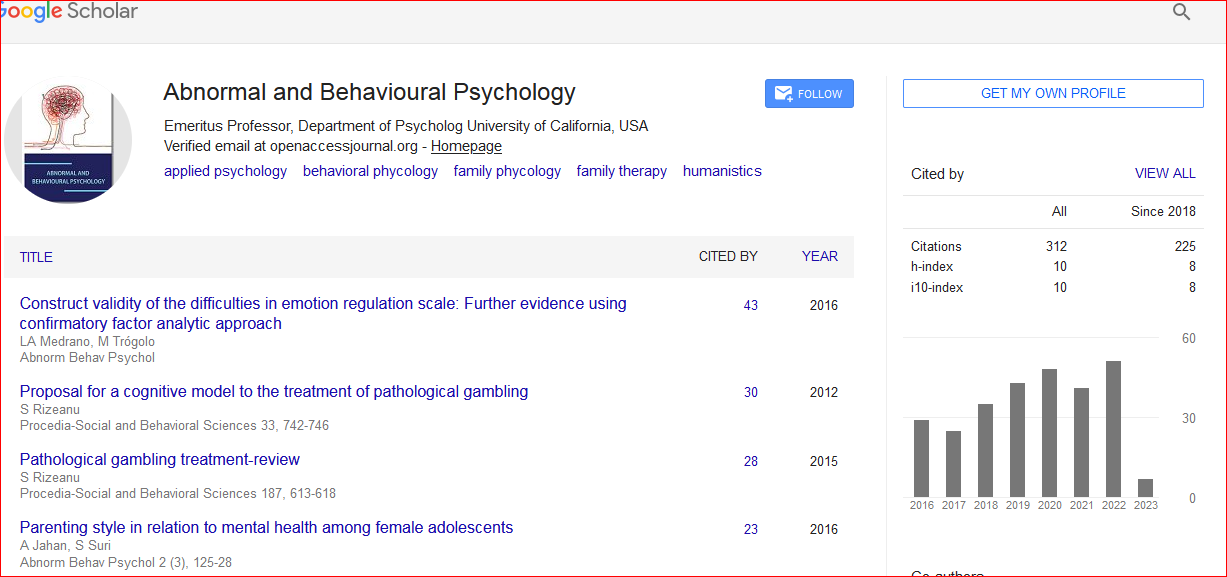
Abnormal and Behavioural Psychology received 361 citations as per Google Scholar report