Short Communication - (2025) Volume 13, Issue 2
Received: 01-Apr-2025, Manuscript No. jcdd-25-175443;
Editor assigned: 03-Apr-2025, Pre QC No. P-175443;
Reviewed: 17-Apr-2025, QC No. Q-175443;
Revised: 22-Apr-2025, Manuscript No. R-175443;
Published:
29-Apr-2025
, DOI: 10.37421/2329-9517.2025.13.664
Citation: Daniel Muller. ”PAD: Comprehensive Diagnosis, Management,
Advancements.” J Cardiovasc Dis Diagn 13 (2025):664.
Copyright: © 2025 M. Daniel This is an open-access article distributed under the terms of the Creative Commons Attribution License, which permits unrestricted use,
distribution and reproduction in any medium, provided the original author and source are credited.
These guidelines from the ESC and ESVS offer a comprehensive, evidence-based approach to diagnosing and managing peripheral arterial diseases. They cover risk factor modification, antiplatelet and anticoagulant therapies, revascularization strategies, and special considerations for various clinical presentations, emphasizing a patient-centered approach to improve outcomes and quality of life for individuals with PAD [1].
A deeper understanding of Peripheral Artery Disease (PAD) begins with clinical assessment, diagnosis, and a range of management strategies. Early detection, often facilitated by tools like the ankle-brachial index, is emphasized as pivotal. Lifestyle adjustments, pharmacotherapy, and revascularization are key components aimed at reducing adverse cardiovascular events and enhancing patient functional independence [2].
When considering revascularization for PAD, synthesizing current evidence on outcomes is vital. This includes assessing how different revascularization techniques influence critical aspects such as limb salvage, symptom resolution, and their broader impact on long-term cardiovascular health. These insights provide clinicians with the necessary data for making informed decisions on the most effective timing and method of intervention [3].
The field of pharmacotherapy for peripheral artery disease is continuously evolving, featuring both well-established treatments and innovative new agents. This area explores antiplatelet, anticoagulant, and lipid-lowering therapies as foundational elements, alongside emerging drug classes that specifically target inflammation and angiogenesis. Such a broad scope offers a valuable framework for symptom management, preventing disease progression, and ultimately improving patient outcomes through tailored medication regimens [4].
Diagnostic imaging is central to effective PAD management, offering detailed insights into vascular pathology. Current modalities, including duplex ultrasound, CT angiography, and MR angiography, each possess distinct strengths and limitations. The continuous pursuit of advancements in imaging technology is set to deliver more accurate and less invasive diagnostic and staging capabilities, which are indispensable for crafting personalized treatment plans for each patient [5].
Supervised exercise therapy stands out as a highly effective, non-invasive treatment option for patients with peripheral artery disease. Findings from systematic reviews and meta-analyses consistently underscore its efficacy as a cornerstone of conservative management. Patients undergoing these structured exercise programs typically experience substantial improvements in critical functional parameters such as walking distance, pain-free walking ability, and their overall quality of life, confirming its role as a vital first-line intervention [6].
Recent advancements in endovascular therapy have profoundly impacted the treatment of Critical Limb Ischemia (CLI), which represents the most severe form of peripheral artery disease. Pivotal clinical trials have showcased how innovative techniques and state-of-the-art devices are significantly improving rates of revascularization success, thereby enhancing limb salvage rates and improving patient outcomes. This progress is crucial in reducing the incidence of major amputations and improving the long-term prospects for these high-risk individuals [7].
Delving into the genetic underpinnings of peripheral artery disease offers crucial insights into disease susceptibility and progression. This research area explores various genetic variants and intricate molecular pathways that contribute to PAD development. A deeper understanding of these genetic factors holds the promise of leading to more personalized risk assessments and the development of highly targeted therapeutic interventions, paving the way for precision medicine in PAD [8].
Acknowledging and addressing the significant racial and ethnic disparities prevalent in the incidence, management, and outcomes of peripheral artery disease is a critical public health priority. This review highlights how complex socioeconomic factors, unequal access to quality healthcare, and embedded systemic biases collectively contribute to a disproportionate burden of PAD among certain populations. It strongly emphasizes the urgent imperative for developing equitable strategies in screening, diagnosis, and treatment to rectify these deep-seated inequalities and ensure fair access to care for all [9].
For patients with peripheral artery disease facing barriers to supervised facilities, home-based exercise programs emerge as a practical and beneficial alternative. Systematic reviews and meta-analyses indicate that while these programs might offer a slightly lesser impact compared to supervised regimens, they nonetheless provide valuable benefits in terms of improving walking performance and overall quality of life. This makes them a crucial option for expanding access to effective rehabilitation [10].
Peripheral Artery Disease (PAD) necessitates a holistic and evidence-based approach to both diagnosis and management. Expert guidelines, such as those from the ESC and ESVS, provide a comprehensive framework that addresses critical aspects like risk factor modification, various therapeutic strategies, and specific considerations for diverse clinical presentations [1]. This foundation is crucial for enhancing patient outcomes and their overall quality of life. Moreover, an in-depth understanding of PAD's clinical assessment, accurate diagnosis, and varied management strategies is paramount. This includes emphasizing early detection through tools like the ankle-brachial index, alongside a careful balance of lifestyle interventions, pharmacotherapy, and revascularization, all designed to curtail cardiovascular events and improve functional status [2].
A critical area within PAD management focuses on revascularization procedures. Current evidence, often synthesized through systematic reviews and meta-analyses, highlights the substantial effectiveness of different revascularization techniques. These interventions are vital for improving limb salvage rates, significantly reducing symptomatic burden, and positively influencing long-term cardiovascular events [3]. The insights derived from such studies are invaluable for clinical decision-making, particularly concerning the optimal timing and method of intervention. Building on this, recent advancements in endovascular therapy are particularly noteworthy in the context of Critical Limb Ischemia (CLI), the most severe manifestation of PAD. Findings from pivotal clinical trials clearly demonstrate how innovative techniques and advanced devices are improving revascularization success, thereby enhancing limb salvage rates and patient outcomes, ultimately diminishing the need for major amputations [7].
Pharmacotherapy plays a foundational role in the comprehensive treatment of peripheral artery disease. A thorough review of this landscape encompasses both well-established and emerging therapeutic agents. It delves into the efficacy of antiplatelet, anticoagulant, and lipid-lowering therapies, which form the bedrock of medical management. Furthermore, it explores novel drugs that specifically target underlying inflammatory processes and angiogenesis. This provides a valuable overview of how medication can effectively manage symptoms, halt disease progression, and ultimately contribute to improved patient outcomes by addressing various pathophysiological pathways [4].
Conservative management, particularly through exercise therapy, is a cornerstone of PAD treatment. Supervised exercise programs have been rigorously assessed, with systematic reviews and meta-analyses strongly supporting their efficacy. These programs are recognized for their ability to significantly improve walking distance, increase pain-free walking time, and enhance the overall quality of life for patients. This consistent evidence underscores their importance as a first-line treatment [6]. Recognizing practical limitations, home-based exercise programs also present a valuable alternative for patients with limited access to supervised facilities. While potentially less intensive, these programs still offer substantial benefits in improving walking performance and quality of life, demonstrating their utility as a practical, accessible option for rehabilitation [10].
The role of diagnostic imaging in peripheral artery disease is indispensable for accurate assessment and tailored treatment. This area of study meticulously outlines the strengths and limitations inherent in current modalities such as duplex ultrasound, CT angiography, and MR angiography. Beyond current capabilities, it also looks towards future directions in imaging technology. The anticipated advancements promise more precise and less invasive methods for diagnosing and staging PAD, which is a key element for developing highly individualized treatment plans that optimize patient care [5].
Beyond direct clinical interventions, research increasingly highlights the importance of understanding the genetic underpinnings of peripheral artery disease. This includes exploring various genetic variants and molecular pathways that are implicated in PAD susceptibility and progression. A deeper comprehension of these genetic factors is expected to lead to more personalized risk assessments and the development of targeted therapeutic interventions, marking a significant step towards precision medicine [8]. Additionally, critical reviews draw attention to the substantial racial and ethnic disparities observed in the incidence, management, and outcomes of PAD. These disparities are often linked to complex socioeconomic factors, unequal healthcare access, and systemic biases, highlighting an urgent need for equitable strategies in screening, diagnosis, and treatment to ensure fair and effective care for all populations [9].
Comprehensive guidelines from organizations like ESC and ESVS offer an evidence-based framework for diagnosing and managing peripheral arterial diseases, encompassing risk factor modification, antiplatelet/anticoagulant therapies, and revascularization, with a focus on patient outcomes and quality of life. Early detection of Peripheral Artery Disease (PAD) via tools like the ankle-brachial index is crucial. Management strategies combine lifestyle interventions, pharmacotherapy, and revascularization to mitigate cardiovascular events and enhance functional status. Systematic reviews highlight the effectiveness of various revascularization techniques in improving limb salvage, symptom reduction, and influencing long-term cardiovascular events, guiding clinical decision-making on intervention timing. Pharmacotherapy for PAD involves established antiplatelet, anticoagulant, and lipid-lowering therapies, alongside novel drugs targeting inflammation and angiogenesis, providing a comprehensive approach to symptom management and disease progression prevention. Diagnostic imaging, utilizing modalities such as duplex ultrasound, CT angiography, and MR angiography, is vital. Ongoing advancements promise more accurate and less invasive diagnosis and staging, which is essential for developing tailored treatment plans. Supervised exercise therapy is a proven cornerstone of conservative PAD management, leading to significant improvements in walking distance, pain-free walking, and overall quality of life. Advances in endovascular therapy for Critical Limb Ischemia (CLI) are enhancing revascularization success and limb salvage rates, considerably reducing the need for major amputations. Research into the genetic underpinnings of PAD identifies variants and pathways implicated in susceptibility and progression, suggesting potential for personalized risk assessment and targeted therapies. Significant racial and ethnic disparities in PAD incidence, management, and outcomes underscore the urgent need for equitable strategies in screening, diagnosis, and treatment, addressing socioeconomic factors and healthcare access. Home-based exercise programs offer a practical and beneficial alternative for improving walking performance and quality of life in PAD patients, particularly those with limited access to supervised facilities.
Indexed at, Google Scholar, Crossref
Indexed at, Google Scholar, Crossref
Indexed at, Google Scholar, Crossref
Indexed at, Google Scholar, Crossref
Indexed at, Google Scholar, Crossref
Indexed at, Google Scholar, Crossref
Indexed at, Google Scholar, Crossref
Indexed at, Google Scholar, Crossref
Indexed at, Google Scholar, Crossref
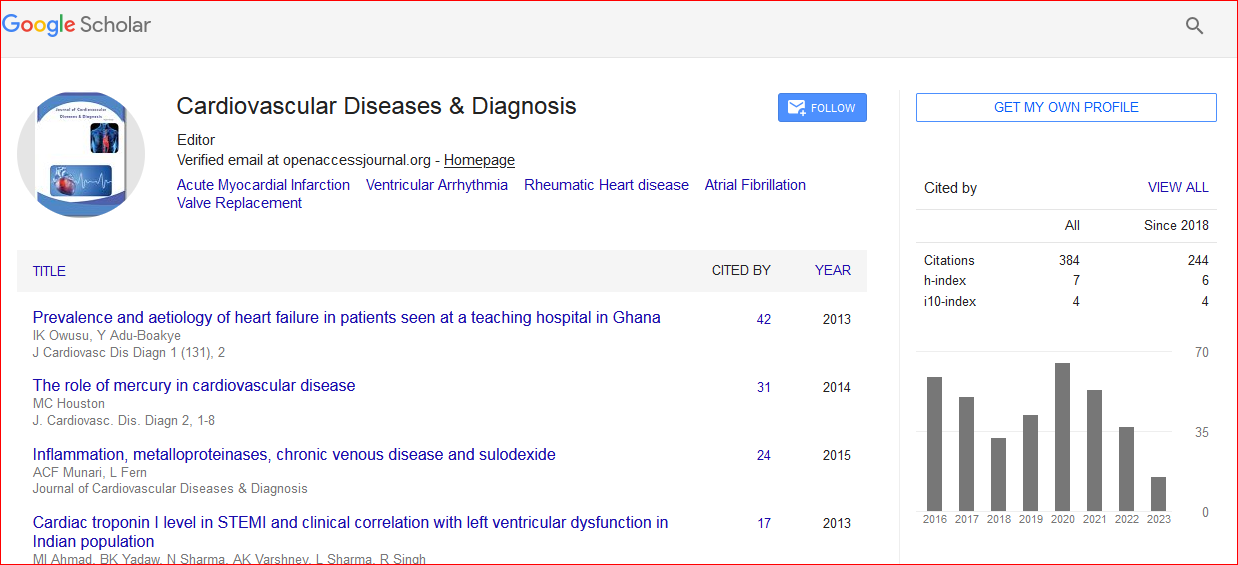
Cardiovascular Diseases & Diagnosis received 427 citations as per Google Scholar report