Short Communication - (2025) Volume 17, Issue 3
Received: 01-May-2025, Manuscript No. jcst-25-172466;
Editor assigned: 05-May-2025, Pre QC No. P-172466;
Reviewed: 19-May-2025, QC No. Q-172466;
Revised: 22-May-2025, Manuscript No. R-172466;
Published:
29-May-2025
, DOI: 10.37421/1948-5956.2025.17.710
Citation: Sato, Yuki. ”Overcoming Cancer Resistance: Mechanisms,
Technologies, Therapies.” J Cancer Sci Ther 17 (2025):710.
Copyright: © 2025 Sato Y. This is an open-access article distributed under the terms of the Creative Commons Attribution License, which permits unrestricted use, distribution
and reproduction in any medium, provided the original author and source are credited.
The field of cancer research continually seeks to overcome the complex mechanisms by which tumors resist therapy and evade immune responses. A significant hurdle lies in understanding how cancer cells manage to sidestep the immune system, even after an initial positive reaction to checkpoint inhibitors. This evasion involves both intrinsic mechanisms within the tumor and extrinsic factors present in the intricate tumor microenvironment, highlighting the persistent challenge of resistance and the ongoing quest for effective countermeasures [1].
The tumor microenvironment itself is a dynamic ecosystem, comprising immune cells, stromal cells, and the extracellular matrix. These components collectively play a critical role in facilitating tumor growth, metastasis, and therapy resistance. Unraveling these intricate interactions provides crucial insights, pointing towards novel therapeutic targets that could disrupt these supportive pathways [2].
Beyond conventional treatments, advanced technologies are reshaping cancer diagnostics and therapeutics. CRISPR-Cas technology, for example, is now being applied beyond its foundational role in gene editing. It offers avenues for highly sensitive cancer diagnostics and introduces innovative therapeutic strategies, such as precise gene disruption or modulating immune responses to specifically target tumors [3].
Similarly, liquid biopsies represent a transformative leap towards personalized cancer management. By analyzing circulating tumor cells, cell-free Deoxyribonucleic Acid (DNA), and exosomes, these non-invasive methods enable early cancer detection, effective monitoring of treatment responses, and early identification of emergent resistance mechanisms [4].
One key aspect of therapeutic resistance involves the metabolic adaptations within cancer cells. These cells often reprogram their metabolic pathways, relying heavily on glucose or glutamine metabolism to fuel their aggressive proliferation and survival. Strategies aimed at targeting these altered metabolic processes hold promise, not only for resensitizing tumors to existing drugs but also for developing entirely new therapeutic approaches that exploit these vulnerabilities [5].
Parallel to this, epigenetic alterations, including changes in DNA methylation and histone modifications, are recognized as significant drivers of cancer development and progression. Epigenetic drugs, designed to reverse these detrimental changes, are emerging as promising components in cancer therapy, frequently employed in combination with other treatments to enhance efficacy [6].
While Chimeric Antigen Receptor (CAR) T cell therapy has achieved remarkable success in treating hematological malignancies, its application to solid tumors presents unique and substantial challenges. Issues such as antigen heterogeneity, the highly suppressive nature of the solid tumor microenvironment, and difficulties with T cell trafficking within these tumors must be addressed. Ongoing research is focused on developing innovative strategies to overcome these hurdles and enhance the therapeutic efficacy of CAR T cells against solid tumors [7].
Furthermore, cancer stem cells (CSCs) are increasingly recognized for their critical role in driving tumor recurrence, metastatic spread, and resistance to standard therapies. These cells possess distinct self-renewal and differentiation capabilities, making their selective eradication a vital objective for achieving durable clinical responses [8].
The integration of Artificial Intelligence (AI) and Machine Learning (ML) is profoundly impacting cancer drug discovery and development. These advanced computational approaches accelerate various stages, from initial target identification and lead optimization to refining clinical trial designs and selecting patients for highly personalized therapies [9].
Finally, a deeper understanding of cancer cell plasticity, defined as their inherent ability to alter phenotype and function, is becoming increasingly critical. This plasticity is a fundamental driver of tumor heterogeneity, metastatic dissemination, and resistance to targeted treatments, marking it as a key area for future therapeutic intervention and the development of more effective, lasting cancer treatments [10].
Understanding the multifaceted nature of cancer involves dissecting both its inherent cellular behaviors and its interactions with the surrounding environment. Cancer cells demonstrate a sophisticated capacity to evade the immune system, even after patients initially respond positively to immune checkpoint inhibitors. This resistance is not singular; it stems from a combination of intrinsic tumor mechanisms and various extrinsic factors within the tumor microenvironment, highlighting a complex landscape that researchers are actively working to decipher and overcome [1]. The tumor microenvironment itself is a dynamic and intricate system, consisting of immune cells, stromal cells, and the extracellular matrix. These elements are not passive bystanders; they actively conspire to promote tumor growth, facilitate metastasis, and contribute significantly to therapy resistance, offering a rich area for identifying new therapeutic targets [2].
Advances in technology are providing unprecedented tools for combating cancer. For instance, CRISPR-Cas systems, originally lauded for their gene-editing capabilities, are now being harnessed for broader applications in oncology. These applications range from developing highly sensitive diagnostic platforms to crafting novel therapeutic strategies, such as precise gene disruption or the modulation of immune responses against cancerous cells [3]. Concurrently, the rise of liquid biopsies represents a monumental shift towards personalized cancer management. By analyzing circulating tumor cells, cell-free Deoxyribonucleic Acid (DNA), or exosomes present in bodily fluids, these non-invasive techniques allow for earlier detection, more accurate monitoring of treatment response, and the timely identification of resistance mechanisms, thereby tailoring treatments to individual patient needs [4].
A critical aspect of tumor survival and drug resistance involves metabolic reprogramming. Cancer cells are adept at altering their metabolic pathways, often favoring glucose or glutamine metabolism, to sustain rapid proliferation and adapt to nutrient-poor environments. Developing therapeutic strategies to specifically target these altered metabolic pathways holds substantial promise. Such approaches could not only resensitize tumors to existing drugs, making them effective again, but also open pathways for entirely new classes of cancer treatments [5]. Furthermore, epigenetic alterations, encompassing modifications like DNA methylation and histone changes, are widely recognized as key drivers in both the initiation and progression of various cancers. Drugs designed to reverse these epigenetic changes are showing considerable potential in cancer therapy, frequently integrated into combination regimens to bolster overall therapeutic efficacy [6].
Chimeric Antigen Receptor (CAR) T cell therapy has revolutionized the treatment landscape for hematological malignancies, offering profound and lasting responses. However, its successful translation to solid tumors faces substantial obstacles. Key challenges include the heterogeneity of antigens expressed on solid tumor cells, the profoundly suppressive nature of the solid tumor microenvironment, and practical issues concerning T cell trafficking and persistence within these complex structures. Ongoing research is intensely focused on devising innovative strategies to overcome these specific hurdles, aiming to unlock the full potential of CAR T cell therapy for a wider range of cancers [7]. In parallel, cancer stem cells (CSCs) are recognized as critical players in the insidious processes of tumor recurrence, metastatic dissemination, and inherent resistance to conventional therapeutic modalities. Their unique properties of self-renewal and differentiation make them formidable adversaries, and strategies specifically designed to eradicate CSCs are being pursued as a path towards achieving more durable and curative clinical responses [8].
The integration of Artificial Intelligence (AI) and Machine Learning (ML) is rapidly transforming the entire pipeline of cancer drug discovery and development. From the initial stages of identifying promising molecular targets and optimizing lead compounds to streamlining clinical trial designs and precisely selecting patients for individualized therapies, AI provides unparalleled efficiency and insight [9]. Finally, the concept of cancer cell plasticity â?? the remarkable ability of cancer cells to change their phenotype and function â?? is increasingly recognized as a fundamental mechanism driving several undesirable tumor characteristics. This plasticity fuels tumor heterogeneity, facilitates metastatic spread, and contributes significantly to the development of resistance against targeted therapies. Understanding and ultimately intervening with this plasticity represents a crucial frontier for future therapeutic development, promising to unlock more effective and enduring cancer treatments [10].
Cancer cells exhibit remarkable abilities to evade the immune system and develop resistance to therapies, often through intrinsic tumor mechanisms and interactions within the tumor microenvironment. This complexity means that even initial responses to checkpoint inhibitors can be overcome, requiring deeper understanding of resistance pathways. The intricate components of the tumor microenvironment, including immune cells, stromal cells, and the extracellular matrix, are known to significantly contribute to tumor growth, metastasis, and therapy resistance, highlighting it as a crucial area for new therapeutic targets. Cutting-edge technologies like CRISPR-Cas are extending beyond gene editing, offering highly sensitive diagnostic tools and innovative therapeutic strategies, such as targeted gene disruption or modulation of anti-tumor immune responses. Furthermore, liquid biopsies are revolutionizing cancer management by enabling non-invasive detection, monitoring treatment efficacy, and identifying resistance, thereby paving the way for personalized medicine. These methods analyze circulating tumor cells, cell-free Deoxyribonucleic Acid (DNA), and exosomes. Resistance mechanisms are also rooted in metabolic adaptations, where cancer cells reprogram pathways like glucose or glutamine metabolism. Targeting these altered pathways could resensitize tumors to existing drugs and foster new therapeutic approaches. Epigenetic alterations, such as DNA methylation and histone modifications, also drive cancer progression, and epigenetic drugs show promise in reversing these changes and their promising role in cancer therapy, often in combination with other treatments. While Chimeric Antigen Receptor (CAR) T cell therapy has transformed hematological cancer treatment, its application to solid tumors faces hurdles like antigen heterogeneity and suppressive microenvironments. Addressing these challenges is key to enhancing efficacy. Cancer stem cells (CSCs) are central to tumor recurrence, metastasis, and therapy resistance due to their self-renewal properties, making their eradication a critical strategy for durable clinical responses. Recent advances also feature the transformative impact of Artificial Intelligence (AI) and Machine Learning (ML) in accelerating drug discovery, from target identification to personalized patient selection. Additionally, recognizing cancer cell plasticity, their capacity to change phenotype and function, is crucial for understanding tumor heterogeneity, metastasis, and resistance to targeted therapies, marking it as a significant area for future intervention.
Indexed at, Google Scholar, Crossref
Indexed at, Google Scholar, Crossref
Indexed at, Google Scholar, Crossref
Indexed at, Google Scholar, Crossref
Indexed at, Google Scholar, Crossref
Indexed at, Google Scholar, Crossref
Indexed at, Google Scholar, Crossref
Indexed at, Google Scholar, Crossref
Indexed at, Google Scholar, Crossref
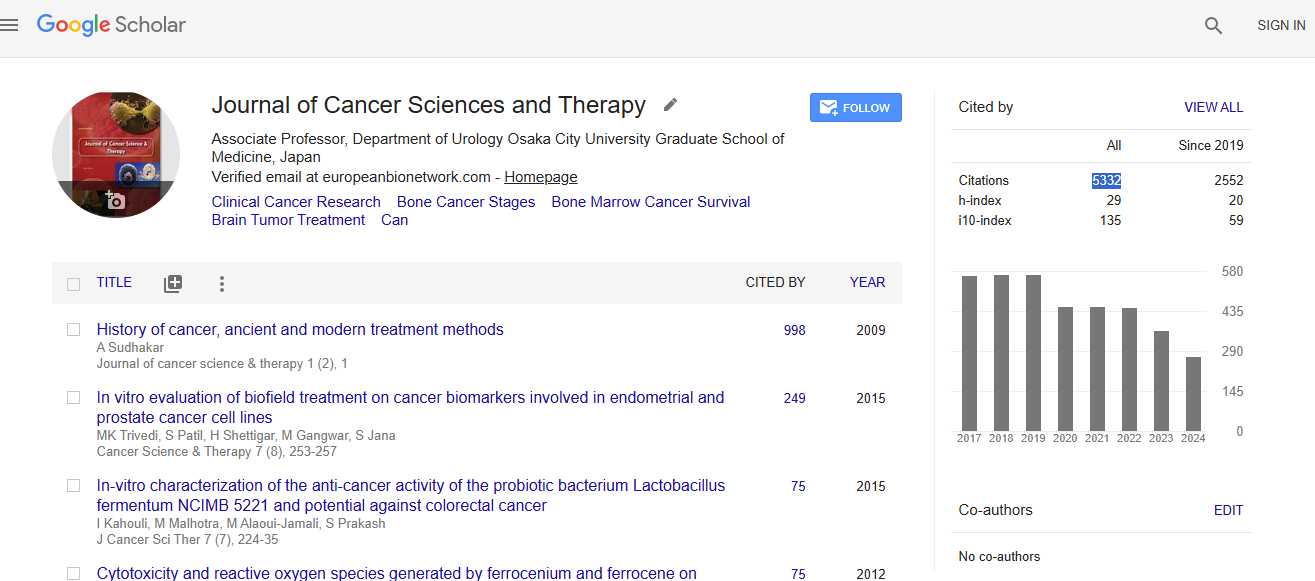
Cancer Science & Therapy received 5332 citations as per Google Scholar report