Brief Report - (2025) Volume 17, Issue 5
Received: 01-Sep-2025, Manuscript No. jcst-25-176296;
Editor assigned: 03-Sep-2025, Pre QC No. P-176296;
Reviewed: 17-Sep-2025, QC No. Q-176296;
Revised: 22-Sep-2025, Manuscript No. R-176296;
Published:
29-Sep-2025
, DOI: 10.37421/1948-5956.2025.17.721
Citation: Rahimi, Noor. ”Overcoming Cancer Resistance: Mechanisms
and Strategies.” J Cancer Sci Ther 17 (2025):721.
Copyright: © 2025 Rahimi N. This is an open-access article distributed under the terms of the Creative Commons Attribution License, which permits unrestricted use,
distribution and reproduction in any medium, provided the original author and source are credited.
Cancer cells frequently develop sophisticated strategies to resist targeted therapies, involving key mechanisms such as secondary mutations, alterations in critical signaling pathways, and complex adaptive responses to therapeutic pressure. A thorough understanding of these underlying biological processes is absolutely crucial for the successful design of more effective, multi-pronged combinatorial treatment strategies in oncology [1].
In lung cancer, for instance, therapy resistance presents as a particularly multifaceted challenge, illustrating a complex and dynamic interplay between specific genetic mutations, the surrounding tumor microenvironment, and the host's intrinsic immune response. This intricate relationship unequivocally highlights the critical need for advanced combination therapies that are specifically tailored to address these diverse and interwoven resistance mechanisms simultaneously [2].
The ongoing endeavor to overcome therapy resistance in cancer confronts continuous and substantial challenges, primarily because resistance often arises from highly intricate and dynamic molecular adaptations within the cancer cells and their environment. This reality strongly suggests that future therapeutic strategies must prioritize the rigorous identification and precise targeting of these adaptive pathways to significantly improve long-term patient outcomes and treatment durability [3].
Resistance to immune checkpoint inhibitors (ICIs) manifests in various forms, encompassing both primary (pre-existing) and acquired (developed during treatment) resistance. Multiple factors converge to contribute to this treatment failure, including specific elements and characteristics within the tumor microenvironment, intrinsic properties of the tumor itself, and broader host-related immunological factors that influence treatment response [4].
Drug resistance in the field of oncology is, without question, a profoundly complex problem, stemming from an astonishingly diverse array of cellular and molecular mechanisms. Cultivating a deep and nuanced understanding of these myriad mechanisms is not merely beneficial but absolutely essential for the successful development of truly novel therapeutic strategies engineered to overcome resistance and ultimately enhance patient prognosis and quality of life [5].
A recent comprehensive review offers the latest and most critical insights into the molecular mechanisms driving resistance to a wide spectrum of anti-cancer therapies, including advanced targeted drugs and immunotherapies. This review underscores the inherently dynamic nature of resistance development, illustrating how cancer cells continuously evolve under selective pressure, and emphasizes the significant potential that well-designed combination approaches hold to successfully circumvent these evolving resistance pathways [6].
The tumor microenvironment (TME) indisputably plays a truly pivotal and often underappreciated role in mediating therapy resistance. The intricate web of complex interactions among tumor cells, their surrounding stromal components, various immune cells, and the extracellular matrix collectively creates a protective and highly specialized niche. This niche effectively empowers cancer cells to evade therapeutic interventions, acting as a sanctuary against treatment [7].
Beyond genetic mutations, epigenetic modifications also emerge as significant contributors to drug resistance, a phenomenon particularly well-observed in breast cancer. This involves various epigenetic mechanisms, such as specific DNA methylation patterns and a range of histone modifications, which lead to profound alterations in gene expression patterns that ultimately result in therapy failure and progression [8].
Encouragingly, new insights and emerging strategies focused on overcoming therapeutic resistance in cancer are providing a comprehensive overview of novel and promising approaches. These include the development of innovative combination therapies, the strategic repurposing of existing drugs for new indications, and directly targeting the specific pathways that drive resistance, all offering considerable hope for significantly improved patient outcomes in the future [9].
Finally, precision medicine approaches hold substantial promise in effectively tackling the pervasive challenge of therapy resistance in cancer. Emphasizing patient-specific molecular profiling is vital for both accurately predicting the likelihood of resistance and developing strategies to circumvent these mechanisms, thereby leading to dramatically enhanced treatment efficacy and a truly personalized therapeutic approach tailored to each individual patient [10].
Cancer therapy resistance stands as one of the most significant obstacles in modern oncology, arising from a sophisticated and intricate interplay of diverse cellular and molecular mechanisms [5]. This pervasive phenomenon manifests through various pathways, including the acquisition of secondary mutations, significant alterations in crucial signaling pathways, and complex adaptive cellular responses that collectively enable cancer cells to effectively evade the intended effects of targeted treatments [1]. A comprehensive and nuanced understanding of the dynamic nature of these resistance mechanisms is not merely beneficial but absolutely paramount for the successful development and implementation of more effective and sustained therapeutic strategies, ultimately aiming to improve long-term patient outcomes [6]. The challenge is inherently multifaceted, frequently demanding a holistic and integrated approach to meticulously identify and strategically address the intricate underlying biological underpinnings.
The emergence of resistance frequently stems from highly intricate molecular adaptations within the cancer cells themselves [3]. For instance, when cancer cells are exposed to targeted therapies, they possess an extraordinary capacity to evolve new genetic mutations that can either directly bypass the drug's mechanism of action or activate alternative, compensatory survival pathways that render the initial therapy ineffective [1]. These intrinsic tumor characteristics, which include genetic heterogeneity and genomic instability, contribute profoundly to eventual treatment failure, vividly illustrating the remarkable adaptability and selective pressure resilience of malignant cells when confronted with therapeutic agents [4]. Recognizing and characterizing these continuously evolving mechanisms is an essential first step towards designing next-generation therapies capable of maintaining therapeutic efficacy over extended periods.
Beyond the intrinsic changes within the tumor cells, the broader external environment profoundly influences the development and maintenance of drug resistance. The tumor microenvironment (TME) plays an unequivocally pivotal role in mediating therapy resistance, primarily through a complex and dynamic network of interactions. This network involves direct communication between tumor cells and their surrounding stromal components, various immune cells (some of which can be co-opted by the tumor), and the intricate extracellular matrix [7]. Collectively, this supportive and often immunosuppressive niche creates a sanctuary that enables cancer cells to effectively evade therapeutic interventions. In the context of lung cancer, for example, therapy resistance is a direct consequence of a delicate and complex interplay between specific genetic mutations, the characteristics of the surrounding TME, and the host's systemic immune response, thereby underscoring the critical need for combination therapies that are designed to simultaneously address these broader contextual factors [2]. Similarly, resistance to immune checkpoint inhibitors (ICIs) can be heavily influenced by factors residing within the TME and the state of host immunity, alongside the intrinsic properties of the tumor itself, presenting a significant hurdle for immunotherapy success [4].
Furthermore, epigenetic modifications represent another significant and often overlooked layer contributing to drug resistance. These mechanisms, which include specific patterns of DNA methylation and a diverse range of histone modifications, lead to profound alterations in gene expression patterns without introducing any changes to the underlying DNA sequence. This capacity to reprogram gene activity ultimately contributes to therapy failure, a phenomenon particularly well-observed in breast cancer models [8]. The implication here is that novel therapeutic approaches targeting these epigenetic regulators could offer a viable and potent strategy to overcome certain types of acquired resistance, by reverting cells to a more drug-sensitive state. These epigenetic changes highlight yet another sophisticated mechanism that cancer cells exploit to ensure their survival against therapeutic attacks.
Given the multifaceted nature of these challenges, the development of novel and emerging strategies is absolutely critical for effectively overcoming therapeutic resistance in cancer [9]. These innovative approaches encompass developing sophisticated combination therapies that simultaneously target multiple resistance-driving pathways, strategically repurposing existing drugs to counteract newly identified resistance mechanisms, and directly targeting the specific molecular pathways that are known to drive the development of resistance [9]. Moreover, the application of precision medicine approaches is increasingly recognized as crucial. These strategies leverage detailed patient-specific molecular profiling to not only predict the likelihood of resistance but also to devise proactive strategies to circumvent these mechanisms from the outset. This highly personalized approach aims to significantly enhance treatment efficacy, reduce toxicity, and tailor therapies more effectively to the unique biological landscape of individual patients, promising more durable and impactful responses in the ongoing battle against cancer [10].
Cancer cells often develop resistance to therapies, a complex issue driven by diverse mechanisms. These include secondary mutations, alterations in signaling pathways, and adaptive responses to targeted treatments. Resistance in specific cancers, like lung cancer, stems from an interplay of genetic mutations, the tumor microenvironment, and host immunity, underscoring the need for combination therapies. Overcoming this resistance presents ongoing challenges, as it frequently involves intricate molecular adaptations that future strategies must target. Immune checkpoint inhibitor resistance, both primary and acquired, involves factors within the tumor microenvironment, intrinsic tumor characteristics, and host responses. Broadly, drug resistance in oncology is a multifaceted problem arising from various cellular and molecular mechanisms, demanding a deep understanding to develop effective novel strategies. Recent reviews summarize molecular mechanisms behind resistance to targeted drugs and immunotherapies, emphasizing its dynamic nature and the potential of combination approaches. The tumor microenvironment, with its complex interactions between tumor cells, stromal components, immune cells, and the extracellular matrix, creates a protective niche enabling cancer cells to evade treatment. Epigenetic modifications, such as DNA methylation and histone changes, also play a significant role in drug resistance, particularly in breast cancer, by altering gene expression. To tackle these issues, new insights and emerging strategies focus on combination therapies, drug repurposing, and targeting resistance-driving pathways, offering hope for better patient outcomes. Precision medicine, through patient-specific molecular profiling, is crucial for predicting and circumventing resistance mechanisms, thereby enhancing treatment efficacy and personalization. This comprehensive understanding of resistance mechanisms is vital for designing more effective combinatorial strategies across cancer treatments.
Indexed at, Google Scholar, Crossref
Indexed at, Google Scholar, Crossref
Indexed at, Google Scholar, Crossref
Indexed at, Google Scholar, Crossref
Indexed at, Google Scholar, Crossref
Indexed at, Google Scholar, Crossref
Indexed at, Google Scholar, Crossref
Indexed at, Google Scholar, Crossref
Indexed at, Google Scholar, Crossref
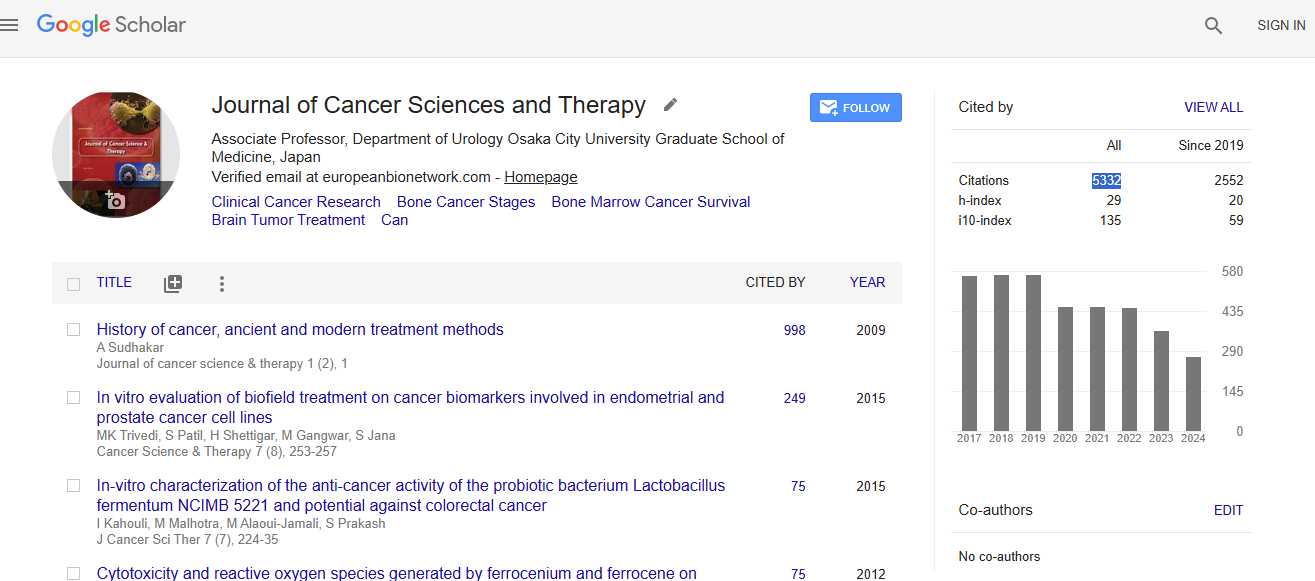
Cancer Science & Therapy received 5332 citations as per Google Scholar report