Short Communication - (2025) Volume 10, Issue 3
Received: 01-Jun-2025, Manuscript No. jidm-26-188072;
Editor assigned: 03-Jun-2025, Pre QC No. P-188072;
Reviewed: 17-Jun-2025, QC No. Q-188072;
Revised: 23-Jun-2025, Manuscript No. R-188072;
Published:
30-Jun-2025
, DOI: 10.37421/2576-1420.2025.10.409
Citation: Zhang, Ying. ”Outbreak Investigation: A Multi-
Disciplinary, Global Response.” J Infect Dis Med 10 (2025):409.
Copyright: © 2025 Zhang Y. This is an open-access article distributed under the terms of the Creative Commons Attribution License, which permits unrestricted use, distribution
and reproduction in any medium, provided the original author and source are credited.
The investigation of infectious disease outbreaks requires a comprehensive and rapid approach, integrating diverse disciplines to effectively control and mitigate their spread [1].
Epidemiological surveillance forms the bedrock of these efforts, enabling early detection of unusual disease patterns and the identification of potential threats to public health [5].
This surveillance is augmented by sophisticated laboratory diagnostics, which are crucial for identifying causative agents and confirming cases, thereby guiding clinical management and public health interventions [6].
The integration of these components allows for a multi-disciplinary response, essential for managing the complex dynamics of outbreaks [1].
Public health interventions, ranging from isolation and quarantine to vaccination and social distancing, are the practical application of this understanding, aimed at disrupting transmission chains [7].
However, the effectiveness of these interventions is not uniform and necessitates continuous evaluation and adaptation to specific outbreak contexts [7].
The role of mathematical modeling has become increasingly vital in predicting disease trajectories, assessing the impact of various interventions, and optimizing the allocation of limited resources, thereby enhancing preparedness and response strategies [2].
Simultaneously, the dissemination of accurate information and the combating of misinformation are paramount challenges during public health emergencies [3].
Effective risk communication builds trust, encourages adherence to public health measures, and counters the spread of false narratives, which can severely impede control efforts [3].
Furthermore, the global nature of infectious disease threats demands robust international cooperation and preparedness mechanisms [4].
Strengthening global networks for surveillance, research, and the rapid development of medical countermeasures is essential for a coordinated defense against future pandemics [4].
The evolving landscape of infectious diseases is further complicated by factors such as antimicrobial resistance, which poses a significant threat to effective treatment and control strategies [8].
Outbreak investigations must therefore consider the epidemiology of resistance patterns and their impact on disease outcomes [8].
Finally, understanding the social and behavioral determinants that influence disease transmission is critical for designing and implementing effective interventions [9].
Community engagement and culturally sensitive approaches are indispensable for fostering public cooperation and adherence to public health guidelines, ensuring the success of control measures [9].
The growing influence of environmental factors, such as climate change, on the epidemiology of infectious diseases presents new and emerging challenges that require careful consideration in outbreak investigation and control strategies [10].
Investigating infectious disease outbreaks demands a rapid and multi-disciplinary approach, seamlessly integrating epidemiological surveillance, laboratory diagnostics, and public health interventions to limit spread [1].
Early detection, which is a cornerstone of this process, is often facilitated by robust surveillance systems designed to identify anomalies in disease occurrence [5].
This initial detection is then bolstered by advanced laboratory diagnostics capable of identifying the causative agents of infectious diseases, providing definitive confirmation for public health actions [6].
These diagnostic capabilities, including molecular techniques and serological assays, are indispensable for confirming cases and understanding the immunological response of affected populations [6].
The multi-disciplinary nature of outbreak investigation means that epidemiologists, clinicians, and public health officials must work collaboratively, leveraging data from various sources to build a comprehensive picture of the outbreak [1].
Mathematical modeling plays a significant role in this collaborative effort by providing tools to predict disease spread, evaluate the potential effectiveness of different intervention strategies, and optimize resource allocation [2].
This predictive power allows public health authorities to make informed decisions about where and how to deploy resources for maximum impact [2].
Public health interventions themselves are a critical component of outbreak control, encompassing measures such as isolation of infected individuals, quarantine of exposed contacts, widespread vaccination campaigns, and social distancing measures [7].
The success of these interventions is highly context-dependent, requiring continuous monitoring and evaluation to ensure their ongoing effectiveness [7].
A significant challenge in managing outbreaks is the rapid dissemination of both accurate information and harmful misinformation, which can undermine public trust and adherence to public health guidance [3].
Therefore, effective risk communication strategies are essential to foster transparency, build confidence, and combat the spread of false narratives [3].
The global interconnectedness of the modern world necessitates a strong focus on international cooperation and preparedness to address novel infectious disease threats [4].
Establishing and strengthening global networks for surveillance, research, and the development of medical countermeasures, such as vaccines, is crucial for mounting a coordinated global defense against potential pandemics [4].
The persistent and growing threat of antimicrobial resistance adds another layer of complexity to outbreak control efforts [8].
Investigations must now incorporate an understanding of antibiotic use patterns and resistance profiles to inform treatment decisions and public health strategies [8].
Furthermore, understanding the social and behavioral factors that influence disease transmission is paramount for designing effective and acceptable public health interventions [9].
Community engagement and culturally sensitive approaches are vital for fostering public cooperation and ensuring adherence to public health guidelines, which are essential for successful outbreak control [9].
The evolving impact of climate change on infectious disease epidemiology is also a growing concern, with altered weather patterns potentially influencing vector distribution and pathogen survival, thereby creating new challenges for outbreak investigation and control [10].
Infectious disease outbreak investigation requires a rapid, multi-disciplinary approach integrating epidemiological surveillance, laboratory diagnostics, and public health interventions. Early detection and contact tracing are crucial, with genomic sequencing aiding in identifying transmission chains. Mathematical modeling helps predict disease spread and evaluate interventions. Effective risk communication is vital to combat misinformation and build trust. Global collaboration and preparedness are essential for responding to emerging threats. Public health interventions like isolation, quarantine, and vaccination are key, but their effectiveness varies and requires evaluation. Antimicrobial resistance presents a significant challenge, necessitating consideration of resistance patterns in investigations. Social and behavioral factors influence transmission and require community engagement for effective control. Climate change also impacts disease epidemiology, posing new challenges for outbreak management.
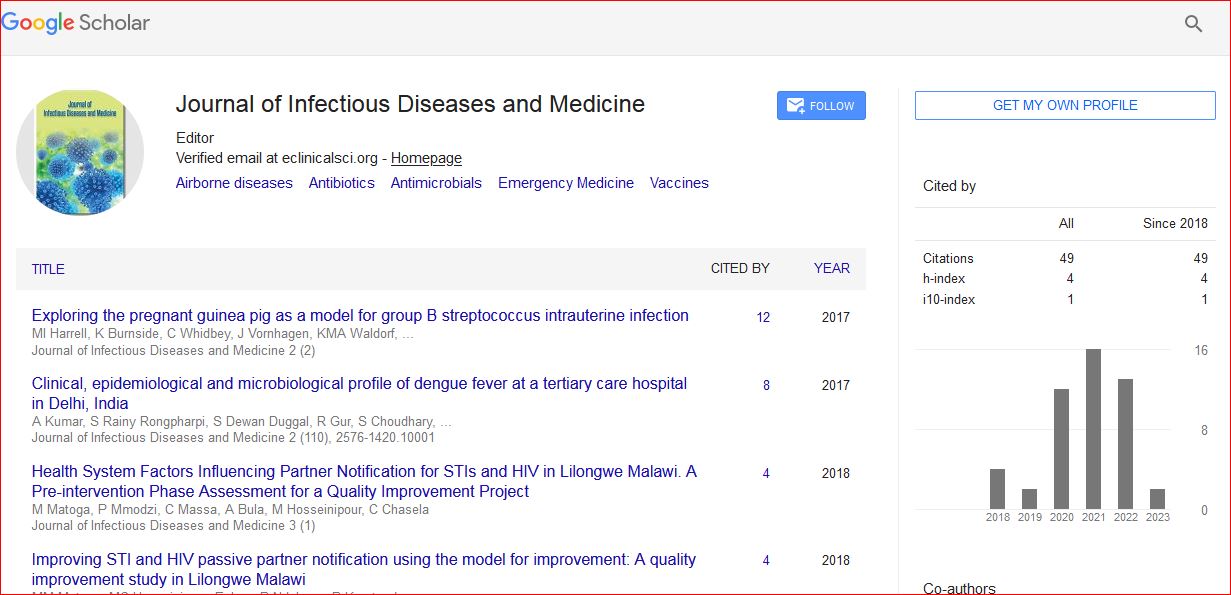
Journal of Infectious Diseases and Medicine received 1059 citations as per Google Scholar report