Short Communication - (2025) Volume 15, Issue 3
Received: 02-Jun-2025, Manuscript No. jprm-25-174453;
Editor assigned: 04-Jun-2025, Pre QC No. P-174453;
Reviewed: 18-Jun-2025, QC No. Q-174453;
Revised: 23-Jun-2025, Manuscript No. R-174453;
Published:
30-Jun-2025
, DOI: 10.37421/2161-105X.2025.15.746
Citation: Turner, Michael. ”OSA: Global Impact, Risks and Management.” J Pulm Respir Med 15 (2025):746.
Copyright: © 2025 Turner M. This is an open-access article distributed under the terms of the Creative Commons Attribution License, which permits unrestricted use, distribution and reproduction in any medium, provided the original author and source are credited.
Obstructive sleep apnea significantly increases the risk for various cardiovascular diseases, including hypertension, coronary artery disease, heart failure, and arrhythmias. The connection is rooted in intermittent hypoxia, sympathetic activation, and systemic inflammation triggered by sleep apnea. Effectively managing sleep apnea with therapies like CPAP can substantially reduce these cardiovascular risks and improve patient outcomes.[1] Obstructive sleep apnea is strongly linked to increased oxidative stress, which contributes significantly to its associated comorbidities, including cardiovascular and metabolic disorders. This review explores the mechanisms by which intermittent hypoxia in sleep apnea generates reactive oxygen species and discusses potential therapeutic strategies targeting oxidative stress pathways to mitigate these adverse health effects.[3] Neurocognitive function is also significantly impacted by obstructive sleep apnea, leading to impairments in attention, memory, executive function, and overall cognitive processing. The chronic intermittent hypoxia and sleep fragmentation characteristic of Obstructive Sleep Apnea (OSA) contribute to brain structural and functional changes. Effective treatment of OSA can mitigate these cognitive deficits and improve quality of life.[9] Recognizing its widespread impact, obstructive sleep apnea affects a significant portion of the global population, leading to substantial health and economic burdens. This comprehensive analysis provides estimates of global prevalence and highlights the indirect costs associated with reduced productivity, increased healthcare utilization, and traffic accidents. The need for greater awareness and accessible diagnostic and treatment strategies is clear.[10] Oral appliance therapy serves as an effective alternative treatment for obstructive sleep apnea and snoring, particularly for patients who cannot tolerate or prefer not to use CPAP. This updated guideline provides detailed recommendations for patient selection, device titration, and long-term management, emphasizing personalized care to achieve optimal therapeutic results.[2] Adherence to CPAP therapy remains a critical challenge in managing obstructive sleep apnea. This comprehensive systematic review and meta-analysis assess the factors influencing CPAP adherence and the effectiveness of various interventions to improve it. Understanding these drivers is key to developing more effective strategies that help patients consistently use their therapy, leading to better health outcomes.[5] Surgical interventions offer viable treatment options for carefully selected patients with obstructive sleep apnea, especially those who cannot tolerate or benefit sufficiently from CPAP therapy. This review explores various surgical techniques, from multilevel airway surgery to hypoglossal nerve stimulation, highlighting their efficacy and considerations for patient selection to achieve personalized and effective outcomes.[6] Understanding the fundamental mechanisms driving obstructive sleep apnea is paving the way for innovative treatments beyond traditional CPAP and surgery. This review highlights emerging therapeutic strategies, including pharmacological interventions targeting airway dilator muscle activity, sleep-state dependent issues, and arousal responses, offering new hope for patients with limited options.[8] Sleep apnea in women often presents with distinct pathophysiological characteristics and clinical symptoms compared to men. Women may experience more subtle symptoms like fatigue and insomnia, leading to underdiagnosis. Recognizing these sex differences is crucial for accurate diagnosis and tailored treatment approaches, improving health outcomes for female patients.[4] Diagnosing and managing obstructive sleep apnea in children requires specialized approaches due to unique anatomical and physiological differences. This guideline provides updated recommendations, emphasizing the importance of early detection and tailored treatments, including adenotonsillectomy, to prevent long-term developmental, cognitive, and cardiovascular complications in pediatric patients.[7]
Obstructive sleep apnea (OSA) poses a significant health risk, notably increasing the likelihood of various cardiovascular diseases such as hypertension, coronary artery disease, heart failure, and arrhythmias. This link stems from intermittent hypoxia, sympathetic activation, and systemic inflammation characteristic of sleep apnea. Beyond cardiovascular concerns, OSA also strongly connects to increased oxidative stress, which contributes substantially to comorbidities like metabolic disorders. The intermittent hypoxia in sleep apnea generates reactive oxygen species, and understanding these mechanisms informs potential therapeutic strategies aimed at mitigating adverse health effects. Moreover, OSA significantly impairs neurocognitive functions, affecting attention, memory, executive function, and overall cognitive processing due to chronic intermittent hypoxia and sleep fragmentation, which induce brain structural and functional changes. Effective treatment for OSA can help alleviate these cognitive deficits and enhance quality of life [1, 3, 9].
Globally, obstructive sleep apnea impacts a substantial portion of the population, leading to considerable health and economic burdens. Analyses estimating global prevalence reveal significant indirect costs tied to reduced productivity, increased healthcare utilization, and traffic accidents. The extensive reach of this condition underscores a critical need for greater public awareness, alongside more accessible diagnostic and treatment strategies [10].
Therapeutic options for OSA vary, including oral appliance therapy, which stands as an effective alternative to CPAP for patients who cannot tolerate or prefer not to use it. Guidelines offer detailed recommendations for patient selection, device titration, and long-term management, emphasizing personalized care for optimal results. Despite its effectiveness, adherence to CPAP therapy remains a major challenge in managing OSA. Systematic reviews and meta-analyses assess factors influencing CPAP adherence and the efficacy of various interventions designed to improve it. Identifying these drivers is essential for developing more effective strategies that enable consistent therapy use and better health outcomes. For carefully selected patients who cannot tolerate or sufficiently benefit from CPAP, surgical interventions provide viable alternatives. A range of surgical techniques, from multilevel airway surgery to hypoglossal nerve stimulation, are explored, with considerations for patient selection crucial for achieving personalized and effective outcomes [2, 5, 6].
What this really means is, new insights into the fundamental mechanisms of OSA are paving the way for innovative treatments beyond traditional CPAP and surgery. Emerging therapeutic strategies include pharmacological interventions that target airway dilator muscle activity, address sleep-state dependent issues, and modulate arousal responses. These advancements offer new hope, especially for patients with limited options [8].
It is also important to consider specific populations. Sleep apnea in women often manifests with distinct pathophysiological characteristics and clinical symptoms compared to men. Women might experience more subtle symptoms like fatigue and insomnia, which often leads to underdiagnosis. Recognizing these sex differences is vital for accurate diagnosis and tailored treatment plans, ultimately improving health outcomes for female patients. Similarly, diagnosing and managing OSA in children requires specialized approaches due to unique anatomical and physiological differences. Updated guidelines emphasize early detection and customized treatments, such as adenotonsillectomy, to prevent long-term developmental, cognitive, and cardiovascular complications in pediatric patients [4, 7].
Obstructive sleep apnea (OSA) is a prevalent condition impacting global health and economy. It significantly raises the risk of various cardiovascular diseases, including hypertension and heart failure, through intermittent hypoxia and inflammation. OSA also contributes to increased oxidative stress and leads to substantial neurocognitive impairments, affecting memory and executive function. Effective management of OSA can mitigate these risks and improve quality of life. Treatment options range from standard therapies like CPAP and oral appliance therapy to surgical interventions. Adherence to CPAP therapy remains a critical challenge, with ongoing efforts to improve patient compliance. There are also emerging pharmacological treatments targeting underlying mechanisms. Specific considerations are crucial for diverse patient populations; for example, OSA in women often presents with subtle symptoms, leading to underdiagnosis, while pediatric OSA requires specialized diagnostic and management approaches, including adenotonsillectomy. Addressing the broad impact of OSA necessitates greater awareness and accessible diagnostic and treatment strategies.
None
None
1. Patrick L, Malcolm K, Walter TM. "Obstructive sleep apnoea and cardiovascular disease: an update".Eur Respir Rev 31 (2022):210252.
Indexed at, Google Scholar, Crossref
2. Vishesh KK, David HA, Susmita C. "Clinical Practice Guideline for the Treatment of Obstructive Sleep Apnea and Snoring with Oral Appliance Therapy: An Update for 2023".J Clin Sleep Med 19 (2023):379-409.
Indexed at, Google Scholar, Crossref
3. Eric S, Frédéric R, Franck C. "Obstructive Sleep Apnea and Oxidative Stress: Current Evidence and Future Perspectives".Front Physiol 10 (2020):1594.
Indexed at, Google Scholar, Crossref
4. Atul M, Amgad G, Salman MK. "Obstructive sleep apnea in women: distinct pathophysiology and clinical presentation".Sleep Med Rev 49 (2020):101229.
Indexed at, Google Scholar, Crossref
5. Emily MW, Brian S, Michelle J. "Adherence to CPAP in Obstructive Sleep Apnea: An American Academy of Sleep Medicine Systematic Review, Meta-Analysis, and GRADE".J Clin Sleep Med 19 (2023):1777-1793.
Indexed at, Google Scholar, Crossref
6. Dong-Yeup K, Ching L, Macario C. "Surgical treatment for obstructive sleep apnea".Sleep Med Rev 49 (2020):101230.
Indexed at, Google Scholar, Crossref
7. Carole LM, Lee JB, Katherine BD. "Clinical Practice Guideline for the Diagnosis and Management of Obstructive Sleep Apnea in Children: An Update for 2023".J Clin Sleep Med 19 (2023):617-640.
Indexed at, Google Scholar, Crossref
8. Atul M, David AW, Susan R. "New insights into the mechanisms and treatment of obstructive sleep apnea".J Clin Invest 133 (2023):e169436.
Indexed at, Google Scholar, Crossref
9. Hojjat K, Somayeh K, Naser M. "Obstructive Sleep Apnea and Cognitive Impairment: A Comprehensive Review".Arch Neurosci 8 (2021):1-14.
Indexed at, Google Scholar, Crossref
10. Adam VB, Najib TA, Peter RE. "Estimation of the global prevalence and burden of obstructive sleep apnoea: a literature-based analysis".Lancet Respir Med 7 (2019):687-698.
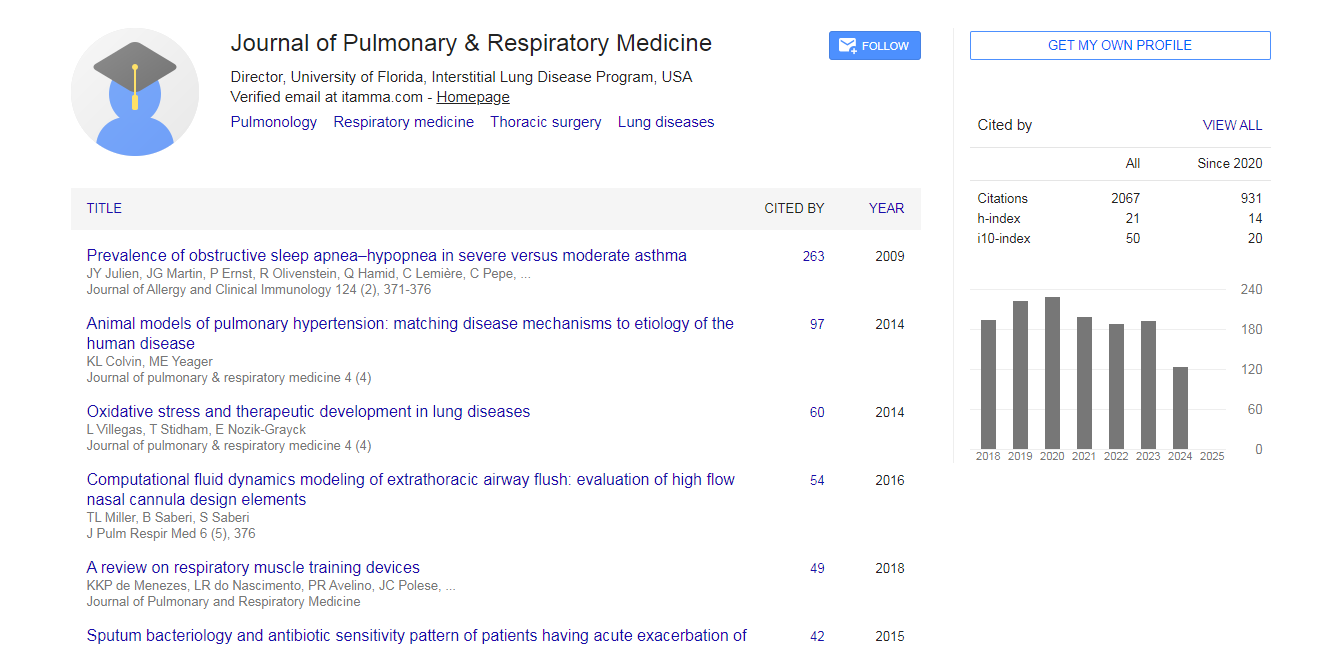
Pulmonary & Respiratory Medicine received 1690 citations as per Google Scholar report