Brief Report - (2025) Volume 9, Issue 6
Received: 02-Nov-2025, Manuscript No. hps-26-184504;
Editor assigned: 04-Nov-2025, Pre QC No. P-184504;
Reviewed: 18-Nov-2025, QC No. Q-184504;
Revised: 24-Nov-2025, Manuscript No. R-184504;
Published:
29-Nov-2025
, DOI: 10.37421/2573-4563.2025.9.373
Citation: Dijk, Peter J. Van. ”Organoids: Revolutionizing Pancreatic Disease Research and Treatment.” J Hepatol Pancreat Sci 09 (2025):373.
Copyright: © 2025 Dijk V. J. Peter This is an open-access article distributed under the terms of the Creative Commons Attribution License, which permits unrestricted use, distribution and reproduction in any medium, provided the original author and source are credited.
Pancreatic organoids represent a significant advancement in the study of pancreatic diseases, offering a more physiologically relevant model than traditional methods. These three-dimensional structures, derived from patient or healthy tissue, effectively recapitulate the cellular diversity and intricate architecture of the native pancreas, thereby enabling a more accurate representation of disease pathologies such as pancreatic cancer and cystic fibrosis [1].
The development of organoid platforms for cystic fibrosis (CF) has substantially improved our comprehension of this disease. Functional organoids generated from CF patient induced pluripotent stem cells (iPSCs) or directly from patient biopsies accurately model CFTR dysfunction and downstream pathologies, serving as a potent tool for screening novel CFTR modulators and assessing their efficacy and personalized response, thereby paving the way for enhanced therapeutic development [3].
This work explores the application of patient-derived pancreatic organoids in understanding the heterogeneity of pancreatic ductal adenocarcinoma (PDAC). By establishing organoids from various PDAC tumors, researchers can investigate inter-tumor variability in response to chemotherapy. These organoid models offer a platform to predict patient outcomes and guide personalized treatment strategies, underscoring their potential in precision medicine within oncology [2].
The study focuses on the genetic engineering of pancreatic organoids to model specific disease mutations. By introducing or correcting mutations linked to hereditary pancreatitis and pancreatic cancer, researchers can create isogenic organoid lines. This precise genetic control facilitates the dissection of molecular mechanisms underlying disease initiation and progression, and aids in the evaluation of gene-editing based therapeutic strategies [4].
The integration of single-cell technologies with pancreatic organoid cultures is providing unprecedented resolution into cellular heterogeneity and developmental processes. Analyzing individual cells within organoids allows researchers to identify distinct cell populations, understand cell-cell interactions, and map developmental trajectories. This approach is vital for unraveling the complex cellular landscape of the pancreas and its role in disease [5].
Furthermore, their amenability to genetic manipulation and high-throughput screening renders them invaluable tools for identifying novel therapeutic targets and testing drug efficacy and toxicity in a personalized manner [1].
Research addressing the challenge of vascularization in larger organoid models is critical for mimicking the in vivo microenvironment and improving drug penetration. This study investigates strategies for creating functional vascular networks within pancreatic organoids, thus enhancing their suitability for long-term culture and drug screening, particularly for solid tumors like PDAC [6].
The integration of patient-derived organoids into drug screening platforms is rapidly advancing personalized medicine for pancreatic cancer. This article emphasizes the capacity of patient-derived organoids to predict drug response and resistance, enabling clinicians to select the most effective treatments for individual patients. The discussion encompasses the validation of organoid models against clinical outcomes and their potential to minimize trial-and-error approaches [8].
This publication details the generation and characterization of organoids derived from pancreatic cancer stem cells (CSCs). These CSC-derived organoids maintain the self-renewal and differentiation potential characteristic of CSCs, making them ideal models for studying tumor initiation, metastasis, and therapeutic resistance. The research highlights the significance of targeting CSCs for effective pancreatic cancer treatment [9].
The development of 3D bioprinting techniques is enhancing the complexity and functionality of pancreatic organoid models. This work explores how bioprinting can be utilized to construct spatially organized pancreatic organoids with controlled microenvironments, including the integration of stromal and immune cells. This advanced platform holds promise for improving the in vivo relevance of organoids for studying complex disease interactions and evaluating multi-drug therapies [10].
The use of organoids in research and clinical applications is accompanied by significant ethical considerations and regulatory challenges. These include issues related to informed consent, intellectual property, and the translation of organoid-based therapies into clinical practice, offering critical insights for researchers and policymakers [7].
The ability of organoids to recapitulate key aspects of the native pancreas allows for more accurate representation of disease pathologies, such as pancreatic cancer and cystic fibrosis, when compared to traditional 2D cell cultures [1].
Pancreatic organoids are revolutionizing disease modeling and drug discovery for pancreatic conditions. These 3D structures, derived from patient or healthy tissue, recapitulate key aspects of the native pancreas, including cellular diversity and architecture [1].
The organoid models provide a platform to predict patient outcomes and guide personalized treatment strategies, highlighting their potential for precision medicine in oncology [2].
These functional organoids, generated from CF patient induced pluripotent stem cells (iPSCs) or directly from patient biopsies, accurately model CFTR dysfunction and downstream pathologies [3].
Precise genetic control facilitates the dissection of molecular mechanisms underlying disease initiation and progression, and aids in the evaluation of gene-editing based therapeutic strategies [4].
By analyzing individual cells within organoids, researchers can identify distinct cell populations, understand cell-cell interactions, and map developmental trajectories [5].
Strategies for creating functional vascular networks within pancreatic organoids enhance their suitability for long-term culture and drug screening, especially for solid tumors like PDAC [6].
Ethical considerations and regulatory challenges are crucial for the translation of organoid-based therapies into clinical practice [7].
Patient-derived organoids can predict drug response and resistance, enabling clinicians to select the most effective treatments for individual patients [8].
CSC-derived organoids are ideal models for studying tumor initiation, metastasis, and therapeutic resistance [9].
3D bioprinting enhances the complexity and functionality of pancreatic organoid models for disease modeling and regenerative medicine [10].
Pancreatic organoids are transforming the landscape of disease modeling and drug discovery for pancreatic conditions. These advanced 3D structures, cultivated from patient or healthy pancreatic tissue, meticulously replicate the native pancreas's cellular diversity and intricate architecture. This fidelity allows for a more accurate representation of disease pathologies, including pancreatic cancer and cystic fibrosis, surpassing the limitations of conventional 2D cell cultures [1].
The cultivation of organoid platforms specifically for cystic fibrosis (CF) has profoundly advanced our understanding of the disease. These functional organoids, whether derived from CF patient induced pluripotent stem cells (iPSCs) or directly from patient biopsies, accurately model the dysfunction of the CFTR protein and subsequent pathological outcomes. They serve as a powerful tool for screening novel CFTR modulators and evaluating their effectiveness and personalized response, thereby accelerating the development of improved therapeutic interventions [3].
This research delves into the application of patient-derived pancreatic organoids for investigating the heterogeneity observed in pancreatic ductal adenocarcinoma (PDAC). By establishing organoids from a diverse range of PDAC tumors, scientists can scrutinize inter-tumor variations in chemotherapy response. The organoid models provide a valuable platform for predicting patient prognoses and tailoring personalized treatment strategies, underscoring their significant potential in the realm of precision medicine within oncology [2].
The study emphasizes the genetic engineering of pancreatic organoids to model specific disease-associated mutations. Through the introduction or correction of mutations linked to hereditary pancreatitis and pancreatic cancer, researchers are capable of generating isogenic organoid lines. This precise genetic control is instrumental in dissecting the molecular mechanisms driving disease initiation and progression, and it facilitates the assessment of therapeutic strategies based on gene editing [4].
The convergence of single-cell technologies with pancreatic organoid cultures is yielding unprecedented insights into cellular heterogeneity and developmental processes. The analysis of individual cells within these organoids enables the identification of distinct cell populations, the elucidation of cell-cell interactions, and the mapping of developmental trajectories. This sophisticated approach is indispensable for unraveling the complex cellular composition of the pancreas and its integral role in disease pathogenesis [5].
Furthermore, their inherent adaptability to genetic manipulation and high-throughput screening establishes them as indispensable tools for the discovery of novel therapeutic targets and the rigorous testing of drug efficacy and toxicity on a personalized basis [1].
Investigations into enhancing vascularization within larger organoid models are crucial for accurately simulating the in vivo microenvironment and improving drug penetration. This research explores methods for constructing functional vascular networks within pancreatic organoids, thereby augmenting their utility for prolonged culture and drug screening, especially in the context of solid tumors like PDAC [6].
The utilization of organoid-based drug screening platforms is rapidly accelerating the progress of personalized medicine for pancreatic cancer. This article highlights the remarkable ability of patient-derived organoids to predict responses and resistance to drugs, empowering clinicians to select the most effective treatments for individual patients. The discussion includes the validation of these organoid models against actual clinical outcomes and their potential to mitigate the inefficiencies of trial-and-error treatment approaches [8].
This publication meticulously details the process of generating and characterizing organoids derived from pancreatic cancer stem cells (CSCs). These CSC-derived organoids retain the fundamental self-renewal and differentiation capabilities characteristic of CSCs, rendering them ideal models for studying tumor initiation, metastasis, and therapeutic resistance. The research underscores the critical importance of targeting CSCs as a strategy for achieving effective treatment outcomes in pancreatic cancer [9].
The advancement of 3D bioprinting techniques is leading to the development of more complex and functional pancreatic organoid models. This work examines how bioprinting can be employed to create spatially organized pancreatic organoids with precisely controlled microenvironments, including the incorporation of stromal and immune cells. This sophisticated platform holds significant promise for improving the in vivo relevance of organoids in studying complex disease interactions and for evaluating multi-drug therapies [10].
The ethical and regulatory considerations associated with the use of human organoids, including pancreatic organoids, in research and clinical settings are a subject of ongoing discussion. These considerations encompass crucial issues such as informed consent, intellectual property rights, and the successful translation of organoid-based therapies into widespread clinical application, offering vital perspectives for both researchers and policymakers [7].
Pancreatic organoids offer a more accurate representation of disease pathologies, including pancreatic cancer and cystic fibrosis, compared to traditional 2D cell cultures [1].
These organoid models provide a platform to predict patient outcomes and guide personalized treatment strategies [2].
Functional organoids accurately model CFTR dysfunction and downstream pathologies for cystic fibrosis [3].
Genetic engineering of pancreatic organoids allows for the dissection of molecular mechanisms underlying disease initiation and progression [4].
Single-cell technologies provide unprecedented resolution into cellular heterogeneity and developmental processes within organoids [5].
Strategies for creating vascular networks enhance organoid suitability for drug screening, especially for solid tumors [6].
Ethical and regulatory challenges are critical for the translation of organoid-based therapies into clinical practice [7].
Patient-derived organoids can predict drug response and resistance, enabling personalized treatment selection [8].
CSC-derived organoids are ideal for studying tumor initiation, metastasis, and therapeutic resistance [9].
3D bioprinting enhances the complexity and functionality of pancreatic organoid models for disease modeling and regenerative medicine [10].
Pancreatic organoids are revolutionizing pancreatic disease research and drug discovery by providing more accurate, physiologically relevant 3D models compared to traditional 2D cultures. They effectively recapitulate pancreatic cellular diversity and architecture, enabling better modeling of conditions like pancreatic cancer and cystic fibrosis. Patient-derived organoids are crucial for studying tumor heterogeneity, predicting drug responses, and guiding personalized treatment strategies. Advances in genetic engineering and single-cell technologies further enhance their utility for dissecting disease mechanisms and understanding cellular interactions. Emerging techniques like vascularization and 3D bioprinting are improving organoid complexity and in vivo relevance. Ethical and regulatory considerations are vital for translating these promising technologies into clinical practice. Overall, organoids represent a powerful platform for personalized medicine and the development of novel therapeutics for pancreatic diseases.
None
None
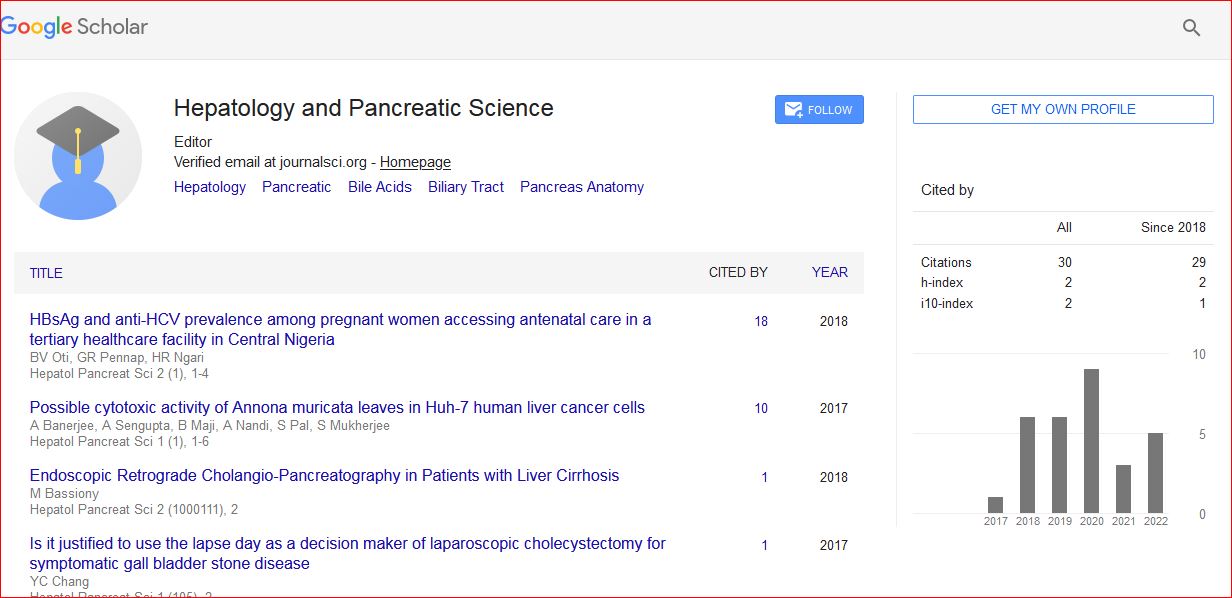
Hepatology and Pancreatic Science received 34 citations as per Google Scholar report