Perspective - (2025) Volume 9, Issue 6
Received: 01-Dec-2025, Manuscript No. jmp-26-190055;
Editor assigned: 03-Dec-2025, Pre QC No. P-190055;
Reviewed: 17-Dec-2025, QC No. Q-190055;
Revised: 22-Dec-2025, Manuscript No. R-190055;
Published:
29-Dec-2025
, DOI: 10.37421/2684-4931.2025.9.277
Citation: Johansson, Erik. ”Organoids: Advancing Study of Human Microbial Pathogenesis.” J Microb Path 09 (2025):277.
Copyright: © 2025 Johansson E. This is an open-access article distributed under the terms of the Creative Commons Attribution License, which permits unrestricted use, distribution and reproduction in any medium, provided the original author and source are credited.
Organoid-based models have emerged as a powerful and sophisticated platform for investigating human-specific microbial pathogenesis. These advanced 3D cultures, meticulously derived from human stem cells, adeptly recapitulate key aspects of tissue architecture and cellular diversity. This provides a significantly more physiologically relevant environment for studying host-pathogen interactions compared to traditional 2D cell cultures or animal models. C001 The application of organoids in studying a wide spectrum of pathogens, including notorious agents like Helicobacter pylori, various enteropathogenic bacteria, and prevalent respiratory viruses, is rapidly increasing in prevalence. These versatile models enable detailed analysis of critical processes such as bacterial colonization, invasion mechanisms, toxin production, and the host's immune responses within a human-relevant context, paving the way for the development of improved diagnostics and therapeutic strategies. C002 While organoid technology offers immense promise, challenges in its development and characterization, such as achieving consistent reproducibility and successfully incorporating diverse cell types, are actively being addressed through continuous technological advancements. Significant efforts are underway to create more complex and representative organoid systems that more accurately mimic the in vivo microenvironment, thereby enhancing their predictive power for human disease. C003 Organoids are proving to be invaluable tools for dissecting the intricate and complex interplay between human cells and pathogenic microbes, particularly those exhibiting human-specific tropisms. This advanced approach allows for the precise study of virulence factors, host susceptibility, and the mechanisms of resistance in a manner that is not feasible with conventional experimental methods. C004 The establishment of well-curated organoid biobanks and the rigorous standardization of experimental protocols are identified as crucial steps toward achieving the wider adoption and validation of organoid-based models in the field of infectious disease research. These concerted efforts will significantly facilitate comparative studies and accelerate the discovery of novel therapeutic targets against a broad range of human pathogens. C005 Investigating the multifaceted role of the microbiome in pathogenesis, especially its intricate interactions with pathogenic microorganisms, can be significantly advanced through the use of co-culture organoid systems. These innovative models permit the simultaneous study of commensal bacteria, invading pathogens, and host cells, thereby providing profound insights into how complex microbial communities influence disease outcomes. C006 Organoids meticulously derived from various human tissues, including the lung, gut, and liver, can be strategically utilized to investigate the tissue-specific tropism of microbial pathogens. This capability allows for a precise and detailed examination of how pathogens adhere to, invade, and replicate within specific human organs, a critical understanding for comprehending disease progression. C007 The integration of multi-omics approaches with sophisticated organoid models is profoundly enhancing our understanding of host-pathogen interactions at a detailed molecular level. Transcriptomics, proteomics, and metabolomics data derived from organoid cultures can effectively reveal intricate signaling pathways and crucial metabolic changes induced by microbial infections. C008 Organoid platforms are increasingly enabling high-throughput screening of antimicrobial compounds and facilitating the identification of novel drug targets. Their inherent human-specific nature allows for more accurate predictions of drug efficacy and toxicity when compared to traditional animal models, thereby significantly accelerating the drug discovery pipeline for various infectious diseases. C009 The ongoing development of advanced organoid systems, including those that incorporate integrated immune components or vascularization, is further enhancing their immense utility in modeling complex human diseases and understanding intricate host-pathogen interactions. These sophisticated models are absolutely crucial for unraveling the nuanced complexities of pathogenesis for human-specific microbes. C010
Organoid-based models represent a sophisticated platform for the investigation of human-specific microbial pathogenesis. These 3D cultures, derived from human stem cells, effectively recapitulate key aspects of tissue architecture and cellular diversity, offering a more physiologically relevant environment than traditional 2D cell cultures or animal models for studying host-pathogen interactions. C001 The application of organoids in studying pathogens such as Helicobacter pylori, enteropathogenic bacteria, and respiratory viruses is becoming increasingly prevalent. These models allow for detailed analysis of bacterial colonization, invasion mechanisms, toxin production, and immune responses within a human-relevant context, facilitating the development of improved diagnostics and therapeutic strategies. C002 Challenges in organoid development and characterization, including achieving consistent reproducibility and incorporating diverse cell types, are actively being addressed through technological advancements. Efforts are focused on creating more complex and representative organoid systems that better mimic the in vivo microenvironment, thereby enhancing their predictive power for human disease. C003 Organoids are proving invaluable for dissecting the complex interplay between human cells and pathogenic microbes, especially those with human-specific tropisms. This approach enables the study of virulence factors, host susceptibility, and resistance mechanisms in a manner not possible with conventional methods. C004 The establishment of organoid biobanks and the standardization of protocols are crucial for the wider adoption and validation of organoid-based models in infectious disease research. These efforts will facilitate comparative studies and accelerate the discovery of novel therapeutic targets against human pathogens. C005 Investigating the microbiome's role in pathogenesis, particularly its interactions with pathogens, can be advanced using co-culture organoid systems. These models allow for the simultaneous study of commensal bacteria, pathogens, and host cells, providing insights into how microbial communities influence disease outcomes. C006 Organoids derived from different human tissues, such as lung, gut, and liver, can be utilized to study tissue-specific tropism of microbial pathogens. This allows for a precise examination of how pathogens adhere, invade, and replicate within specific human organs, which is critical for understanding disease progression. C007 The integration of multi-omics approaches with organoid models is enhancing the understanding of host-pathogen interactions at a molecular level. Transcriptomics, proteomics, and metabolomics data from organoid cultures can reveal intricate signaling pathways and metabolic changes induced by microbial infections. C008 Organoid platforms are enabling high-throughput screening of antimicrobial compounds and identification of novel drug targets. Their human-specific nature allows for more accurate predictions of drug efficacy and toxicity compared to animal models, accelerating the drug discovery pipeline for infectious diseases. C009 The development of advanced organoid systems, including those with integrated immune components or vascularization, is further enhancing their utility in modeling complex human diseases and host-pathogen interactions. These sophisticated models are crucial for unraveling the nuances of pathogenesis for human-specific microbes. C010
Organoid models provide a sophisticated platform for studying human-specific microbial pathogenesis, recapitulating tissue architecture and cellular diversity for more physiologically relevant host-pathogen interaction studies. These 3D cultures are increasingly used for pathogens like Helicobacter pylori and respiratory viruses, allowing detailed analysis of infection mechanisms and immune responses, leading to improved diagnostics and therapeutics. While challenges in reproducibility and complexity exist, technological advancements are addressing these, enhancing the predictive power of organoids. Organoids are invaluable for dissecting host-pathogen interplay, studying virulence factors, and host susceptibility. Establishing organoid biobanks and standardizing protocols are key for wider adoption and drug target discovery. Co-culture organoid systems allow for the simultaneous study of commensal bacteria, pathogens, and host cells, shedding light on microbiome influence in pathogenesis. Tissue-specific organoids from lung, gut, and liver aid in understanding pathogen tropism and disease progression. Multi-omics integration with organoid models deepens molecular understanding of host-pathogen interactions. Furthermore, organoid platforms facilitate high-throughput screening of antimicrobial compounds, accelerating drug discovery. Advanced organoid systems with immune components or vascularization are crucial for modeling complex diseases and understanding human-specific microbial pathogenesis.
None
None
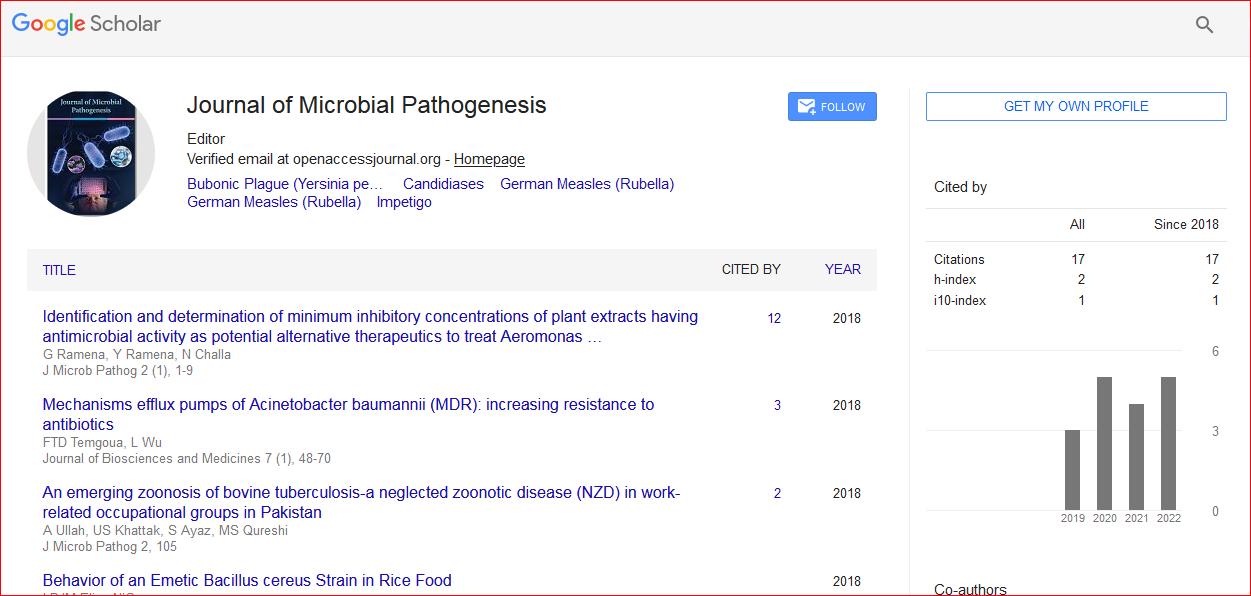
Journal of Microbial Pathogenesis received 17 citations as per Google Scholar report