Brief Report - (2025) Volume 14, Issue 6
Received: 01-Nov-2025, Manuscript No. jtsm-26-179596;
Editor assigned: 03-Nov-2025, Pre QC No. P-179596;
Reviewed: 17-Nov-2025, QC No. Q-179596;
Revised: 24-Nov-2025, Manuscript No. R-179596;
Published:
29-Nov-2025
, DOI: 10.37421/2167-0919.2025.14.526
Citation: Novak, Peter. ”Optimizing Wireless Spectrum: Advanced Techniques for Future Networks.” J Telecommun Syst Manage 14 (2025):526.
Copyright: © 2025 Novak P. This is an open-access article distributed under the terms of the Creative Commons Attribution License, which permits unrestricted use, distribution
and reproduction in any medium, provided the original author and source are credited.
The increasing demand for wireless communication services has led to a critical challenge of spectrum scarcity, necessitating advanced techniques for efficient spectrum utilization. This research area focuses on developing intelligent solutions to optimize the use of limited radio frequency resources, a fundamental aspect of modern wireless networks. One promising avenue is the exploration of dynamic spectrum access (DSA) and cognitive radio (CR) principles. These paradigms allow secondary users to opportunistically access licensed spectrum when it is not in use by primary users, thereby enhancing spectral efficiency. Machine learning plays a pivotal role in predicting spectrum availability and adapting transmission parameters, which can significantly improve network capacity and reduce interference. Furthermore, the integration of deep learning models offers a powerful approach to understanding and managing complex spectrum usage patterns. Novel deep neural network architectures can learn these patterns in real-time, enabling efficient spectrum sharing and leading to substantial improvements in spectral efficiency and user throughput, particularly for future wireless systems like 5G and beyond. In the context of millimeter-wave (mmWave) networks, which operate at higher frequencies and offer vast bandwidth, intelligent beamforming techniques are crucial. Dynamic beam steering algorithms that adapt to user mobility and channel conditions can ensure robust connectivity and minimize interference, effectively enhancing the usable spectrum for users. Addressing the energy consumption associated with spectrum sensing and allocation is another critical aspect. An energy-efficient framework for cognitive radio networks balances sensing performance with energy consumption, promoting more sustainable and efficient spectrum utilization through adaptive sensing durations and optimized allocation. For heterogeneous wireless networks, distributed spectrum management schemes are vital. Game theory can be employed to enable autonomous agents to make optimal spectrum sharing decisions, thereby improving overall network performance and fairness in dynamic and complex radio environments. The deployment of aerial base stations (ABS) presents a unique opportunity to enhance spectrum utilization efficiency in cellular networks. Resource allocation algorithms that leverage the aerial positioning of ABS can improve coverage and capacity, significantly boosting spectral efficiency in challenging terrestrial settings. In the rapidly expanding realm of the Internet of Things (IoT), cognitive spectrum sharing using reinforcement learning is a key enabler. This approach allows IoT devices to dynamically learn and adapt their spectrum access strategies, improving utilization and reducing interference in dense deployments. The integration of artificial intelligence (AI) and blockchain technology offers a novel approach to secure and efficient spectrum trading. A decentralized platform can facilitate secure trading of spectrum resources, enhancing utilization and fostering economic opportunities while ensuring transaction transparency and immutability. Finally, as we look towards future generations of wireless networks like 6G, comprehensive understanding of spectrum sharing models is essential. Analyzing existing models and proposing new frameworks for intelligent spectrum management is crucial to maximize resource utilization in high-frequency bands.
The quest for greater spectral efficiency has driven significant research into advanced wireless communication techniques. Dynamic spectrum access (DSA) and cognitive radio (CR) are central to these efforts, enabling intelligent utilization of underutilized spectrum. Machine learning algorithms are instrumental in this domain, facilitating accurate spectrum prediction and adaptive transmission, which ultimately leads to enhanced network capacity and reduced interference. Deep learning has emerged as a transformative technology for spectrum management, particularly in the context of 5G and future wireless networks. By developing sophisticated deep neural network architectures, researchers can enable systems to learn intricate spectrum usage patterns and make real-time decisions for optimal spectrum allocation. This approach has demonstrated significant gains in spectral efficiency and user throughput compared to conventional methods. Millimeter-wave (mmWave) communication, with its potential for massive bandwidth, relies heavily on advanced spatial management. Intelligent beamforming techniques, particularly dynamic beam steering, are essential for overcoming the challenges of signal propagation at these frequencies. Adapting beam direction based on user mobility and channel conditions ensures robust connectivity and minimizes interference, thereby maximizing the effective spectrum available. Energy efficiency is a critical consideration in the design of sustainable wireless systems. For cognitive radio networks, an energy-efficient framework for spectrum sensing and allocation has been proposed. This framework intelligently balances the need for thorough spectrum sensing with the imperative to conserve energy, employing adaptive sensing durations and optimization algorithms to achieve a sustainable spectral utilization strategy. In heterogeneous wireless networks, where diverse communication technologies coexist, effective spectrum management is complex. A distributed spectrum management scheme based on game theory provides a robust solution. This approach allows autonomous agents to independently optimize their spectrum sharing decisions, leading to improved overall network performance and fairness, especially in highly dynamic environments. The unique characteristics of aerial base stations (ABS) can be leveraged to boost spectrum utilization efficiency in cellular networks. By developing specialized resource allocation algorithms that capitalize on the flexible positioning of ABS, significant improvements in coverage and capacity can be achieved. This is particularly beneficial in challenging terrestrial environments where traditional infrastructure may be limited. The burgeoning Internet of Things (IoT) ecosystem presents unique spectrum access challenges due to the sheer number of devices. Reinforcement learning-based cognitive spectrum sharing offers a dynamic and adaptive solution. This framework empowers IoT devices to learn and adjust their spectrum access behaviors in real-time, leading to better spectrum utilization and reduced interference in dense IoT deployments. Innovations in spectrum trading are also crucial for maximizing resource utilization. The integration of artificial intelligence (AI) and blockchain technology provides a secure and efficient platform for decentralized spectrum trading. This approach enhances the opportunistic use of spectrum resources and opens up new economic models while ensuring the integrity and transparency of transactions. Looking ahead to 6G wireless networks, the need for sophisticated spectrum sharing strategies becomes even more pronounced. A comprehensive survey of spectrum sharing models, including licensed shared access and unlicensed access, is vital. Future research should focus on developing novel frameworks for intelligent spectrum management to fully exploit the potential of high-frequency bands anticipated for 6G. In cognitive radio networks, efficient spectrum sensing is the prerequisite for opportunistic access. Unsupervised learning techniques offer a method for devices to detect available spectrum holes without prior knowledge of primary user activity. This enhances the efficiency of opportunistic spectrum access and contributes to overall network performance.
This collection of research explores advanced techniques for optimizing spectrum utilization in wireless networks. Key themes include dynamic spectrum access, cognitive radio, deep learning for spectrum sharing, intelligent beamforming in mmWave networks, energy-efficient spectrum management, distributed spectrum schemes using game theory, the role of aerial base stations, reinforcement learning for IoT spectrum access, and the integration of AI and blockchain for spectrum trading. Research also examines spectrum sharing strategies for 6G networks and unsupervised learning for cognitive radio spectrum sensing. These approaches aim to combat spectrum scarcity, improve network capacity, enhance spectral efficiency, and reduce interference in diverse wireless environments.
None
None
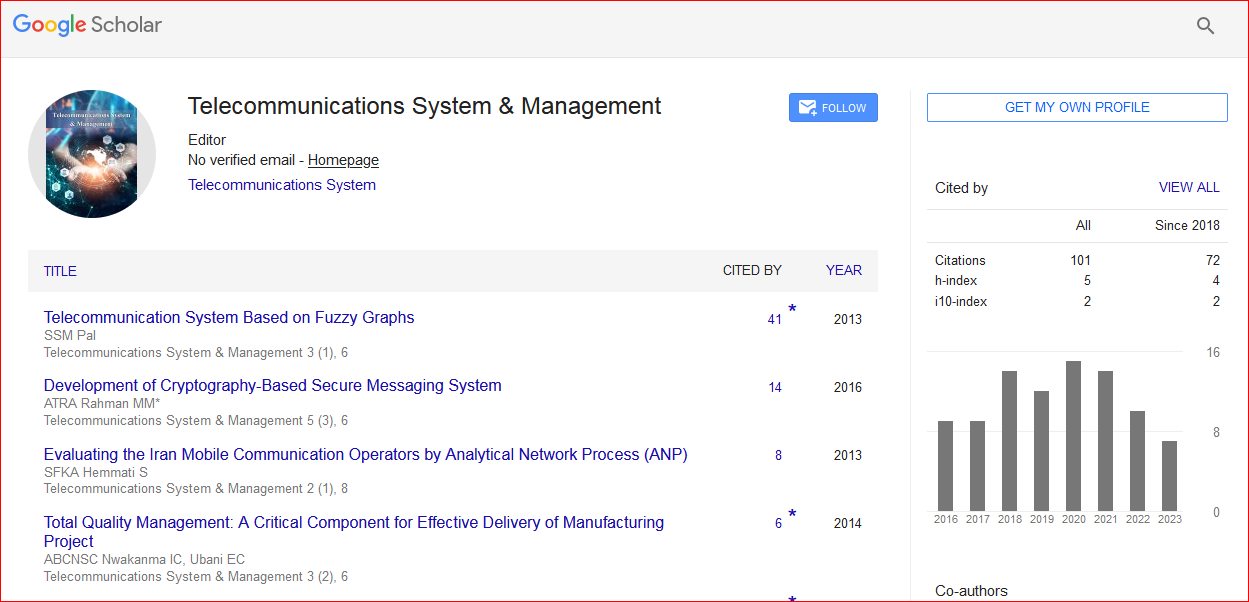
Telecommunications System & Management received 109 citations as per Google Scholar report