Opinion - (2025) Volume 9, Issue 5
Received: 01-Oct-2025, Manuscript No. cmcr-25-178081;
Editor assigned: 03-Oct-2025, Pre QC No. P-178081;
Reviewed: 17-Oct-2025, QC No. Q-178081;
Revised: 22-Oct-2025, Manuscript No. R-178081;
Published:
29-Oct-2025
, DOI: 10.37421/2684-4915.2025.9.397
Citation: Anderson, Grace. ”Optimizing Surgical Outcomes: Complication Prevention and Management.” Clin Med Case Rep 09 (2025):397.
Copyright: © 2025 Anderson G. This is an open-access article distributed under the terms of the Creative Commons Attribution License, which permits unrestricted use, distribution and reproduction in any medium, provided the original author and source are credited.
Enhancing recovery after surgery through structured pathways significantly influences the prevention and effective management of postoperative complications. These pathways delve into critical risk factors and outline specific strategies, demonstrating how a structured, multidisciplinary approach can improve patient outcomes by proactively addressing potential issues [1].
Beyond traditional pathways, the burgeoning role of Artificial Intelligence (AI) is transforming prediction and management of surgical complications. AI applications range from pre-operative risk assessment to real-time intraoperative guidance and post-operative surveillance, holding immense potential to enable earlier detection and more personalized interventions [2].
Implementing comprehensive complication management programs within high-volume surgical departments comes with unique challenges, but also offers valuable lessons. These programs focus on practical aspects such as robust data collection, meticulous incident reporting, effective feedback mechanisms, and continuous improvement loops, all designed to enhance patient safety and minimize adverse events [3].
The complexity inherent in advanced oncological surgery often necessitates a multidisciplinary team approach for effective complication prevention and management. Integrating expertise from various specialtiesâ??including surgical oncology, radiology, pathology, and critical careâ??becomes crucial for optimizing patient selection, guiding intraoperative decision-making, and refining postoperative care to successfully mitigate adverse outcomes [4].
A cornerstone of patient-centered care, active patient engagement in their own recovery journey, profoundly impacts complication management. Strategies that empower patients through comprehensive education, shared decision-making processes, and diligent self-monitoring can lead to earlier recognition of complications and improved adherence to vital recovery protocols [5].
For critically ill patients, the early recognition and aggressive management of sepsis and its associated complications are paramount for survival. Contemporary diagnostic tools, timely therapeutic interventions, and continuous monitoring strategies are explored as essential components for mitigating the devastating effects of sepsis and ultimately improving outcomes in intensive care settings [6].
Further strategies include various perioperative optimization techniques specifically aimed at reducing postoperative complications in high-risk surgical patients. These approaches emphasize pre-operative risk stratification, adequate nutritional support, physiological optimization, and structured post-operative care as fundamental for enhancing patient resilience and significantly minimizing adverse events [7].
Extending care beyond hospital walls, telemedicine offers innovative solutions for post-discharge complication surveillance and management. Remote monitoring, virtual consultations, and advanced digital health platforms facilitate the early detection of complications, enable timely interventions, and provide crucial support for patient recovery, particularly beneficial for geographically dispersed populations [8].
To continuously improve patient safety across all surgical specialties, establishing a standardized approach to complication reporting and learning is indispensable. Frameworks for consistent data collection, classification, and analysis of surgical complications are discussed, stressing the importance of fostering a blame-free environment that encourages learning from adverse events and drives sustained quality improvement [9].
Addressing specific complications, postoperative delirium remains a significant concern for surgical patients. Pharmacological interventions for its prevention and management are systematically reviewed, evaluating the efficacy of different drug classes and underscoring the necessity for careful patient selection and personalized approaches to reduce the incidence and severity of delirium, thereby improving overall patient recovery [10].
Effective management of surgical complications begins with foundational strategies, notably Enhanced Recovery After Surgery (ERAS) pathways. These structured, multidisciplinary approaches proactively identify and address risk factors, significantly improving patient outcomes by integrating specific protocols for prevention and management [1]. Complementing this, implementing comprehensive complication management programs within surgical departments is critical. Such programs leverage data collection, incident reporting, feedback mechanisms, and continuous improvement loops to enhance patient safety and reduce adverse events [3]. These initiatives create a structured environment for addressing potential issues throughout the surgical journey.
Here's the thing: complexity, especially in advanced oncological surgery, often demands a truly collaborative effort. Multidisciplinary teams, encompassing surgical oncology, radiology, pathology, and critical care, are crucial for optimizing patient selection, intraoperative decisions, and postoperative care, ultimately mitigating adverse outcomes [4]. What this really means is that expert integration leads to better results. Moreover, patient engagement forms a cornerstone of effective complication management. Empowering patients through comprehensive education, shared decision-making, and self-monitoring not only promotes earlier recognition of complications but also improves adherence to vital recovery protocols, making patients active participants in their healing process [5].
Innovation plays a crucial role in advancing complication management. Artificial Intelligence (AI) is rapidly emerging, with applications spanning pre-operative risk assessment, real-time intraoperative guidance, and post-operative surveillance, paving the way for earlier detection and personalized interventions [2]. In parallel, perioperative optimization strategies are vital for high-risk surgical patients. These include pre-operative risk stratification, robust nutritional support, physiological optimization, and structured post-operative care, all working together to boost patient resilience and minimize adverse events [7]. These advancements highlight a multifaceted approach to patient care.
Care doesn't end at discharge. Telemedicine offers innovative solutions for post-discharge complication surveillance and management, extending care beyond the hospital. Remote monitoring, virtual consultations, and digital health platforms are invaluable for early detection, timely interventions, and supporting patient recovery, especially for those in remote areas [8]. Addressing specific acute complications, early recognition and aggressive management of sepsis in critically ill patients are paramount for survival. Contemporary diagnostic tools, timely therapeutic interventions, and continuous monitoring strategies are essential for mitigating its devastating effects and improving intensive care outcomes [6]. Furthermore, postoperative delirium is a significant concern, and pharmacological interventions are being systematically reviewed. The efficacy of different drug classes, combined with careful patient selection and personalized approaches, helps reduce delirium incidence and severity, improving overall recovery [10].
Finally, continuous quality improvement is fueled by standardized complication reporting and learning. Developing frameworks for consistent data collection, classification, and analysis of surgical complications is vital for improving patient safety across all surgical specialties. Emphasizing a blame-free environment encourages learning from adverse events, which is essential for driving ongoing enhancements in patient care [9]. This systematic approach ensures that every incident contributes to a safer future.
The data explores diverse strategies for preventing and managing postoperative complications. Key approaches include the adoption of Enhanced Recovery After Surgery (ERAS) pathways, which utilize structured, multidisciplinary methods to address risk factors proactively. The integration of Artificial Intelligence (AI) is also highlighted for its potential in predictive analytics, real-time guidance, and personalized interventions to improve detection and management of complications. Robust complication management programs in surgical departments emphasize data collection, incident reporting, and continuous improvement for patient safety. Multidisciplinary teams are crucial in complex surgeries, particularly oncological procedures, for optimizing patient selection and care. Patient-centered approaches, empowering individuals through education and self-monitoring, are shown to enhance recovery and early complication recognition. Furthermore, perioperative optimization strategies, including risk stratification and nutritional support, are vital for high-risk patients. Telemedicine offers solutions for post-discharge surveillance, while standardized reporting systems foster learning from adverse events. Specific attention is given to the early management of sepsis in critically ill patients and pharmacological interventions for postoperative delirium, showcasing a comprehensive effort towards improving surgical outcomes and patient recovery.
None
None
Indexed at, Google Scholar, Crossref
Indexed at, Google Scholar, Crossref
Indexed at, Google Scholar, Crossref
Indexed at, Google Scholar, Crossref
Indexed at, Google Scholar, Crossref
Indexed at, Google Scholar, Crossref
Indexed at, Google Scholar, Crossref
Indexed at, Google Scholar, Crossref
Indexed at, Google Scholar, Crossref
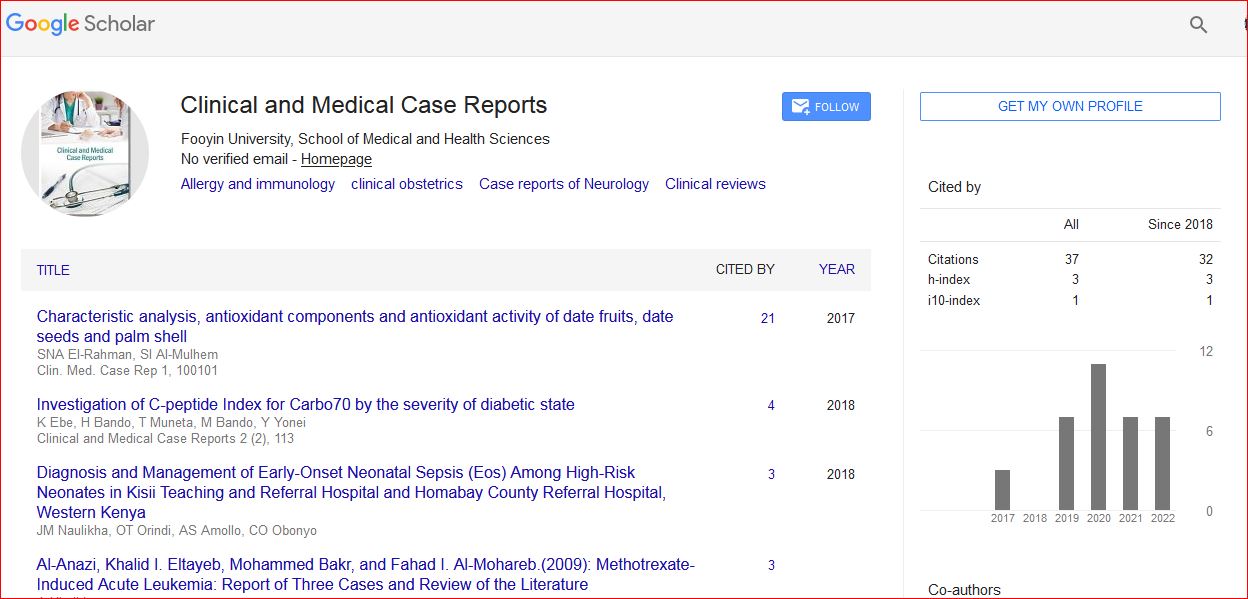
Clinical and Medical Case Reports received 53 citations as per Google Scholar report