Perspective - (2025) Volume 13, Issue 5
Received: 01-Oct-2025, Manuscript No. jcdd-25-177672;
Editor assigned: 03-Oct-2025, Pre QC No. P-177672;
Reviewed: 17-Oct-2025, QC No. Q-177672;
Revised: 22-Oct-2025, Manuscript No. R-177672;
Published:
29-Oct-2025
, DOI: 10.37421/2329-9517.2025.13.696
Citation: Nieminen, Hanna. ”Optimizing Sudden Cardiac Arrest
Prevention and Care.” J Cardiovasc Dis Diagn 13 (2025):696.
Copyright: © 2025 Nieminen H. This is an open-access article distributed under the terms of the Creative Commons Attribution License, which permits unrestricted use,
distribution and reproduction in any medium, provided the original author and source are credited.
The landscape of sudden cardiac arrest (SCA) research is multifaceted, continually bringing forth crucial insights into its diverse epidemiological patterns, complex underlying causes, and pioneering advancements in therapeutic and preventive strategies. For instance, a detailed examination of out-of-hospital cardiac arrest (OHCA) incidence and outcomes across Europe vividly illustrates significant country-specific variations. This variation itself highlights substantial opportunities to enhance survival rates through a deeper understanding and targeted improvements in local emergency response systems and post-arrest care protocols, suggesting that a one-size-fits-all approach is insufficient and tailored interventions are key for regional improvements.[1] Here's the thing: technological advancements are profoundly impacting the management of cardiac conditions. Wearable devices, for example, are becoming incredibly valuable tools in detecting and managing cardiac arrhythmias. This review points to their expanding utility, ranging from aiding in the early diagnosis of heart rhythm issues to providing continuous monitoring capabilities and even exploring potential therapeutic applications. Their emergence moves us closer to a future where proactive prevention of sudden cardiac arrest becomes a more tangible reality, shifting from reactive treatment to predictive care.[2] Parallel to this, our understanding of the fundamental causes of SCA is deepening. Let's break down the genetic side of sudden cardiac arrest. Current research clearly outlines how genetic factors contribute significantly to SCA susceptibility and critically identifies promising avenues for future investigation. What this really means is a growing potential for developing highly personalized risk stratification methods and prevention strategies directly informed by an individual's unique genetic makeup, allowing for precision medicine in cardiology.[3] Beyond individual patient management, community-level interventions are paramount. This article underscores the vital importance of public access defibrillation, particularly clarifying the indispensable role of Automated External Defibrillators (AEDs) in markedly improving outcomes for sudden cardiac arrest. Essentially, the ready availability of AEDs, coupled with a populace trained in their use, can make a profound difference in saving lives during those critical moments before professional medical assistance arrives, turning bystanders into lifesavers.[4] Following the acute event, managing patients after sudden cardiac arrest presents a complex and demanding clinical challenge. A comprehensive review offers a thorough examination of the post-cardiac arrest syndrome, specifically highlighting advanced neuroprotection strategies. It emphasizes that effective management is about more than just restarting the heart; it extends to actively preserving brain function and crucially improving long-term neurological recovery, which is central to patient quality of life.[5] The precise mechanisms leading to SCA are also under intense scrutiny. When we talk about sudden cardiac arrest, ventricular arrhythmias are frequently identified as the primary instigators. This review provides a deep dive into ventricular arrhythmias, particularly those occurring in the context of both ischemic and non-ischemic cardiomyopathies. Such detailed understanding is instrumental in refining our approaches to risk stratification and developing more effective therapeutic interventions, moving beyond generalized treatments to targeted care.[6] Similarly, post-resuscitation care continues to evolve. Targeted Temperature Management (TTM) remains a critical intervention after cardiac arrest. This article offers an important update on its application, stressing how precise control of body temperature can significantly improve neurological outcomes and overall survival for patients who have experienced SCA, solidifying its place as a cornerstone therapy.[7] Recognizing demographic nuances is also essential for a complete picture. It's important to recognize that sudden cardiac arrest affects people differently based on sex. This paper meticulously delves into these sex differences, encompassing everything from variations in incidence rates and etiological factors to ultimate outcomes. This nuanced understanding provides a more complete and informed perspective on this critical health issue, enabling more equitable and effective care strategies.[8] Furthermore, specific patient populations present unique management challenges. Dealing with sudden cardiac arrest in children with channelopathies, for example, requires specialized expertise. This study offers crucial insights into effectively managing these pediatric patients, highlighting the necessity of tailored resuscitation strategies and a thorough understanding of their underlying genetic predispositions to achieve better outcomes in a vulnerable population.[9] Finally, refining pharmacological interventions remains an active area of debate and research. There's an ongoing discussion about epinephrine's role in out-of-hospital cardiac arrest. This piece critically appraises its use, evaluating both its potential benefits and associated risks. What it really comes down to is the continuous effort to optimize its administration to maximize survival and neurological recovery, while diligently minimizing any unintended side effects, striking a delicate balance in emergency medicine.[10]
The intricate landscape of sudden cardiac arrest (SCA) research spans from broad epidemiological studies to highly specific molecular and therapeutic interventions, all aimed at improving survival and patient outcomes. Global assessments of out-of-hospital cardiac arrest (OHCA) incidence and outcomes, particularly across diverse regions like Europe, reveal significant variations between countries [1]. These disparities underscore a critical opportunity to enhance survival rates by meticulously understanding and actively addressing local differences in emergency response frameworks and subsequent care protocols [1]. Moreover, it is important to recognize that SCA does not affect all individuals uniformly; sex differences play a notable role, influencing everything from the frequency of occurrence and underlying causes to eventual patient outcomes, necessitating a more nuanced and inclusive approach to research and clinical practice [8].
Advancements in technology are profoundly reshaping the diagnostic and preventive aspects of cardiac care. Wearable devices, for instance, are increasingly proving invaluable in managing cardiac arrhythmias. These devices extend their utility from early diagnosis of heart rhythm disturbances to continuous monitoring, and even show promise for therapeutic applications, pushing the boundaries towards proactive prevention of sudden cardiac arrest [2]. Complementing these personal technologies, the broader public health strategy emphasizes public access defibrillation. This involves the critical deployment and utilization of Automated External Defibrillators (AEDs). Having readily available AEDs and a trained public capable of using them makes a significant, life-saving difference in improving outcomes for SCA patients before professional medical help can arrive [4].
Delving deeper into the etiology of SCA, genetic factors are increasingly recognized as fundamental contributors. Let's break down the genetic side of sudden cardiac arrest; current understanding outlines how these genetic predispositions contribute to SCA and points towards compelling future research directions [3]. This research paves the way for personalized risk stratification and prevention strategies, tailored to an individualâ??s unique genetic makeup [3]. Furthermore, ventricular arrhythmias are frequently at the core of sudden cardiac arrest. A comprehensive review provides deep insights into these arrhythmias, particularly in the context of both ischemic and non-ischemic cardiomyopathies, which is crucial for refining risk stratification and developing more targeted therapeutic approaches [6]. Special considerations are also vital for specific vulnerable populations, such as children. Dealing with sudden cardiac arrest in pediatric patients with channelopathies presents unique challenges, requiring tailored resuscitation strategies and a thorough understanding of their underlying genetic predispositions to achieve better outcomes [9].
Post-resuscitation care is another critical pillar in improving SCA survival. Managing patients after sudden cardiac arrest is a complex challenge, necessitating a comprehensive look at the post-cardiac arrest syndrome. This specifically includes advanced neuroprotection strategies, emphasizing that successful care extends beyond merely restarting the heart to actively preserving brain function and improving long-term recovery [5]. Targeted Temperature Management (TTM) remains a pivotal intervention in this phase. An update on TTM's application highlights how precise control of body temperature can significantly improve neurological outcomes and overall survival for patients who have experienced SCA [7]. Finally, pharmacological interventions in the acute phase are continuously re-evaluated. There's an ongoing discussion about epinephrine's role in out-of-hospital cardiac arrest. A critical appraisal of its use, weighing both benefits and risks, aims to optimize its administration to maximize survival and neurological recovery while minimizing unintended side effects, reflecting the ongoing quest for optimal emergency care [10].
Research into sudden cardiac arrest (SCA) offers a multifaceted view, spanning from understanding global epidemiology to optimizing intricate therapeutic interventions. We see that out-of-hospital cardiac arrest (OHCA) incidence and outcomes vary significantly across regions, like Europe, which points to a clear opportunity to improve survival by tailoring emergency responses and care protocols to local needs. This also extends to recognizing sex-specific differences in SCA epidemiology, etiology, and outcomes, which are essential for a nuanced understanding of this critical health issue. Technological advancements are clearly making a difference. Wearable devices, here's the thing, are becoming incredibly valuable for diagnosing and continuously monitoring cardiac arrhythmias, paving the way for proactive prevention of sudden cardiac arrest. Equally vital is public access defibrillation, where readily available Automated External Defibrillators (AEDs) and trained individuals significantly improve survival rates before professional medical help arrives. Let's break down the genetic side: current research highlights how genetic factors contribute to SCA, opening doors for personalized risk stratification and prevention strategies. Understanding ventricular arrhythmias, especially in various cardiomyopathies, further refines our approach to risk assessment and therapy. For specific populations, like children with channelopathies, tailored resuscitation and management strategies are crucial. Post-arrest care is complex. Comprehensive reviews address the post-cardiac arrest syndrome, emphasizing neuroprotection to preserve brain function and improve long-term recovery. Targeted Temperature Management (TTM) remains a critical intervention, showing how precise temperature control improves neurological outcomes and survival. Finally, the ongoing discussion about epinephrine's role in OHCA focuses on optimizing its administration to maximize survival and neurological recovery while minimizing side effects, reflecting a continuous drive for better patient care.
Indexed at, Google Scholar, Crossref
Indexed at, Google Scholar, Crossref
Indexed at, Google Scholar, Crossref
Indexed at, Google Scholar, Crossref
Indexed at, Google Scholar, Crossref
Indexed at, Google Scholar, Crossref
Indexed at, Google Scholar, Crossref
Indexed at, Google Scholar, Crossref
Indexed at, Google Scholar, Crossref
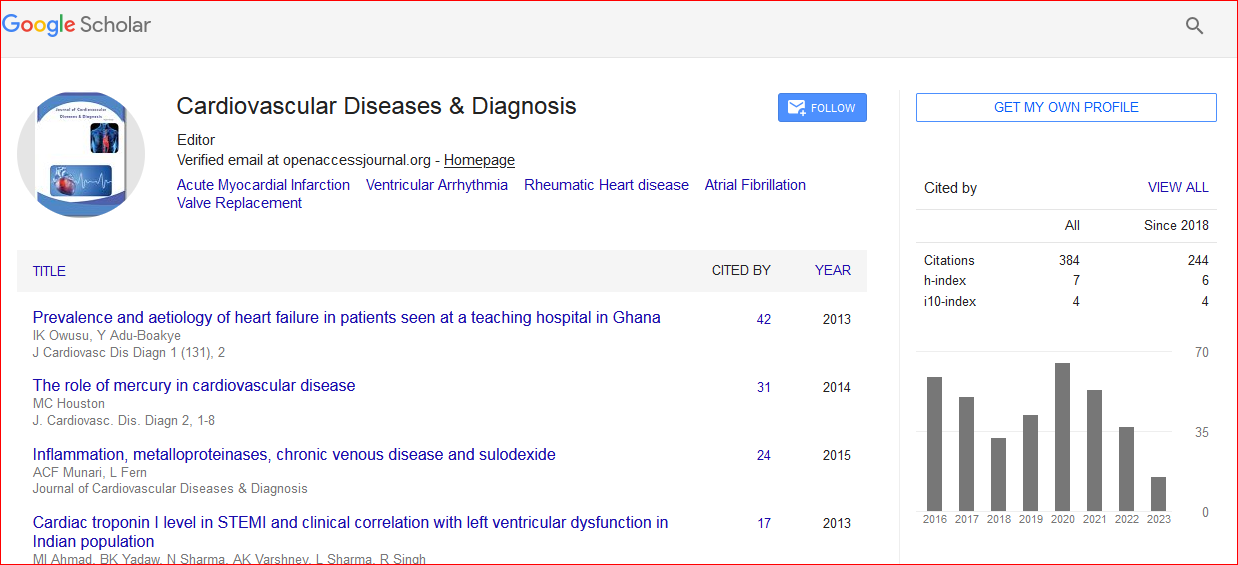
Cardiovascular Diseases & Diagnosis received 427 citations as per Google Scholar report