Perspective - (2025) Volume 9, Issue 2
Received: 01-Apr-2025, Manuscript No. jcao-26-187113;
Editor assigned: 03-Apr-2025, Pre QC No. P-187113;
Reviewed: 17-Apr-2025, QC No. Q-187113;
Revised: 22-Apr-2025, Manuscript No. R-187113;
Published:
29-Apr-2025
, DOI: 10.37421/2684-6004.2025.9.289
Citation: Rossi, Giovanni. ”Optimizing Acute Pain Management: A Comprehensive Approach.” J Clin Anesthesiol 09 (2025):289.
Copyright: © 2025 Rossi G. This is an open-access article distributed under the terms of the Creative Commons Attribution License, which permits unrestricted use, distribution and reproduction in any medium , provided the original author and source are credited.
Acute pain management is a cornerstone of modern healthcare, profoundly impacting patient recovery trajectories and overall satisfaction with medical services [1].
The comprehensive review presented here likely delves into the multifaceted domain of multimodal analgesia, exploring its efficacy in conjunction with regional anesthesia techniques and the seamless integration of non-pharmacological interventions within specialized acute pain services [1].
A significant emphasis is anticipated on patient-centered care paradigms, the critical role of validated pain assessment tools, and the implementation of robust strategies designed to minimize the incidence of opioid-related adverse events, thereby prioritizing patient safety and functional recovery [1].
The evolving landscape of acute pain management is a subject of ongoing research, with a particular focus on novel pharmacological agents and their demonstrated efficacy in mitigating postoperative pain [2].
This exploration may extend to the sophisticated application of advanced monitoring techniques, aiming to personalize pain management protocols and proactively prevent potential complications, while also addressing the practical challenges inherent in implementing evidence-based practices within acute pain services and proposing actionable solutions for enhanced patient outcomes [2].
A crucial aspect of contemporary pain management involves the deliberate integration of non-pharmacological therapies within acute pain services, encompassing a review of modalities such as acupuncture, transcutaneous electrical nerve stimulation (TENS), and mindfulness-based interventions [3].
The evaluation of their effectiveness in reducing opioid reliance and augmenting patient comfort is paramount, alongside a discussion of the supporting evidence and practical considerations for their successful implementation in diverse clinical settings [3].
This section likely offers an in-depth examination of the foundational aspects and operational intricacies of establishing and efficiently managing specialized acute pain services, covering critical elements such as optimal team composition, strategic resource allocation, and the implementation of quality improvement initiatives [4].
The impact of these services on both patient satisfaction and broader healthcare costs is a key consideration, with the aim of sharing best practices and valuable lessons learned to guide the development of effective pain management programs across institutions [4].
The pivotal role of regional anesthesia techniques in acute pain management, particularly within the perioperative context, is a central theme, likely involving a thorough review of various nerve blocks and epidural techniques [5].
Their effectiveness in delivering targeted analgesia, reducing the need for systemic opioids, and ultimately improving functional outcomes is a primary focus, alongside a discussion of potential complications and proactive strategies for their prevention and effective management [5].
The significant impact of acute pain on the overall patient experience and satisfaction is another critical area of focus, examining how effective pain management directly influences recovery times, the duration of hospital stays, and the perceived quality of care received [6].
The article may also underscore the vital importance of open communication, comprehensive patient education, and active patient involvement in the development and execution of pain management strategies to foster greater overall satisfaction [6].
The persistent challenge associated with opioid use in acute pain management and the imperative to mitigate associated risks, such as opioid-induced hyperalgesia and the potential for addiction, are critically addressed [7].
Evidence supporting opioid-sparing techniques, the judicious administration of opioids, and the necessity of clear, standardized protocols for their prescribing and monitoring within acute pain services are likely highlighted [7].
Technological innovations and advanced data analytics are increasingly recognized for their potential to significantly enhance the delivery and efficiency of acute pain services [8].
This may include discussions on the utilization of electronic health records for precise pain monitoring, the development of predictive models to forecast pain severity, and the application of telemedicine for remote pain management, all contributing to more personalized and effective patient care [8].
The management of acute pain within specific patient demographics, such as the elderly, pediatric populations, or individuals with pre-existing chronic pain conditions, presents unique challenges and necessitates tailored strategies [9].
This exploration likely covers the distinct considerations for these groups, including altered pharmacokinetics, potential drug interactions, and the need for specialized assessment tools, ensuring safe and effective pain relief for vulnerable individuals [9].
The foundational evidence and established guidelines governing the management of acute postoperative pain are likely reviewed, providing a comprehensive overview of multimodal analgesia approaches [10].
This includes the judicious use of acetaminophen, non-steroidal anti-inflammatory drugs (NSAIDs), regional anesthesia, and carefully considered opioid administration, emphasizing the indispensable role of a multidisciplinary approach and patient-centered care in achieving optimal pain relief and facilitating successful recovery [10].
Acute pain management is a critical component of patient care, directly influencing recovery speed and patient satisfaction [1].
This article is expected to explore various multimodal analgesia strategies, the application of regional anesthesia, and the integration of non-pharmacological interventions within acute pain services [1].
The focus will likely be on patient-centered care, pain assessment tools, and methods to reduce opioid-related adverse events, aiming to optimize pain relief while ensuring patient safety and functional recovery [1].
This reference is anticipated to examine the evolving field of acute pain management, spotlighting new pharmacological agents and their effectiveness in reducing postoperative pain [2].
It may also delve into the use of advanced monitoring techniques for personalized pain management and complication prevention, addressing the challenges in implementing evidence-based practices and suggesting solutions for improved patient outcomes [2].
The focus here is on incorporating non-pharmacological therapies into acute pain services, potentially reviewing techniques like acupuncture, TENS, and mindfulness-based interventions [3].
Their role in decreasing opioid dependence and improving patient comfort will be evaluated, along with the evidence supporting these methods and practical aspects of their clinical application [3].
This article likely provides an in-depth look at the establishment and operation of specialized acute pain services, covering aspects such as team composition, resource management, and quality improvement [4].
It may also discuss the impact on patient satisfaction and healthcare costs, sharing best practices to guide the development of effective pain management programs [4].
This publication is expected to concentrate on the significant role of regional anesthesia in acute pain management, especially in the perioperative setting [5].
It will likely review nerve blocks and epidural techniques, discussing their efficacy in providing targeted pain relief, lowering systemic opioid use, and enhancing functional outcomes, while also addressing potential complications and management strategies [5].
This work likely investigates how acute pain affects patient experience and satisfaction, exploring how effective pain management influences recovery, hospital stay duration, and the perception of care quality [6].
It might also emphasize the importance of communication, patient education, and involvement in pain management strategies to boost overall satisfaction [6].
This article is expected to address the ongoing issue of opioid use in acute pain management and strategies to reduce risks like opioid-induced hyperalgesia and addiction [7].
It may present evidence for opioid-sparing approaches, the appropriate use of opioids, and the necessity of clear protocols for their prescription and monitoring in acute pain services [7].
The application of technology and data analytics to improve acute pain services is likely explored in this reference [8].
This could include discussions on using electronic health records for pain monitoring, developing predictive models for pain severity, and employing telemedicine for pain management, all aimed at delivering more personalized and efficient patient care [8].
This article likely focuses on managing acute pain in specific patient groups, such as the elderly, children, or individuals with chronic pain conditions [9].
It may address the unique considerations for these populations, including altered drug metabolism, potential interactions, and the need for specialized assessment tools, to ensure safe and effective pain relief [9].
This reference likely reviews current evidence and guidelines for acute postoperative pain management, covering multimodal analgesia, including acetaminophen, NSAIDs, regional anesthesia, and judicious opioid use [10].
The importance of a multidisciplinary approach and patient-centered care for optimal pain relief and recovery will likely be emphasized [10].
This collection of articles provides a comprehensive overview of acute pain management. It covers multimodal analgesia, regional anesthesia, and non-pharmacological interventions, emphasizing patient-centered care and minimizing opioid use. The literature also addresses the development and optimization of acute pain services, technological advancements, and pain management in special populations. Patient satisfaction and evidence-based guidelines are also key themes, aiming to improve patient outcomes and recovery.
None
None
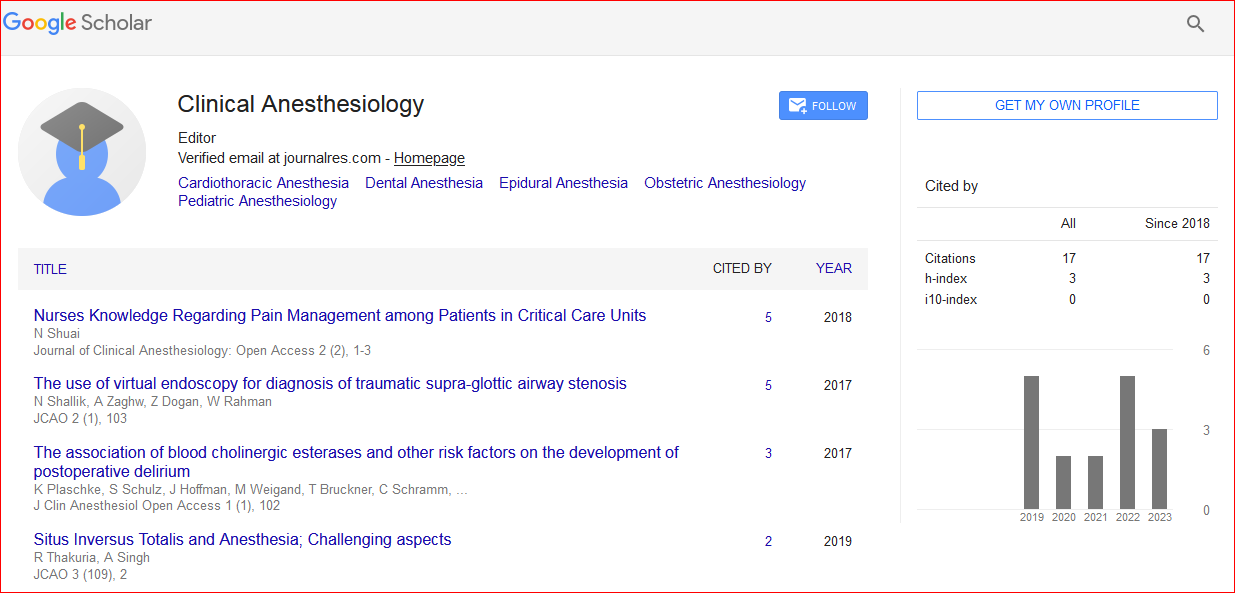
Journal of Clinical Anesthesiology: Open Access received 31 citations as per Google Scholar report