Commentary - (2025) Volume 14, Issue 5
Received: 01-Sep-2025, Manuscript No. iem-26-179829;
Editor assigned: 03-Sep-2025, Pre QC No. P-179829;
Reviewed: 14-Sep-2025, QC No. Q-179829;
Revised: 22-Sep-2025, Manuscript No. R-179829;
Published:
29-Sep-2025
, DOI: 10.37421/2169- 0316.2025.14.321
Citation: Williams, John. âOptimizing Inventory Management: Strategies for Cost Reduction.â J Ind Eng Manag 14 (2025):321.
Copyright: © 2025 Williams J. This is an open-access article distributed under the terms of the Creative Commons Attribution License, which permits unrestricted use, distribution and reproduction in any medium, provided the original author and source are credited.
The optimization of inventory management is a cornerstone of operational efficiency and financial health for organizations across diverse industries. Minimizing operational expenses through strategic inventory control is paramount, and this involves a multifaceted approach that addresses demand forecasting, safety stock levels, and reorder point calculations. Advanced analytics and real-time monitoring systems are increasingly recognized for their ability to prevent overstocking and stockouts, thereby improving cash flow and customer satisfaction in manufacturing [1].
The dynamic nature of modern supply chains necessitates advanced methodologies for inventory optimization. Machine learning algorithms offer a powerful means to predict demand with enhanced accuracy, leading to more informed decisions regarding procurement and stocking strategies. These data-driven approaches are instrumental in reducing holding costs and minimizing waste, fostering a more sustainable and cost-effective inventory management system [2].
Lean inventory principles provide a framework for significant cost reductions and enhanced operational efficiency within manufacturing environments. By focusing on minimizing work-in-progress inventory, reducing lead times, and improving overall flow, organizations can achieve substantial savings. Practical implementation of lean techniques, such as Kanban and Just-In-Time (JIT), is crucial for streamlining inventory management and eliminating wasteful practices [3].
Integrating inventory and production planning is a critical strategy for cost optimization. Synchronizing these two functions leads to improved resource utilization and lower inventory holding expenses. Mathematical frameworks are employed to balance production schedules with inventory requirements, thereby achieving significant cost savings through optimized planning [4].
Managing inventory under conditions of uncertainty, such as fluctuating demand and lead times, presents unique challenges. Fuzzy logic offers a promising approach to address these complexities by providing a framework for determining optimal inventory policies. Fuzzy-based methods can lead to more robust and cost-effective inventory control by effectively handling imprecise or uncertain information [5].
Optimizing safety stock levels through advanced statistical methods and simulation is vital for balancing service levels with inventory holding costs. Accurately calculating safety stock requires a deep understanding of historical data and probability distributions. Methodologies that utilize these factors are essential for determining optimal safety stock for various product categories, thereby reducing unnecessary inventory investment [6].
Collaborative inventory management plays a significant role in reducing overall supply chain costs. By fostering information sharing and coordinated inventory policies among supply chain partners, organizations can achieve substantial benefits. These include reducing the bullwhip effect and lowering overall inventory levels, leading to enhanced efficiency and decreased costs throughout the supply chain [7].
Vendor-managed inventory (VMI) systems offer a distinct approach to managing inventory costs and performance. Shifting inventory management responsibility to the vendor can lead to more efficient operations. VMI systems have the potential for cost savings through reduced administrative effort, optimized stock levels, and improved supplier relationships [8].
Simulation modeling is a powerful tool for optimizing inventory policies within complex supply chains. Discrete-event simulation allows for the testing of various inventory strategies to identify those that yield the lowest costs. This approach is invaluable for evaluating the trade-offs between inventory holding costs, ordering costs, and stockout costs [9].
The application of advanced analytics and Big Data in inventory management is increasingly recognized as a strategy for cost reduction. Analyzing extensive datasets provides deeper insights into demand patterns, potential supply chain disruptions, and cost drivers. Leveraging these capabilities enables organizations to implement more dynamic and cost-efficient inventory control strategies [10].
Strategic inventory control methods are vital for minimizing operational expenses in manufacturing. This encompasses accurate demand forecasting, optimized safety stock levels, and efficient reorder point calculations. The implementation of advanced analytics and real-time monitoring systems is a key driver for significant cost reductions by preventing overstocking and stockouts, ultimately enhancing cash flow and customer satisfaction [1].
Optimizing inventory levels within dynamic supply chains can be effectively achieved through machine learning algorithms. These predictive models significantly improve forecasting accuracy, which in turn supports better decision-making in procurement and stocking. The adoption of these data-driven strategies leads to a tangible reduction in holding costs and a decrease in waste, contributing to a more sustainable and cost-effective inventory management system [2].
Lean inventory principles are a proven methodology for reducing operational costs and enhancing efficiency in manufacturing. The core tenets involve minimizing work-in-progress, shortening lead times, and improving production flow, all of which translate into substantial savings. Practical application of lean techniques, such as Kanban and Just-In-Time (JIT), is essential for streamlining inventory processes and eliminating inefficiencies [3].
Integrated inventory and production planning models are instrumental in achieving cost optimization. By synchronizing these two critical functions, organizations can achieve better resource utilization and lower inventory holding expenses. The development of mathematical frameworks that effectively balance production schedules with inventory demands is key to realizing significant cost savings [4].
In environments characterized by uncertainty, such as fluctuating demand and lead times, fuzzy logic offers an innovative solution for inventory management. A fuzzy-based approach can effectively determine optimal inventory policies by adeptly handling imprecise information. This leads to more robust and cost-effective inventory control strategies that are resilient to variability [5].
Optimizing safety stock levels is a crucial aspect of cost-effective inventory management, requiring advanced statistical methods and simulation. The accurate determination of safety stock is essential for balancing the provision of adequate service levels with the control of inventory holding costs. Methodologies that leverage historical data and probability distributions enable the precise calculation of optimal safety stock for diverse product categories, thereby minimizing unnecessary inventory investment [6].
Collaborative inventory management emerges as a significant factor in reducing supply chain costs. Enhanced information sharing and coordinated inventory policies among supply chain partners yield considerable benefits, including the mitigation of the bullwhip effect and a reduction in overall inventory levels. This collaborative approach demonstrably improves efficiency and decreases costs across the entire supply chain [7].
Vendor-managed inventory (VMI) systems provide a structured approach to managing inventory costs and improving performance. By transferring inventory management responsibilities to the vendor, organizations can achieve greater efficiency. Potential cost savings are realized through reduced administrative burdens, optimized stock levels, and strengthened supplier relationships [8].
Simulation modeling serves as a powerful instrument for optimizing inventory policies, particularly within complex supply chain structures. Discrete-event simulation enables the evaluation of diverse inventory strategies to identify those that minimize costs. This methodology is highly effective for analyzing the trade-offs inherent in inventory holding, ordering, and stockout costs [9].
The strategic application of advanced analytics and Big Data in inventory management offers substantial opportunities for cost reduction. Comprehensive analysis of large datasets provides deep insights into demand dynamics, supply chain vulnerabilities, and cost drivers. By harnessing these analytical capabilities, organizations can develop and implement inventory control strategies that are both dynamic and highly cost-efficient [10].
This collection of research explores various strategies for optimizing inventory management to reduce costs. Key themes include the use of advanced analytics and machine learning for accurate demand forecasting, the application of lean principles to minimize waste and improve flow, and the integration of inventory and production planning. The studies also highlight the importance of optimizing safety stock levels, leveraging fuzzy logic for uncertainty management, and the benefits of collaborative inventory management and vendor-managed inventory systems. Simulation modeling and the analysis of Big Data are presented as powerful tools for evaluating and implementing cost-effective inventory policies.
None
None
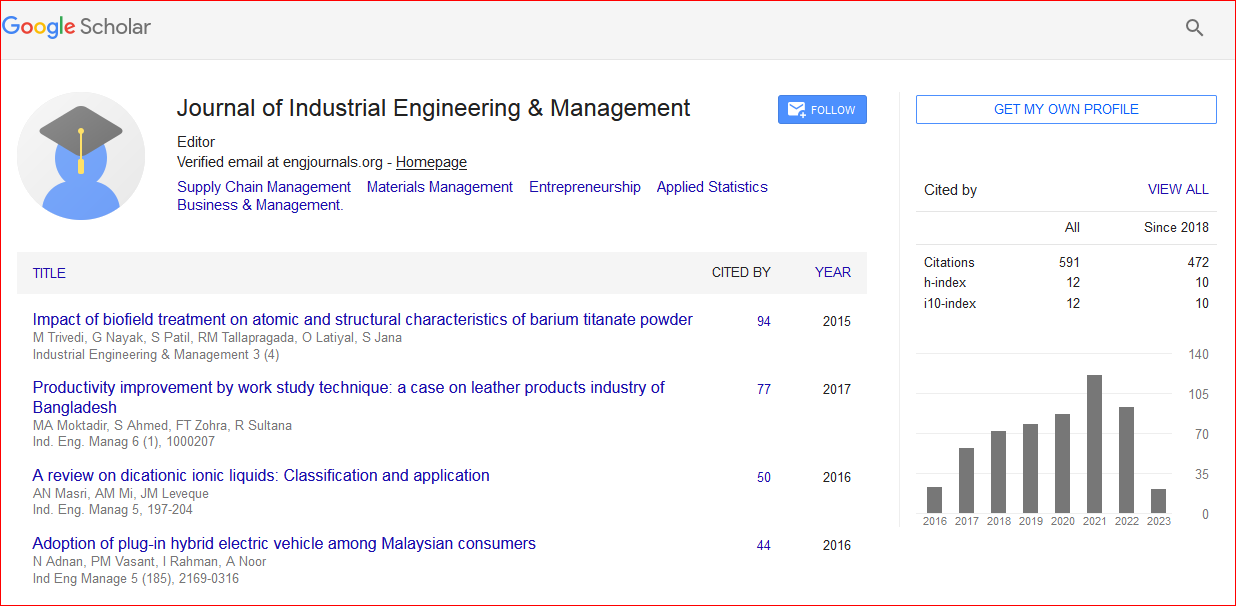
Industrial Engineering & Management received 739 citations as per Google Scholar report