Short Communication - (2025) Volume 14, Issue 4
Received: 01-Aug-2025, Manuscript No. idse-26-182842;
Editor assigned: 04-Aug-2025, Pre QC No. P-182842;
Reviewed: 18-Aug-2025, QC No. Q-182842;
Revised: 22-Aug-2025, Manuscript No. R-182842;
Published:
29-Aug-2025
, DOI: 10.37421/2168-9768.2025.14.506
Citation: Park, Seung-Min. ”Optimizing Agriculture Through
Smart Irrigation and Drainage.” Irrigat Drainage Sys Eng 14 (2025):506.
Copyright: © 2025 Park S. This is an open-access article distributed under the terms of the Creative Commons Attribution License, which permits unrestricted use, distribution
and reproduction in any medium, provided the original author and source are credited.
The intricate design and implementation of efficient irrigation and drainage systems stand as a cornerstone for modern agricultural practices, ensuring that crop water requirements are met precisely, thereby maximizing agricultural output and judiciously managing precious water resources. This foundational aspect of agricultural water management necessitates a comprehensive evaluation of crop physiology, the inherent characteristics of the soil, prevailing climatic conditions, and the availability of water sources to ascertain optimal irrigation scheduling and the most effective application methodologies. Concurrently, the provision of adequate drainage infrastructure is indispensable for averting detrimental conditions such as waterlogging and the insidious buildup of salinity, both of which can severely diminish crop yields and compromise soil health. The integration of advanced design principles, incorporating water-saving technologies and sustainable practices, is paramount for elevating water use efficiency and minimizing the ecological footprint of agricultural operations [1].
A thorough understanding of the specific water demands of diverse crops, which are dynamically influenced by their developmental stages and fluctuating environmental factors, forms the bedrock upon which efficient irrigation systems are conceived. Research endeavors are increasingly focused on elucidating how the precise application of water, guided by evapotranspiration rates and real-time soil moisture monitoring, can lead to substantial improvements in water use efficiency and a commensurate increase in crop yields across a spectrum of climatic zones [2].
In parallel, the design of effective drainage systems must meticulously account for critical factors including soil permeability, the undulations of the topography, and historical rainfall patterns to facilitate the timely removal of excess water. Investigations into various subsurface drainage designs have underscored their profound impact on crucial soil attributes such as aeration, the efficacy of salinity control, and the overall health of the root zone, emphatically highlighting the imperative of integrated planning that encompasses both irrigation and drainage strategies [3].
Contemporary agricultural landscapes are increasingly characterized by the adoption of innovative irrigation technologies, notably drip and sprinkler systems, which offer substantial water conservation benefits by delivering moisture directly to the plant's root zone. Rigorous evaluations of the water use efficiency and economic viability of these diverse irrigation methods, when applied across various cropping systems, consistently emphasize their pivotal role in fulfilling crop water demands while simultaneously conserving vital water resources [4].
The complex interplay between dynamic soil water processes, the physiological demand for water by crops through evapotranspiration, and the crucial function of drainage is fundamental to the establishment of sustainable agricultural systems. Analytical studies that examine how variations in soil types and prevailing hydrological conditions influence the effectiveness of integrated irrigation and drainage systems are vital for developing strategies that effectively prevent both water stress and waterlogging [5].
Faced with the escalating challenges posed by climate change to agricultural water resource management, the development and implementation of adaptive strategies for the design of irrigation and drainage systems have become critically important. Such studies often employ sophisticated modeling approaches to assess the ramifications of shifting rainfall patterns and rising temperatures on crop water requirements and drainage needs, ultimately proposing resilient system designs capable of withstanding future environmental uncertainties [6].
Cutting-edge advancements in remote sensing technologies coupled with Geographic Information Systems (GIS) are providing potent tools for the optimization of irrigation and drainage system design. These technologies furnish spatially explicit data pertaining to soil properties, crop health indicators, and water availability, thereby enabling more informed and precise water management decisions that enhance overall system efficiency [7].
In an era marked by increasing water scarcity, the strategic adoption of water-efficient irrigation techniques, complemented by well-designed drainage strategies, is essential for sustaining agricultural productivity. Research specifically targeting the design considerations for irrigation and drainage systems in arid and semi-arid regions is crucial, with a pronounced focus on maximizing water use efficiency and mitigating the pervasive issue of salt accumulation [8].
The long-term economic prosperity and environmental integrity of agricultural practices are inextricably linked to the efficiency of water management. Comprehensive lifecycle assessments of different irrigation and drainage system designs are increasingly being undertaken to evaluate their multifaceted impacts on water consumption, energy utilization, and the overall environmental footprint, guiding the development of more sustainable solutions [9].
Furthermore, significant progress in sensor technology and sophisticated data analytics is revolutionizing the design and operational capabilities of irrigation and drainage systems. The integration of Internet of Things (IoT) devices and advanced machine learning algorithms is enabling real-time monitoring of critical parameters like soil moisture, weather patterns, and crop status, paving the way for highly optimized water application and drainage control [10].
The optimization of irrigation and drainage systems represents a critical juncture in agricultural water management, aiming to precisely meet crop water needs and thereby enhance both productivity and resource stewardship. This necessitates a thorough assessment encompassing crop physiology, soil characteristics, climatic variables, and water availability to establish optimal irrigation schedules and delivery methods. Simultaneously, effective drainage is paramount to prevent waterlogging and salinity, which can lead to significant yield losses [1].
Understanding the intricate water requirements of various crops, which are influenced by growth stages and environmental conditions, is fundamental to the design of efficient irrigation strategies. Research highlights that precise water application, informed by evapotranspiration rates and soil moisture monitoring, can substantially improve water use efficiency and crop yields across different climatic zones [2].
The design of drainage systems must meticulously consider soil permeability, topography, and rainfall patterns to ensure the efficient removal of excess water. Studies exploring various subsurface drainage designs have demonstrated their positive impact on soil aeration, salinity control, and root zone health, underscoring the importance of integrated planning for both irrigation and drainage [3].
Modern irrigation technologies, such as drip and sprinkler systems, are instrumental in conserving water by delivering it directly to the root zone. Evaluations of these technologies across diverse cropping systems confirm their effectiveness in enhancing water use efficiency and economic viability, contributing to meeting crop water demands while conserving resources [4].
The dynamic relationship between soil water content, crop evapotranspiration, and drainage is a key consideration for sustainable agriculture. Research analyzing how soil types and hydrological conditions affect the performance of integrated irrigation and drainage systems is crucial for developing strategies that prevent water stress and waterlogging [5].
Climate change presents considerable challenges to agricultural water management, necessitating adaptive approaches in the design of irrigation and drainage systems. Modeling studies are employed to assess the impacts of altered rainfall and temperature regimes on crop water demands and drainage requirements, leading to the proposal of resilient system designs [6].
Remote sensing and GIS technologies offer powerful capabilities for optimizing irrigation and drainage system design by providing spatially detailed data on soil conditions, crop health, and water availability. The application of these tools facilitates precision water management and improves overall system efficiency [7].
In regions facing water scarcity, the implementation of water-efficient irrigation techniques and robust drainage strategies is vital for maintaining agricultural productivity. Design considerations for irrigation and drainage systems in arid and semi-arid environments focus on maximizing water use efficiency and minimizing salt accumulation [8].
The economic and environmental sustainability of agriculture is significantly influenced by efficient water management. Lifecycle assessments of various irrigation and drainage system designs are conducted to evaluate their impacts on water consumption, energy use, and the broader environmental footprint, promoting more sustainable agricultural practices [9].
Advancements in sensor technology and data analytics are revolutionizing the design and operation of irrigation and drainage systems. The integration of IoT devices and machine learning algorithms allows for real-time monitoring of soil moisture, weather, and crop conditions, leading to optimized water application and drainage control [10].
Effective irrigation and drainage systems are crucial for optimizing agricultural productivity and water resource management. Designing these systems requires a deep understanding of crop physiology, soil conditions, climate, and water availability. Precise irrigation scheduling and application methods, informed by evapotranspiration rates and soil moisture monitoring, significantly improve water use efficiency and crop yields. Adequate drainage is essential to prevent waterlogging and salinity, thereby preserving soil health and yield potential. Modern technologies like drip and sprinkler systems offer substantial water savings by delivering water directly to the root zone. Integrated approaches that consider soil-water dynamics, crop evapotranspiration, and drainage are vital for sustainable agriculture. Climate change necessitates adaptive designs for irrigation and drainage systems to cope with altered weather patterns. Remote sensing and GIS provide powerful tools for precision water management, while water-scarce regions require specialized designs focusing on water efficiency and salt management. Lifecycle assessments help evaluate the environmental impact of different system designs, promoting sustainability. Advancements in IoT and data analytics are enabling smart irrigation and drainage systems for optimized water management.
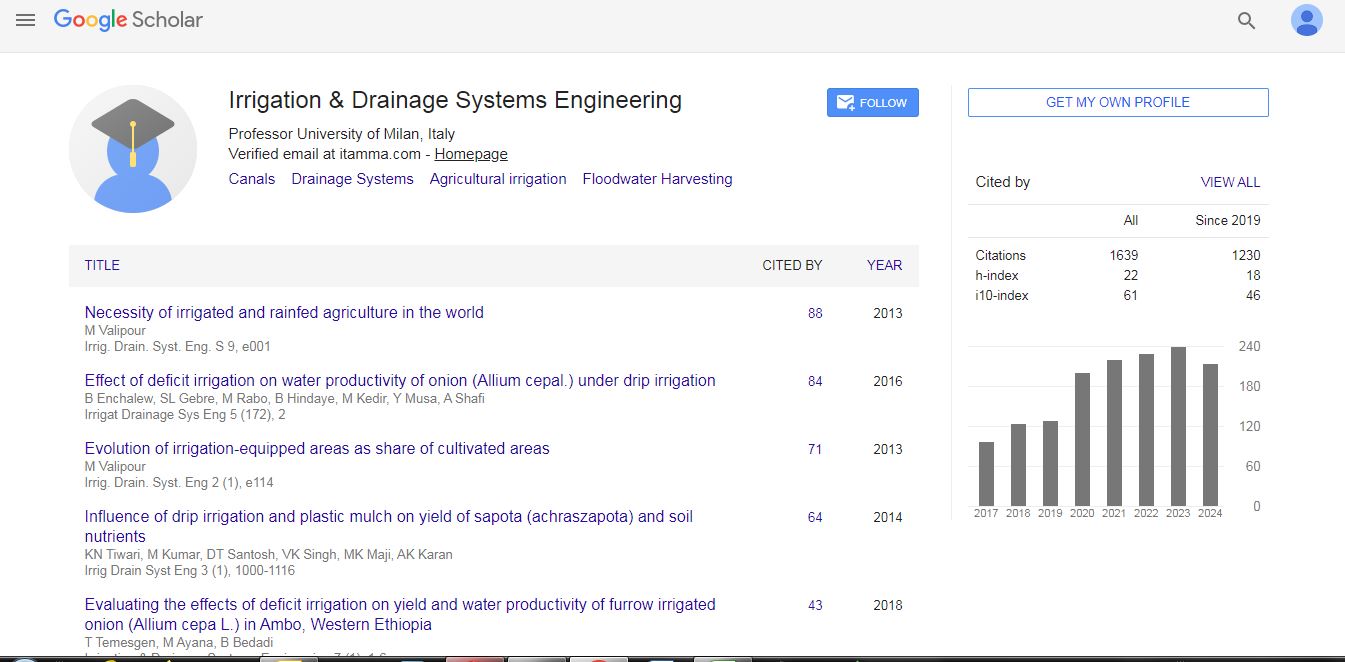
Irrigation & Drainage Systems Engineering received 835 citations as per Google Scholar report