Short Communication - (2025) Volume 16, Issue 4
Received: 01-Jul-2025, Manuscript No. assj-25-174785;
Editor assigned: 03-Jul-2025, Pre QC No. P-174785;
Reviewed: 17-Jul-2025, QC No. Q-174785;
Revised: 22-Jul-2025, Manuscript No. R-174785;
Published:
29-Jul-2025
, DOI: 10.37421/2151-6200.2025.16.679
Citation: Ruo, Xinyi. ”Social Inequalities: Pandemic Amplifier, Structural Drivers.” Arts Social Sci J 16 (2025):679
Copyright: © 2025 Ruo X. This is an open-access article distributed under the terms of the Creative Commons Attribution License, which permits unrestricted use, distribution and reproduction in any medium, provided the original author and source are credited.
The intricate web of social inequalities represents a profound challenge across global societies, manifesting in diverse yet interconnected ways. Understanding these disparities requires examining their roots in social structures, economic systems, and policy choices. The COVID-19 pandemic, here's the thing, served as a stark mirror, reflecting and magnifying existing societal fractures. For example, research details how the pandemic disproportionately affected racial, ethnic, and socioeconomically disadvantaged groups, amplifying existing social inequalities and leading to worse infection rates, more hospitalizations, and higher mortality among these populations. It highlights how factors like housing, employment, and access to healthcare, which are deeply tied to social structures, played a critical role in shaping health outcomes during the crisis [1].
The scope of inequality extends beyond health crises, encompassing economic dimensions on a global scale. Thereâ??s a complex dynamic of global income inequality, considering both between-country and within-country disparities. It's clear that while some convergence has happened between nations, internal inequalities within many countries remain stubbornly high or are even increasing. The authors point out how policy choices and global economic shifts are constantly reshaping the landscape of wealth distribution, making it a moving target for policymakers [2].
Educational attainment, a cornerstone of social mobility, also reveals significant disparities. A comparative study explores how socioeconomic background influences educational outcomes across different countries. What emerges is a clear pattern: children from disadvantaged backgrounds consistently achieve lower educational results. The research highlights the complex interplay of family resources, school systems, and national policies in either mitigating or exacerbating these inequalities, suggesting that no single factor is at play [3].
The immediate environment, particularly housing, also played a crucial role during the recent global health crisis. A commentary argues that inadequate and unequal housing played a significant role in magnifying the health and economic impacts of the COVID-19 pandemic. Here's the thing: crowded living conditions, unstable housing, and homelessness made it incredibly difficult for many to follow public health guidelines, thus accelerating disease spread among vulnerable populations. The authors emphasize an urgent need for robust housing policies to address these underlying social inequalities [4].
Furthermore, the pandemic exposed and exacerbated gender-specific challenges in the labor market. Research investigates how the COVID-19 pandemic exacerbated existing gender inequalities in the labor market. The core finding is that women, particularly those with young children, faced a disproportionate burden of childcare and household duties, leading to significant drops in employment or working hours. This really means the pandemic didn't just expose cracks; it widened them, pushing women back in terms of economic participation and career progression [5].
As societies increasingly rely on digital platforms, new forms of inequality emerge or deepen. A systematic review examines how the digital divide exacerbated social inequalities during the COVID-19 pandemic. The core insight is that unequal access to and skills in using digital technologies deepened existing disparities in education, employment, and healthcare. What this really means is that as services shifted online, those already disadvantaged by socioeconomic factors faced additional barriers, further entrenching their marginalization [6].
Environmental factors also contribute significantly to health disparities, illustrating another facet of social injustice. Let's break it down: a systematic review highlights how air pollution disproportionately affects vulnerable populations, creating a clear pattern of environmental injustice. Communities with lower socioeconomic status and racial minorities are often exposed to higher levels of pollutants, leading to worse health outcomes. This demonstrates that social inequalities are not just about income or education, but also about who bears the brunt of environmental degradation [7].
At a more fundamental level, systemic issues like racism are critical determinants of well-being. An article proposes an analytical framework to understand how systemic racism fundamentally shapes health outcomes. The authors make a strong case that racism isn't just about individual bias; it's embedded in institutions, policies, and cultural norms, leading to persistent health disparities across racial groups. What this really means is addressing health inequality requires dismantling these systemic structures, not just treating symptoms [8].
The transmission of wealth across generations further solidifies existing economic hierarchies. A review synthesizes research on how wealth is passed down through generations and its impact on persistent inequality. The main takeaway is that significant wealth transmission mechanisms, like inheritances and gifts, play a crucial role in perpetuating economic disparities across family lines. It becomes clear that tackling wealth inequality effectively means looking beyond current income and addressing these deep-seated intergenerational transfers [9].
Finally, the recent global health crisis offers critical insights into addressing these complex challenges. An article reflects on the profound lessons learned from the COVID-19 pandemic regarding social inequalities in health. The authors argue that the pandemic laid bare the extent to which existing social disadvantages translate into stark differences in health outcomes. Here's the thing: effective public health strategies and policies aimed at reducing health disparities must fundamentally address the underlying social determinants of health, moving beyond purely medical interventions [10].
Collectively, these studies emphasize that social inequalities are multi-dimensional, deeply entrenched, and demand integrated, policy-driven solutions that consider economic, social, environmental, and systemic factors to foster more equitable societies.
The pandemic also sharpened existing gender inequalities, particularly within the labor market. Women, especially those balancing work with young children, faced a disproportionate burden of childcare and household duties. This led to significant reductions in employment or working hours, pushing women back in terms of economic participation and career progression. Here's the thing: the crisis did not just highlight existing cracks; it significantly widened them [5]. Moreover, as essential services shifted online, the digital divide became a critical factor in deepening social disparities. Unequal access to digital technologies and varying levels of digital literacy created additional barriers in education, employment, and healthcare for already disadvantaged populations, further entrenching their marginalization [6]. These interconnected challenges demonstrate how a single crisis can unveil and worsen multiple dimensions of inequality simultaneously.
Beyond the immediate context of the pandemic, underlying structural issues consistently perpetuate vast inequalities. Global income inequality, for example, presents a complex picture. While some convergence might be observed between nations, internal disparities within many countries remain stubbornly high or are even increasing. These trends are not accidental; they are shaped by specific policy choices and broader global economic shifts, making wealth distribution a constantly moving target for policymakers to address effectively [2]. Education, a key pathway to upward mobility, also shows significant disparities influenced by socioeconomic background. Children from disadvantaged backgrounds consistently achieve lower educational results across various countries, underscoring the complex interplay of family resources, school systems, and national policies in either mitigating or exacerbating these achievement gaps. No single factor is at play; it is a multifaceted issue [3].
Environmental factors also contribute to a stark pattern of social injustice. Let's break it down: communities with lower socioeconomic status and racial minorities are frequently exposed to higher levels of air pollution. This exposure leads to worse health outcomes, demonstrating that social inequalities extend beyond income or education to who bears the brunt of environmental degradation [7]. Fundamentally, systemic racism is identified as a core shaper of health outcomes. It's not just about individual biases; racism is embedded in institutions, policies, and cultural norms, resulting in persistent health disparities across racial groups. What this really means is that effectively addressing health inequality requires dismantling these systemic structures, rather than merely treating symptoms [8].
Finally, the persistence of economic disparities is significantly reinforced by intergenerational wealth transmission. Mechanisms like inheritances and substantial gifts play a crucial role in perpetuating wealth across family lines, making it clear that tackling wealth inequality must involve looking beyond current income and addressing these deep-seated intergenerational transfers [9]. The lessons from the COVID-19 pandemic regarding social inequalities in health underscore this comprehensive perspective. The pandemic revealed the extent to which existing social disadvantages directly translate into stark differences in health outcomes. Here's the thing: effective public health strategies and policies aimed at reducing health disparities must fundamentally address these underlying social determinants of health, moving beyond purely medical interventions towards holistic societal change [10]. These insights collectively emphasize the necessity for integrated, multi-sectoral approaches to confront and mitigate the pervasive challenge of social inequalities.
The provided research collectively underlines the pervasive and interconnected nature of social inequalities across global contexts. A significant theme revolves around how the COVID-19 pandemic served as a critical amplifier, laying bare and worsening pre-existing disparities. For instance, the pandemic disproportionately affected racial, ethnic, and socioeconomically disadvantaged groups, leading to worse infection rates, more hospitalizations, and higher mortality among these populations. This amplification was due to underlying factors such as housing, employment, and access to healthcare. Similarly, inadequate housing and crowded living conditions were shown to accelerate disease spread, while the pandemic also exacerbated gender inequalities in the labor market, placing undue burdens on women, particularly those with young children. Beyond the pandemic's immediate impact, the research delves into broader structural issues. Global income inequality remains a complex challenge, with internal disparities stubbornly high within many countries despite some international convergence. Socioeconomic background consistently influences educational outcomes, with children from disadvantaged backgrounds often achieving lower results. The digital divide also deepened existing disparities in education, employment, and healthcare as services shifted online. Environmental injustice is another stark reality, where vulnerable populations, often racial minorities and those with lower socioeconomic status, bear the brunt of air pollution and its associated health consequences. Underlying these issues are systemic factors like racism, which is deeply embedded in institutions and policies, fundamentally shaping health outcomes. Additionally, the persistence of wealth inequality is perpetuated by significant intergenerational transfers like inheritances. What this really means is effective strategies for reducing social inequalities must move beyond superficial interventions to address these deep-seated social determinants across all sectors.
None
None
Indexed at, Google Scholar, Crossref
Indexed at, Google Scholar, Crossref
Indexed at, Google Scholar, Crossref
Indexed at, Google Scholar, Crossref
Indexed at, Google Scholar, Crossref
Indexed at, Google Scholar, Crossref
Indexed at, Google Scholar, Crossref
Indexed at, Google Scholar, Crossref
Indexed at, Google Scholar, Crossref
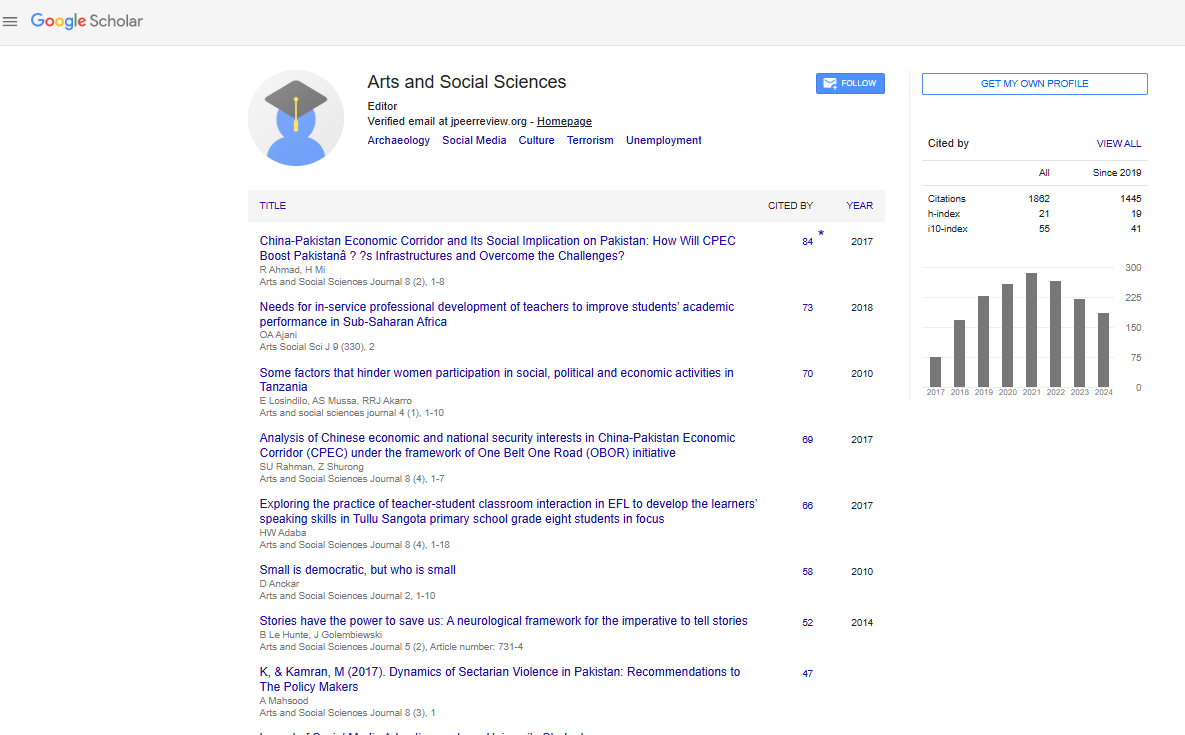
Arts and Social Sciences Journal received 1413 citations as per Google Scholar report