Brief Report - (2025) Volume 16, Issue 6
Received: 28-Nov-2025, Manuscript No. gjto-25-176205;
Editor assigned: 02-Dec-2025, Pre QC No. P-176205;
Reviewed: 15-Dec-2025, QC No. QC-176205;
Revised: 22-Dec-0025, Manuscript No. R-176205;
Published:
29-Dec-2025
, DOI: 10.37421/2229-8711.2025.16.473
Citation: Holub, Dmytro. ”Optimized Naïve Bayes: Versatile Applications, Powerful Results.” Global J Technol Optim 16 (2025):473.
Copyright: © 2025 Holub D. This is an open-access article distributed under the terms of the Creative Commons Attribution License, which permits unrestricted use, distribution and reproduction in any medium, provided the original author and source are credited.
The Naïve Bayes classifier proves its versatility across diverse applications, consistently demonstrating its effectiveness when optimized for specific tasks. For instance, enhancing a Naïve Bayes classifier through smart feature selection and parameter tweaking can significantly boost its performance, particularly in areas like filtering unwanted spam. What this really means is that optimizing the data going into the classifier often holds as much importance as the classifier algorithm itself [1].
In public health, a look at using Naïve Bayes to build a predictive model specifically for COVID-19 revealed it to be quite effective in distinguishing positive cases. This is a big deal for early diagnosis and resource allocation. Even with limited data, Naïve Bayes can offer valuable insights, proving its utility in urgent public health situations [2].
Looking at consumer insights, studies dive into improving Naïve Bayes for sentiment analysis, specifically on product reviews. The key insight here is that by refining feature engineering—how characteristics are extracted from text—accuracy in identifying positive or negative sentiments sees a significant boost. This helps businesses understand customer feedback better, which can really make a difference in product development [3].
For cybersecurity, research demonstrates how a finely tuned Naïve Bayes model can serve as an efficient system for detecting network intrusions. The critical takeaway is that intelligently processing network traffic data allows Naïve Bayes to quickly identify anomalies, making it a valuable tool. It shows the algorithm's strength in identifying unusual patterns with relatively low computational overhead [4].
In bioinformatics, a paper explores how to improve Naïve Bayes performance for classifying complex gene expression data. This is achieved by using sophisticated hybrid feature selection techniques. The core insight is that carefully choosing the most relevant genes, instead of using all of them, can significantly enhance classification accuracy. This is crucial where data dimensionality presents a major challenge [5].
Financial risk assessment benefits from a robust model for credit scoring, integrating hyperparameter optimization with a weighted Naïve Bayes approach. The core insight suggests that tailoring the algorithm's internal settings and assigning different importance to features can drastically improve prediction accuracy. This means financial institutions can make more informed lending decisions with greater confidence [6].
Healthcare diagnostics also leverage this algorithm. One paper explores the creation of a clinical decision support system utilizing a Naïve Bayes classifier to predict Type 2 Diabetes. The important discovery here is that Naïve Bayes can effectively process patient data to identify at-risk individuals, providing valuable assistance for early intervention. This highlights its potential to streamline diagnostic processes in healthcare settings [7].
Environmental monitoring is another critical area. A study investigates air quality prediction using various machine learning techniques, including Naïve Bayes, in a specific urban context. The main point is that even simpler models like Naïve Bayes offer valuable insights for environmental monitoring when optimized with relevant features. It demonstrates the algorithm's practicality in analyzing complex environmental datasets for timely warnings [8].
Agriculture also sees its utility. A paper focuses on using an optimized Naïve Bayes model for predicting crop yield by leveraging remote sensing data. The main point is that by integrating satellite imagery and environmental factors with a tailored Naïve Bayes approach, farmers can get more accurate forecasts. This offers practical benefits for precision agriculture, enabling better resource management and boosting food production [9].
Finally, in genomic research, a study evaluates the effectiveness of Naïve Bayes for classifying DNA sequences. The important finding is that Naïve Bayes can be a remarkably efficient and accurate tool for processing complex biological data. This is particularly true when dealing with the high dimensionality of genomic information, helping in tasks like gene function prediction or identifying disease markers [10].
The Naïve Bayes classifier stands out for its adaptability across a wide range of analytical challenges. A recurring theme across various studies is that while Naïve Bayes is inherently simple, its performance can be drastically improved through careful optimization, particularly in feature selection and parameter tuning. This fundamental approach allows even a basic algorithm to become much more powerful when the inputs it uses and how it processes them are fine-tuned. What this really means is that optimizing the data going into the classifier often proves just as important as the classifier itself [1]. This focus on data preparation and model refinement is evident in its application to diverse, complex datasets.
In the realm of textual data and natural language processing, Naïve Bayes shows considerable strength. For example, enhancements to the classifier through smart feature selection and parameter tweaking really boost its performance, especially for filtering spam [1]. Similarly, for sentiment analysis on product reviews, the key insight lies in refining feature engineering—the method of extracting characteristics from text. This refinement significantly boosts the accuracy of identifying positive or negative sentiments, offering businesses a better way to understand customer feedback and influence product development [3]. This demonstrates the algorithm's effectiveness in understanding human language patterns.
Its utility extends significantly into health, biology, and medicine. A predictive model for COVID-19, developed using Naïve Bayes, was found to be quite effective in distinguishing positive cases, which is a big deal for early diagnosis and resource allocation. Even with limited data, Naïve Bayes offers valuable insights, proving its use in urgent public health situations [2]. In clinical settings, a Naïve Bayes Classifier-based Clinical Decision Support System has been created for predicting Type 2 Diabetes. The important discovery here is that it effectively processes patient data to identify at-risk individuals, providing valuable assistance for early intervention and potentially streamlining diagnostic processes [7]. Furthermore, in more complex biological data environments, such as classifying gene expression data, improvements come from sophisticated hybrid feature selection techniques. Choosing the most relevant genes, rather than using all of them, can significantly enhance classification accuracy, which is crucial for bioinformatics where data dimensionality is often a major challenge [5]. Lastly, for DNA sequence classification, Naïve Bayes proves to be a remarkably efficient and accurate tool, especially when dealing with the high dimensionality inherent in genomic information. This helps in critical tasks like gene function prediction or identifying disease markers [10].
Beyond life sciences, Naïve Bayes plays a role in security and environmental monitoring. Research demonstrates how a finely tuned Naïve Bayes model can serve as an efficient system for detecting network intrusions. The critical takeaway is that by intelligently processing network traffic data, Naïve Bayes can quickly identify anomalies, making it a valuable tool for cybersecurity. It showcases the algorithm's strength in identifying unusual patterns with relatively low computational overhead [4]. In environmental science, a study investigating air quality prediction using various machine learning techniques, including Naïve Bayes, in a specific urban context highlighted that even simpler models like Naïve Bayes offer valuable insights for environmental monitoring when optimized with relevant features. This shows its practicality in analyzing complex environmental datasets for timely warnings [8].
Economically significant applications also stand out. In finance, a robust model for credit scoring integrates hyperparameter optimization with a weighted Naïve Bayes approach. The core insight is that tailoring the algorithm's internal settings and assigning different importance to features can drastically improve prediction accuracy in financial risk assessment. This means financial institutions can make more informed lending decisions with greater confidence [6]. Lastly, in agriculture, an optimized Naïve Bayes model is used for predicting crop yield by leveraging remote sensing data. By integrating satellite imagery and environmental factors with a tailored Naïve Bayes approach, farmers can get more accurate forecasts. This offers practical benefits for precision agriculture, enabling better resource management and boosting food production [9].
The Naïve Bayes classifier is a versatile and effective algorithm, finding applications across a wide array of domains from cybersecurity to healthcare and agriculture. Its performance is consistently enhanced through strategic optimization, primarily involving smart feature selection, parameter tuning, and hyperparameter optimization. These methods are crucial for boosting accuracy in tasks like spam detection and sentiment analysis on product reviews, where refining how text features are extracted makes a significant difference. In medical fields, Naïve Bayes models prove valuable for developing predictive tools for conditions such as COVID-19 and Type 2 Diabetes, enabling early diagnosis and intervention by effectively processing patient data. For complex biological data like gene expression and DNA sequences, optimized Naïve Bayes models provide efficient and accurate classification, which is essential given the high dimensionality of such information. Beyond these, the algorithm aids in detecting network intrusions by identifying anomalies in traffic data and contributes to environmental monitoring through air quality prediction. In finance, it supports robust credit scoring by intelligently weighting features, and in agriculture, it forecasts crop yields using remote sensing data. Across all these applications, the core insight remains: a carefully optimized Naïve Bayes model, often tailored by fine-tuning its inputs and internal settings, can yield powerful and practical results, proving that data optimization is as critical as the algorithm itself.
None
None
Jian-wei Y, Jian-feng Y, Dong-liang H. "An improved naive Bayes classifier for spam detection using feature selection and parameter optimization".Soft Comput 24 (2020):1373-1386.
Indexed at, Google Scholar, Crossref
Sreekanth P, Nagaratna PM, B. DCNP. "Development of a Predictive Model Using Naïve Bayes Classifier for COVID-19 Disease".Mach Learn Knowl Extr 2 (2020):434-447.
Indexed at, Google Scholar, Crossref
Pradipta KD, Sujata D, Sarat CN. "An enhanced Naive Bayes classifier for sentiment analysis of product reviews".J King Saud Univ Comput Inf Sci 33 (2021):460-468.
Indexed at, Google Scholar, Crossref
Abdul R, Muazam M, Muhammad AH. "An efficient Naive Bayes model for network intrusion detection system".Cluster Comput 25 (2022):295-309.
Indexed at, Google Scholar, Crossref
Yassine T, Adel G, Sami S. "Hybrid feature selection method based on mRMR and SVM-RFE for gene expression data classification using Naive Bayes".Comput Biol Med 137 (2021):104809.
Indexed at, Google Scholar, Crossref
Animesh G, Ashish G, Sandeep K. "A Robust Model for Credit Scoring Using Hyperparameter Optimization and Weighted Naïve Bayes".Appl Artif Intell 37 (2023):2268761.
Indexed at, Google Scholar, Crossref
R. N, P. K, P. K. "A Naive Bayes Classifier-based Clinical Decision Support System for Predicting Type 2 Diabetes".J Med Syst 44 (2020):116.
Indexed at, Google Scholar, Crossref
Z. AKB, M. A, A. BC. "Air Quality Prediction Using Optimized Machine Learning Techniques: A Case Study of Lahore, Pakistan".IEEE Access 8 (2020):70764-70775.
Indexed at, Google Scholar, Crossref
T. NR, S. VNKK, A. AK. "Optimized Naive Bayes Model for Crop Yield Prediction Using Remote Sensing Data".Int J Remote Sens 43 (2022):5997-6014.
Indexed at, Google Scholar, Crossref
M. MR, M. MI, M. MH. "Evaluation of Naive Bayes and Logistic Regression for DNA Sequence Classification".J Bioinform Comput Biol 19 (2021):2150017.
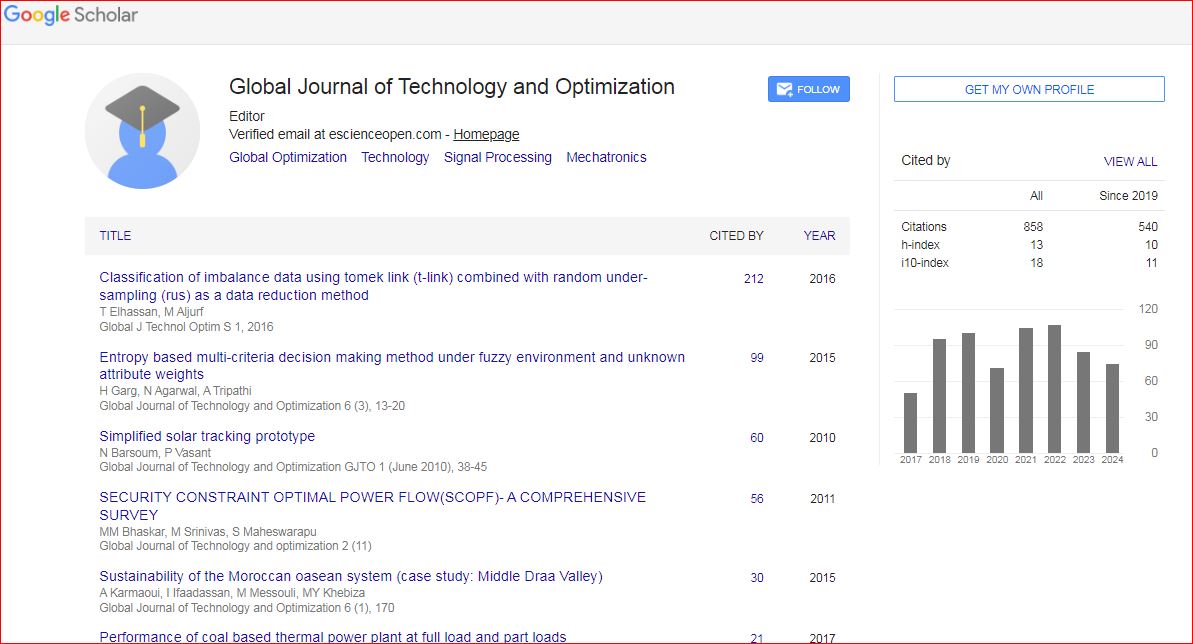
Global Journal of Technology and Optimization received 847 citations as per Google Scholar report