Short Communication - (2025) Volume 14, Issue 6
Received: 02-Nov-2025, Manuscript No. iem-26-179852;
Editor assigned: 04-Nov-2025, Pre QC No. P-179852;
Reviewed: 16-Nov-2025, QC No. Q-179852;
Revised: 23-Nov-2025, Manuscript No. R-179852;
Published:
30-Nov-2025
, DOI: 10.37421/2169- 0316.2025.14.335
Citation: Al-Hassan, Abdullah. âOperations Research: Tools for Industrial Optimization and Efficiency.â J Ind Eng Manag 14 (2025):335.
Copyright: © 2025 Al-Hassan A. This is an open-access article distributed under the terms of the Creative Commons Attribution License, which permits unrestricted use, distribution and reproduction in any medium, provided the original author and source are credited.
Operations Research (OR) has emerged as a pivotal discipline in industrial engineering and management, offering a comprehensive suite of methodologies to address intricate challenges and drive operational excellence. The field provides a powerful toolkit for optimizing complex systems, enabling data-driven decision-making that results in significant cost savings and enhanced productivity across various industrial sectors. This introduction will explore the multifaceted applications of OR, setting the stage for a deeper understanding of its impact. The application of OR methodologies, such as linear programming, simulation, and queuing theory, is fundamental to modern industrial engineering and management. These techniques are instrumental in optimizing production schedules, refining supply chain efficiency, effectively managing inventory levels, and strategically allocating resources within industrial settings. The insights derived from these OR applications underscore the transformative potential of data-driven approaches for achieving substantial cost reductions and productivity gains. Simulation modeling stands out as a crucial tool for optimizing manufacturing processes, specifically targeting the reduction of bottlenecks and the enhancement of overall throughput. By constructing digital representations of production lines, researchers can rigorously test a multitude of scenarios. These scenarios can include adjustments to machine speeds, alterations in staffing levels, or modifications to workflow sequences. The objective is to identify the most efficient operational configuration without disrupting ongoing physical operations. The findings from such simulations consistently highlight the immense value of this proactive problem-solving approach in strategic planning within industrial environments. Integer programming offers a sophisticated mathematical framework for optimizing complex scheduling tasks, particularly in large-scale industrial plants. The development of specialized models within this domain allows for the consideration of a wide array of constraints. These can encompass worker availability, the specific skill sets possessed by individuals, and adherence to legal working hour regulations. The ultimate goal is to generate optimal shift assignments that balance operational needs with employee well-being and legal compliance. The results typically demonstrate substantial improvements in schedule fairness and a tangible reduction in costly overtime expenditures, clearly illustrating the power of mathematical optimization in effective human resource management. Queuing theory provides an invaluable lens through which to analyze and significantly improve customer service times within industrial support departments. By meticulously understanding the patterns of customer arrivals and the durations of service provision, queuing models can effectively identify existing bottlenecks within the service process. Furthermore, these models offer strategic recommendations for resource allocation, thereby minimizing customer wait times. The successful implementation of queuing theory-based strategies has consistently led to a marked decrease in average customer wait times and a corresponding increase in overall service efficiency. Inventory management within industrial contexts is profoundly influenced by stochastic optimization techniques. These advanced methods address the inherent challenge of balancing the costs associated with holding inventory against the detrimental effects of stockouts. By developing dynamic ordering policies, businesses can achieve a more optimal equilibrium. This proposed approach leverages historical demand data and sophisticated forecasting models to create more resilient and cost-effective inventory systems for industrial goods. The ultimate aim is to ensure product availability while simultaneously minimizing waste and associated carrying costs. Network optimization models are instrumental in enhancing the efficiency of logistics and transportation networks within industrial operations. These models delve into critical aspects such as routing problems and strategic facility location decisions. The overarching objective is to minimize overall transportation costs and reduce delivery times across the entire network. The practical application of these OR techniques has consistently resulted in the establishment of more streamlined and demonstrably cost-effective supply chains, bolstering overall operational agility. Metaheuristics, including powerful algorithms such as genetic algorithms and simulated annealing, offer effective solutions for tackling complex scheduling problems prevalent in manufacturing environments. These computational methods are particularly adept at finding near-optimal solutions for problems that are otherwise computationally intractable for exact methods. The successful implementation of metaheuristic approaches has been shown to yield significant improvements in production schedules and a reduction in overall lead times, contributing to more agile and responsive manufacturing operations. Decision analysis and multi-criteria decision-making (MCDM) methods play a vital role in supporting strategic investment decisions within industrial projects. These OR tools provide a structured approach for evaluating potential investments by incorporating a diverse range of factors. These can include both qualitative aspects, such as strategic alignment and market impact, and quantitative metrics, such as projected return on investment and associated risks. By systematically analyzing these varied inputs, OR facilitates the selection of the most advantageous projects, thereby maximizing value and minimizing potential downsides. Dynamic programming offers a robust framework for optimizing sequential decision-making processes, particularly in the critical area of industrial maintenance planning. This methodology provides a systematic approach for determining optimal schedules for preventive maintenance activities. The primary objectives are to minimize overall maintenance costs and to maximize the operational lifespan of valuable equipment. This is achieved by carefully considering the time-dependent nature of equipment degradation and the strategic timing of maintenance interventions, thereby ensuring long-term operational reliability and cost-effectiveness.
Operations Research (OR) presents a robust framework for addressing the complexities inherent in modern industrial engineering and management. Its methodologies, including linear programming, simulation, and queuing theory, are pivotal in optimizing production schedules, enhancing supply chain performance, managing inventory efficiently, and allocating resources strategically within industrial settings. The adoption of OR facilitates data-driven decision-making, leading to substantial cost reductions and significant productivity improvements. The deployment of OR methodologies such as linear programming, simulation, and queuing theory is essential for optimizing various facets of industrial operations. These techniques are applied to refine production scheduling, boost supply chain efficiency, manage inventory levels, and improve resource allocation. The insights gained from applying OR principles underscore the value of data-centric approaches for achieving considerable cost savings and enhanced productivity. Simulation modeling provides a powerful means to optimize manufacturing processes, focusing on the critical areas of bottleneck reduction and throughput improvement. By creating virtual replicas, or digital twins, of production lines, researchers can experiment with numerous scenarios. These experiments might involve altering machine speeds or adjusting staffing levels, with the goal of identifying the most efficient configuration without impacting real-time operations. The outcomes of such simulations consistently demonstrate the utility of simulation in proactive problem resolution and strategic planning within industrial contexts. Integer programming is employed to optimize workforce scheduling in large industrial facilities. The models developed consider multiple constraints, including employee availability, skill matching, and legal working hour regulations, to create ideal shift assignments. The results typically show significant improvements in schedule fairness and a reduction in overtime costs, underscoring the efficacy of mathematical optimization for human resource management. Queuing theory is applied to analyze and enhance customer service times in industrial support departments. By understanding customer arrival rates and service durations, models can identify bottlenecks and suggest resource adjustments to minimize wait times. Practical implementations have led to noticeable reductions in average customer wait times and a boost in service efficiency. Stochastic optimization techniques are central to inventory management in industrial settings, addressing the trade-off between inventory holding costs and stockout penalties. By creating dynamic ordering policies, businesses can better balance these competing factors. This approach utilizes historical demand data and forecasts to build more resilient and cost-effective inventory systems for industrial goods, ensuring availability while minimizing excess stock. Network optimization models are utilized to streamline logistics and transportation networks in industrial operations. These models focus on optimizing routing and facility location to reduce transportation expenses and delivery lead times. The implementation of these OR techniques has resulted in more efficient and cost-effective supply chain operations. Metaheuristics, such as genetic algorithms and simulated annealing, are applied to solve complex industrial scheduling problems. These methods are effective for finding high-quality solutions to problems that are computationally intensive. Their successful application has led to improved production schedules and reduced lead times, enhancing manufacturing agility. Decision analysis and multi-criteria decision-making (MCDM) methods support strategic investment decisions in industrial projects. These tools integrate various qualitative and quantitative factors, aiding in the selection of projects that offer the best balance of risk, return, and strategic alignment. Dynamic programming is employed for optimizing sequential decision-making in industrial maintenance planning. This approach helps establish optimal preventive maintenance schedules to minimize costs and maximize equipment longevity, accounting for equipment degradation and maintenance timing.
Operations Research (OR) offers essential tools for industrial engineering and management, utilizing methodologies like linear programming, simulation, and queuing theory to optimize production, supply chains, inventory, and resource allocation. These data-driven approaches yield significant cost savings and productivity gains. Simulation modeling enhances manufacturing processes by identifying bottlenecks and improving throughput through virtual testing. Integer programming optimizes workforce scheduling by considering various constraints, leading to improved fairness and reduced overtime costs. Queuing theory minimizes customer wait times in support departments through process analysis and resource adjustment. Stochastic optimization improves inventory management by balancing holding and stockout costs. Network optimization streamlines logistics and transportation for greater efficiency. Metaheuristics solve complex scheduling problems, improving production and reducing lead times. Decision analysis and MCDM aid strategic investment decisions by evaluating multiple factors. Dynamic programming optimizes maintenance planning to minimize costs and maximize equipment lifespan.
None
None
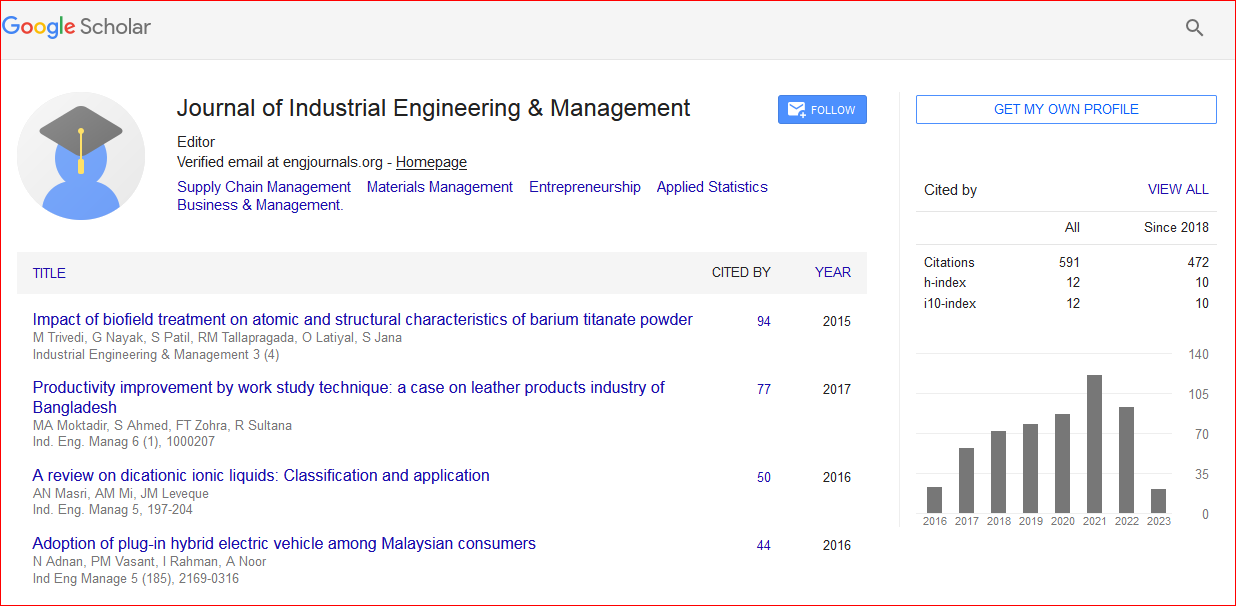
Industrial Engineering & Management received 739 citations as per Google Scholar report