Commentary - (2025) Volume 14, Issue 3
Received: 01-May-2025, Manuscript No. iem-26-179781;
Editor assigned: 04-May-2025, Pre QC No. P-179781;
Reviewed: 14-May-2025, QC No. Q-179781;
Revised: 21-May-2025, Manuscript No. R-179781;
Published:
29-May-2025
, DOI: 10.37421/2169- 0316.2025.14.302
Citation: Hassan, Amina. Operations Research: Driving Industrial Efficiency and Optimization. J Ind Eng Manag 14 (2025):302.
Copyright: © 2025 Hassan A. This is an open-access article distributed under the terms of the Creative Commons Attribution License, which permits unrestricted use,
distribution and reproduction in any medium, provided the original author and source are credited.
Operations Research (OR) has emerged as a transformative discipline within industrial systems, offering a sophisticated suite of analytical tools designed to facilitate optimal decision-making across a wide spectrum of complex operational challenges. This field is adept at addressing intricate problems inherent in modern manufacturing and production, including the meticulous planning of production schedules, the strategic management of inventory levels, and the efficient allocation of scarce resources. By constructing robust mathematical models that accurately represent real-world industrial scenarios, OR empowers organizations to pinpoint operational bottlenecks, significantly reduce associated costs, and systematically enhance overall efficiency. The cumulative effect of these interventions is the cultivation of industrial operations that are not only more competitive in the global marketplace but also demonstrably more sustainable in the long term, fostering resilience and adaptability [1].
The contemporary industrial landscape increasingly demands the sophisticated integration of Operations Research techniques, with a particular emphasis on methodologies involving simulation and advanced optimization. These powerful tools are indispensable for the modernization of industrial plant layouts and the strategic design of workflows. By enabling predictive analysis of diverse configurations, OR techniques facilitate the minimization of material handling distances, a critical factor in operational efficiency, and the maximization of overall throughput. The direct consequence of this optimized design is a substantial uplift in operational efficiency and a marked improvement in safety standards within industrial environments, creating more streamlined and secure workspaces [2].
Within the intricate web of industrial operations, inventory control stands out as a critical area profoundly impacted by Operations Research models. Classic yet effective models such as the Economic Order Quantity (EOQ) and Reorder Point (ROP) are instrumental in achieving a delicate balance. They meticulously weigh the costs associated with holding inventory against the potential risks and repercussions of stockouts. This judicious balance ensures that production lines maintain a consistent flow of necessary materials, thereby preventing costly interruptions, while simultaneously minimizing the amount of capital that is immobilized in static stock. This direct influence on cash flow and the assurance of operational continuity represent significant advantages for any industrial enterprise [3].
Scheduling, a ubiquitous challenge in industrial settings, spans a broad range of activities from the precise sequencing of tasks on machinery to the strategic allocation of human resources through workforce scheduling. Operations Research techniques, including powerful methods like integer programming and sophisticated metaheuristics, provide effective solutions to these complex scheduling problems. Their application ensures that tasks are executed with maximum efficiency, systematically minimizing unproductive idle time and achieving the highest possible utilization of available resources. The tangible outcome is a production schedule that is not only more predictable but also demonstrably more cost-effective, contributing to overall operational reliability [4].
Quality control within industrial systems receives a significant boost through the application of Operations Research tools. These tools are adept at the meticulous analysis of defect data, enabling the identification of root causes with a high degree of precision. Methodologies such as statistical process control and design of experiments, when informed by the principles of OR, lead to a marked improvement in the consistency of product quality and a substantial reduction in material waste. This unwavering focus on statistical rigor serves as a powerful engine for continuous improvement, driving higher standards and greater reliability in manufactured goods [5].
Logistics and supply chain management, integral components of any industrial operation, are prime candidates for optimization through Operations Research. A variety of OR models, including those for network optimization, solving vehicle routing problems, and sophisticated demand forecasting, are employed to enhance the efficiency of the entire supply chain. These methods facilitate the most efficient movement of goods, lead to a reduction in transportation costs, and contribute to improved delivery times. In today's interconnected global economy, these capabilities are absolutely critical for maintaining a distinct competitive edge and ensuring market responsiveness [6].
Maintenance scheduling and the broader field of reliability engineering within industrial systems are areas where Operations Research plays a vital and often indispensable role. Predictive maintenance models, which are increasingly sophisticated and rely on robust statistical analysis and advanced optimization techniques, are crucial for minimizing costly equipment downtime. By ensuring that maintenance is performed at the most optimal times, these models effectively prevent catastrophic failures before they occur, thereby reducing overall maintenance expenditures and enhancing operational uptime [7].
Energy management and the optimization of resource utilization within industrial plants represent a growing area of focus for Operations Research applications. A range of OR models are being developed and implemented to optimize energy consumption patterns, strategically schedule energy-intensive processes, and effectively integrate diverse renewable energy sources into the industrial energy mix. These initiatives contribute significantly to both substantial cost savings for the facility and the promotion of enhanced environmental sustainability in industrial operations [8].
Human factors and the effective management of the workforce within industrial settings can be substantially improved through the strategic application of Operations Research techniques. Optimization models are employed for tasks such as equitable task assignment, efficient shift scheduling, and the design of ergonomic workstations. These applications contribute to creating a safer working environment, fostering a more productive workforce, and ultimately leading to increased job satisfaction, which indirectly but significantly boosts the overall performance of the industrial system [9].
In the specialized domain of process industries, such as the chemical or petroleum sectors, the application of Operations Research is particularly focused on optimizing intricate continuous and batch operations. This encompasses a wide array of challenges, including the optimization of chemical reactions, the design of efficient separation processes, and the planning of plant-wide production strategies. The overarching objectives in these applications are to maximize product yield, minimize the generation of waste materials, and rigorously ensure the safe and reliable operation of complex industrial facilities [10].
Operations Research (OR) serves as a powerful analytical engine for industrial systems, providing essential tools for optimal decision-making in complex environments. Its applications are diverse, tackling critical areas such as production planning, inventory management, and resource allocation. By employing mathematical modeling to represent real-world industrial scenarios, OR enables the identification of inefficiencies, cost reduction, and performance enhancement, ultimately leading to more competitive and sustainable industrial practices [1].
The integration of advanced Operations Research techniques, particularly those involving simulation and optimization, is fundamental to the modernization of industrial plant layouts and the strategic design of workflows. These methodologies empower organizations with the capability for predictive analysis of various configurations, thereby facilitating the minimization of material handling distances and the maximization of throughput. The outcome is a tangible improvement in operational efficiency and a significant enhancement of safety standards within industrial settings [2].
Inventory control within industrial systems is significantly enhanced through the application of Operations Research models, notably the Economic Order Quantity (EOQ) and Reorder Point (ROP) models. These models are crucial for striking an effective balance between the costs associated with maintaining inventory and the inherent risks of stockouts. This ensures continuous material supply for production lines while minimizing capital expenditure on stock, directly impacting cash flow and operational continuity positively [3].
Scheduling problems, prevalent in industrial settings from machine operations to workforce management, find effective solutions through OR techniques like integer programming and metaheuristics. These methods are designed to ensure the efficient completion of tasks, thereby minimizing idle time and maximizing the utilization of resources. The result is a more predictable and cost-effective production schedule, contributing to overall operational reliability [4].
Quality control in industrial systems benefits substantially from OR tools focused on defect data analysis and root cause identification. Methodologies such as statistical process control and design of experiments, guided by OR principles, lead to more consistent product quality and a reduction in waste. This emphasis on statistical rigor drives a culture of continuous improvement and enhanced product reliability [5].
Logistics and supply chain management within industrial operations are greatly optimized using OR. Techniques such as network optimization, vehicle routing problem solutions, and demand forecasting models enable efficient goods movement, reduce transportation costs, and improve delivery times. These capabilities are vital for maintaining a competitive advantage in the dynamic global market [6].
Maintenance scheduling and reliability engineering in industrial systems are critically supported by OR. Predictive maintenance models, leveraging statistical analysis and optimization, are instrumental in minimizing equipment downtime and reducing maintenance costs by scheduling servicing at optimal times to prevent failures before they occur [7].
Energy management and resource optimization in industrial plants are increasingly addressed by OR. Models designed to optimize energy consumption, schedule energy-intensive processes, and integrate renewable energy sources contribute to both cost savings and environmental sustainability within industrial operations, aligning economic and ecological goals [8].
Human factors and workforce management in industrial settings are areas where OR techniques can yield significant improvements. Optimization models for task assignment, shift scheduling, and ergonomic design contribute to a safer, more productive, and more satisfied workforce, indirectly enhancing overall industrial system performance [9].
The application of OR in process industries, including chemical and petroleum sectors, is focused on optimizing complex continuous and batch operations. This involves optimizing reactions, designing separation processes, and planning plant-wide production to maximize yield, minimize waste, and ensure safe operations [10].
Operations Research (OR) significantly improves industrial systems through analytical tools for optimal decision-making in areas like production planning, inventory, and resource allocation. It helps identify bottlenecks, reduce costs, and boost efficiency. Modern industrial layouts and workflows benefit from simulation and optimization techniques, leading to improved efficiency and safety. Inventory control is enhanced by OR models like EOQ and ROP, balancing holding costs with stockout risks. Scheduling problems are effectively solved using OR methods, maximizing resource utilization. Quality control improves through OR-driven defect analysis and statistical process control. Logistics and supply chains are optimized with OR for efficient goods movement and cost reduction. Maintenance scheduling and reliability are enhanced by predictive models. Energy management and resource optimization are addressed by OR for cost savings and sustainability. Human factors and workforce management also see improvements through OR applications, leading to a safer and more productive workforce. Finally, process industries leverage OR to optimize complex operations, maximizing yield and ensuring safety.
None
None
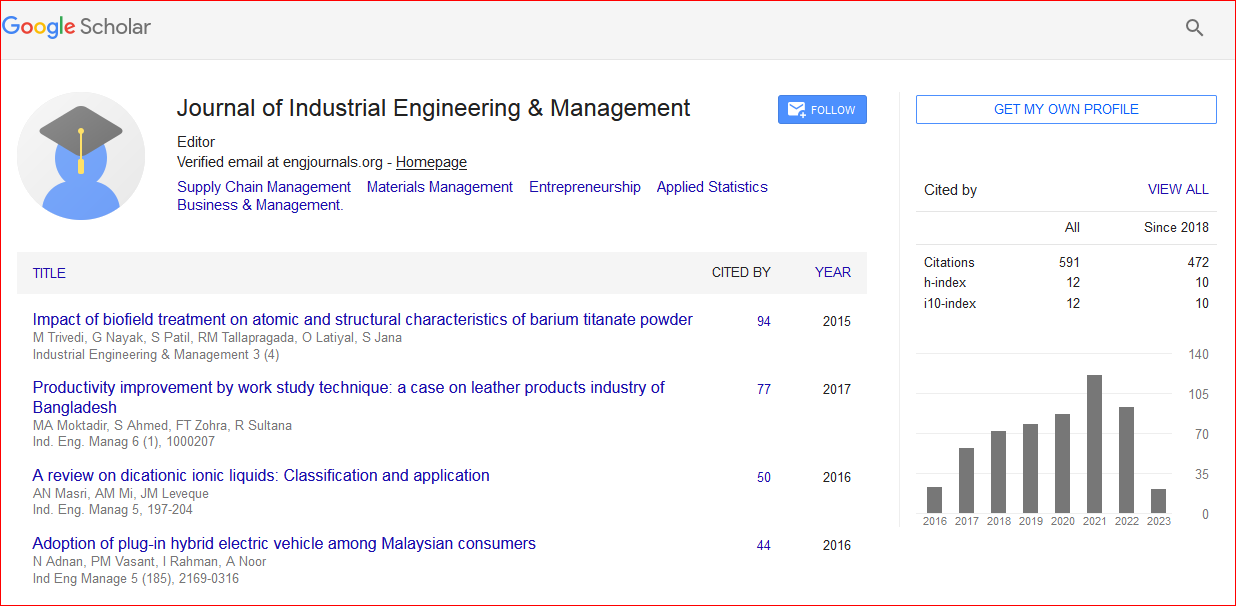
Industrial Engineering & Management received 739 citations as per Google Scholar report