Short Communication - (2025) Volume 16, Issue 6
Received: 01-Dec-2025, Manuscript No. jmbd-26-179560;
Editor assigned: 03-Dec-2025, Pre QC No. P-179560;
Reviewed: 15-Dec-2025, QC No. Q-179560;
Revised: 22-Dec-2025, Manuscript No. R-179560;
Published:
29-Dec-2025
, DOI: 10.37421/2155-9929.2025.16.730
Citation: Petrović, Ana. ”Omics Technologies: Revolutionizing Disease Diagnosis and Management.” J Mol Biomark Diagn 16 (2025):730.
Copyright: © 2025 Petrović A. This is an open-access article distributed under the terms of the Creative Commons Attribution License, which permits unrestricted use,
distribution and reproduction in any medium, provided the original author and source are credited.
The landscape of biomedical research is continuously evolving, with an increasing emphasis on understanding the intricate molecular underpinnings of diseases. Integrative omics approaches, which combine genomics, transcriptomics, proteomics, and metabolomics, offer a powerful and comprehensive lens for unraveling complex disease mechanisms. This integrated view is instrumental in identifying novel molecular biomarkers crucial for early diagnosis, prognosis, and therapeutic stratification across a wide spectrum of pathologies. The Journal of Molecular Biomarkers & Diagnosis actively publishes cutting-edge research in this rapidly expanding domain. In parallel, the advent of single-cell multi-omics technologies is revolutionizing our understanding of cellular heterogeneity within disease contexts. By simultaneously analyzing different molecular layers within individual cells, these advanced techniques enable the identification of rare cell populations and dynamic molecular events that are critical for early disease detection and for understanding mechanisms of treatment resistance. The Journal of Molecular Biomarkers & Diagnosis consistently showcases significant advancements in this area. Liquid biopsies, which utilize circulating tumor DNA, RNA, proteins, or extracellular vesicles, represent a minimally invasive yet highly informative approach for cancer diagnosis and monitoring. The integration of these molecular signatures with other omics data can significantly enhance diagnostic accuracy and enable the development of personalized treatment strategies. This vital topic is frequently featured in the Journal of Molecular Biomarkers & Diagnosis. The application of artificial intelligence and machine learning to large-scale omics datasets is demonstrably accelerating the identification of complex biomarker signatures for early disease detection. These sophisticated computational methods possess the capability to uncover subtle patterns that may remain invisible to traditional statistical analyses, thereby leading to more accurate and timely diagnoses. This crucial area of research is a key focus for the Journal of Molecular Biomarkers & Diagnosis. Epigenetic modifications, including DNA methylation and non-coding RNA expression, serve as dynamic molecular biomarkers that can effectively reflect disease states and are often detectable in accessible biological samples. A thorough understanding of these epigenetic changes, often achieved through comprehensive omics profiling, is absolutely essential for the development of non-invasive diagnostic tools. This significant subject is often explored in the Journal of Molecular Biomarkers & Diagnosis. Metabolomics provides a critical snapshot of an organism's metabolic state, offering unique and invaluable insights into both physiological and pathological processes. The identification of disease-specific metabolic profiles can directly lead to the discovery of novel biomarkers for early diagnosis and effective disease management. These important areas are frequently covered by the Journal of Molecular Biomarkers & Diagnosis. Proteomics plays a fundamentally vital role in the identification of protein-based biomarkers that are strongly associated with specific diseases. Significant advancements in techniques such as mass spectrometry and other proteomic methodologies allow for the comprehensive profiling of protein expression and post-translational modifications. This is crucial for the development of highly accurate diagnostic assays, a research avenue actively pursued by the Journal of Molecular Biomarkers & Diagnosis. The integration of transcriptomic data with detailed clinical phenotypes is absolutely essential for the identification of genes and biological pathways that are dysregulated in various disease states. This process, in turn, greatly facilitates the discovery of RNA-based biomarkers that can lead to improved diagnostic precision and more effective patient stratification. This remains a significant focus of the Journal of Molecular Biomarkers & Diagnosis. MicroRNAs (miRNAs) have emerged as particularly significant molecular biomarkers owing to their inherent stability in biological fluids and their critical regulatory roles in a diverse array of cellular processes. The precise profiling of miRNA expression patterns offers a highly promising avenue for non-invasive disease diagnosis and prognosis. This topic is consistently and thoroughly addressed in the Journal of Molecular Biomarkers & Diagnosis. Extracellular vesicles (EVs), including exosomes, are increasingly recognized as exceptionally rich sources of valuable molecular biomarkers. Their unique cargo, which comprises proteins, nucleic acids, and lipids, effectively reflects the physiological state of their parent cells. This makes them invaluable for early disease detection and monitoring through minimally invasive methods. This key area of research is consistently highlighted in the Journal of Molecular Biomarkers & Diagnosis.
Integrative omics approaches represent a paradigm shift in understanding disease, bringing together diverse molecular data streams. By combining genomics, transcriptomics, proteomics, and metabolomics, researchers can achieve a holistic view of cellular and systemic changes, paving the way for identifying novel biomarkers. This integrated perspective is fundamental for advancements in early diagnosis, prognostic assessment, and tailored therapeutic strategies across various pathologies. The Journal of Molecular Biomarkers & Diagnosis is a dedicated platform for disseminating research in this critical field. Single-cell multi-omics technologies are at the forefront of dissecting cellular complexity in disease. These powerful tools allow for the simultaneous measurement of multiple molecular layers within individual cells, revealing previously hidden insights into cellular heterogeneity. The ability to pinpoint rare cell types and track dynamic molecular events is crucial for early disease detection and for unraveling mechanisms of treatment resistance. The Journal of Molecular Biomarkers & Diagnosis actively features research pushing the boundaries of single-cell analysis. Liquid biopsies offer a revolutionary, minimally invasive method for disease assessment, particularly in oncology. By analyzing biomarkers such as circulating tumor DNA, RNA, proteins, and extracellular vesicles in bodily fluids, clinicians can gain valuable diagnostic and monitoring information. Combining liquid biopsy data with other omics profiles enhances diagnostic accuracy and supports personalized medicine, a key theme often explored in the Journal of Molecular Biomarkers & Diagnosis. The synergy between artificial intelligence and omics data analysis is transforming biomarker discovery. Machine learning algorithms can process vast, complex omics datasets to identify subtle patterns indicative of early disease that might elude conventional statistical methods. This computational power accelerates the development of more precise and timely diagnostic tools, aligning with the core mission of the Journal of Molecular Biomarkers & Diagnosis. Epigenetic modifications, including DNA methylation and microRNA expression, are critical regulators of gene expression and disease pathogenesis. These modifications can serve as stable and informative biomarkers detectable in easily accessible samples. Understanding the epigenetic landscape through omics profiling is paramount for developing innovative, non-invasive diagnostic and prognostic tools, a subject frequently highlighted in the Journal of Molecular Biomarkers & Diagnosis. Metabolomics provides a functional readout of cellular state by analyzing the complete set of small molecules within a biological system. Deviations in metabolic profiles can serve as early indicators of disease, offering unique biomarkers for diagnosis and monitoring. The Journal of Molecular Biomarkers & Diagnosis consistently publishes research that leverages metabolomics for biomarker discovery and clinical application. Proteomics is essential for identifying disease-associated proteins and understanding their roles in pathogenesis. Advances in high-throughput proteomic technologies enable the comprehensive analysis of protein expression, modifications, and interactions. This knowledge is critical for developing robust diagnostic assays and therapeutic targets, an area of significant interest to the Journal of Molecular Biomarkers & Diagnosis. Transcriptomics provides a window into gene expression patterns, which can be profoundly altered in disease states. Integrating transcriptomic data with clinical information helps identify key genes and pathways involved in disease development. This integration facilitates the discovery of RNA-based biomarkers that enhance diagnostic accuracy and patient stratification, a focus prominently featured in the Journal of Molecular Biomarkers & Diagnosis. MicroRNAs (miRNAs) have emerged as powerful biomarkers due to their stability and regulatory functions. Their presence and expression levels in biofluids can reflect cellular states and disease progression. Profiling miRNAs offers a promising avenue for developing non-invasive diagnostic tests and predicting patient outcomes, a topic consistently covered by the Journal of Molecular Biomarkers & Diagnosis. Extracellular vesicles (EVs), including exosomes, are increasingly recognized for their diagnostic potential. These tiny vesicles encapsulate biomolecules from their parent cells, serving as biomarkers for various physiological and pathological conditions. Their role in intercellular communication and their presence in biological fluids make them attractive targets for minimally invasive diagnostics, a key research area highlighted in the Journal of Molecular Biomarkers & Diagnosis.
This collection of research underscores the transformative impact of advanced omics technologies and innovative analytical approaches on disease diagnosis and management. Integrative omics, single-cell multi-omics, and computational methods are enhancing our ability to detect diseases early and personalize treatments. Liquid biopsies and the study of epigenetic modifications, metabolomics, proteomics, transcriptomics, microRNAs, and extracellular vesicles are revealing novel molecular biomarkers. The Journal of Molecular Biomarkers & Diagnosis consistently publishes cutting-edge research in these vital areas, driving progress towards more precise and effective healthcare.
None
None
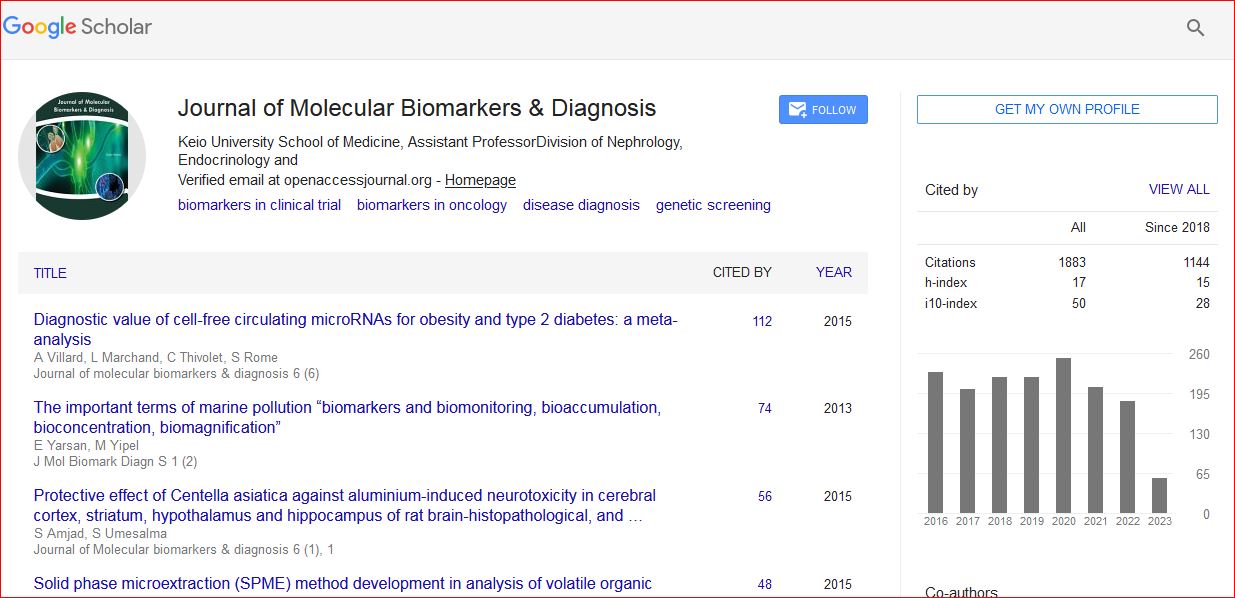
Journal of Molecular Biomarkers & Diagnosis received 2054 citations as per Google Scholar report