Short Communication - (2025) Volume 16, Issue 5
Received: 01-Oct-2025, Manuscript No. jmbd-26-179564;
Editor assigned: 03-Oct-2025, Pre QC No. P-179564;
Reviewed: 16-Oct-2025, QC No. Q-179564;
Revised: 23-Oct-2025, Manuscript No. R-179564;
Published:
30-Oct-2025
, DOI: 10.37421/2155-9929.2025.16.727
Citation: Zieliński, Tomasz. ”Omics, AI, and Liquid Biopsies: Revolutionizing Disease Biomarkers.” J Mol Biomark Diagn 16 (2025):727.
Copyright: © 2025 Zieliński T. This is an open-access article distributed under the terms of the Creative Commons Attribution License, which permits unrestricted use,
distribution and reproduction in any medium, provided the original author and source are credited.
The identification and validation of molecular signatures and biomarkers are fundamental to the advancement of disease diagnosis, facilitating earlier detection, more precise prognostication, and the development of personalized treatment strategies. This dynamic field is witnessing considerable progress in elucidating complex disease mechanisms at the molecular level. Biomarkers derived from diverse omics disciplines, including genomics, transcriptomics, proteomics, and metabolomics, are offering unprecedented opportunities to differentiate between healthy and diseased states and to stratify patient populations effectively [1].
Liquid biopsies, particularly those that analyze circulating tumor DNA (ctDNA), present a non-invasive avenue for cancer diagnosis and monitoring. These ctDNA-based biomarkers hold the potential to detect minimal residual disease, track treatment responses, and identify resistance mutations, thereby providing a dynamic perspective on tumor evolution. Significant advancements in next-generation sequencing and digital PCR technologies are concurrently enhancing the sensitivity and specificity of these diagnostic assays [2].
The integration of machine learning and artificial intelligence is proving to be a transformative force in biomarker discovery and interpretation. By processing vast and intricate datasets from multi-omics studies, AI algorithms are capable of discerning subtle patterns and predictive signatures that might elude traditional statistical methodologies. This synergistic approach promises to accelerate the development of more accurate diagnostic tools and highly personalized treatment regimens [3].
Proteomic profiling provides a dynamic snapshot of cellular activities and can unveil biomarkers indicative of disease states, often before the manifestation of overt symptoms. Mass spectrometry-based proteomics, when combined with sophisticated bioinformatics, is instrumental in identifying novel protein signatures for the early detection of cancer and for gaining insights into disease progression and treatment response in conditions such as Alzheimer's disease and cardiovascular diseases [4].
Metabolomics offers valuable insights into the metabolic alterations associated with various diseases. Changes observed in the metabolome can serve as direct reflections of physiological and pathological processes, rendering metabolites potent biomarkers for early diagnosis and prognosis. For instance, aberrant metabolic profiles are increasingly implicated in neurodegenerative diseases, metabolic disorders, and a spectrum of cancers, thereby paving the way for the development of targeted interventions [5].
The development of robust and reproducible biomarker assays is paramount for their successful translation from research settings to routine clinical practice. The implementation of standardized protocols, rigorous validation studies, and inter-laboratory comparisons is essential to guarantee the reliability and clinical utility of molecular biomarkers in everyday diagnostics. This includes ensuring that biomarkers possess adequate sensitivity, specificity, and predictive accuracy [6].
Epigenetic modifications, encompassing phenomena such as DNA methylation and alterations in microRNA expression, are emerging as highly promising biomarkers for disease diagnosis and prognosis. These changes can emerge early in the disease development continuum and often exhibit considerable stability, making them attractive candidates for non-invasive diagnostic tests. Their significance is increasingly recognized across various cancers and chronic diseases, fueling extensive research efforts [7].
The advancements in single-cell technologies are revolutionizing the identification of novel cellular subpopulations and their associated molecular signatures that can function as effective biomarkers. This high-resolution analytical approach permits a more nuanced comprehension of disease heterogeneity and the potential to identify rare cell types or states that are critical for accurate diagnosis and targeted therapeutic interventions, particularly in complex conditions like autoimmune disorders and cancer [8].
The integration of multi-omics data is indispensable for comprehensively capturing the intricate nature of diseases and for identifying comprehensive molecular signatures. By synergistically combining genomic, transcriptomic, proteomic, and metabolomic information, researchers can attain a more holistic understanding of disease pathogenesis and discover more robust biomarkers possessing enhanced diagnostic and prognostic power, ultimately leading to improved patient outcomes [9].
The development of innovative assay technologies, including microfluidics and advanced imaging techniques, is significantly expanding the capabilities for biomarker detection. These technologies offer enhanced sensitivity, reduced sample volume requirements, and the promising potential for point-of-care diagnostics. Their widespread application is broadening the reach of molecular diagnostics, making sophisticated biomarker analysis more accessible and feasible in diverse clinical settings [10].
The identification and validation of molecular signatures and biomarkers represent a cornerstone in the evolution of disease diagnosis, enabling earlier detection, more accurate prognostication, and the tailoring of personalized treatment strategies. This field is characterized by rapid advancements, with significant progress being made in understanding complex disease mechanisms at the molecular level. Biomarkers originating from genomics, transcriptomics, proteomics, and metabolomics are providing unprecedented opportunities to distinguish between healthy and diseased states and to stratify patient populations [1].
Liquid biopsies, particularly those focusing on circulating tumor DNA (ctDNA), offer a non-invasive methodology for cancer diagnosis and monitoring. These ctDNA-based biomarkers have the capability to detect minimal residual disease, track treatment responses, and identify resistance mutations, thus providing a dynamic view of tumor evolution. The ongoing advancements in next-generation sequencing and digital PCR technologies are continuously improving the sensitivity and specificity of these crucial assays [2].
The application of machine learning and artificial intelligence is profoundly transforming the landscape of biomarker discovery and interpretation. By analyzing large and complex datasets generated from multi-omics studies, AI algorithms can identify subtle patterns and predictive signatures that might be overlooked by conventional statistical methods. This integration promises to accelerate the development of more accurate diagnostic tools and personalized treatment regimens [3].
Proteomic profiling provides a dynamic overview of cellular activity and can reveal biomarkers indicative of disease states, sometimes even before the onset of overt symptoms. Mass spectrometry-based proteomics, when coupled with advanced bioinformatics tools, is instrumental in identifying novel protein signatures for early cancer detection and for understanding disease progression and treatment response in conditions such as Alzheimer's and cardiovascular diseases [4].
Metabolomics offers deep insights into the metabolic alterations associated with disease processes. Changes in the metabolome can reflect underlying physiological and pathological events, establishing metabolites as valuable biomarkers for early diagnosis and prognosis. For instance, altered metabolic profiles are increasingly recognized in neurodegenerative diseases, metabolic disorders, and various cancers, opening new avenues for targeted therapeutic interventions [5].
The creation of robust and reproducible biomarker assays is a critical step for their successful translation from research environments to clinical practice. The establishment of standardized protocols, rigorous validation studies, and inter-laboratory comparisons is fundamental to ensuring the reliability and clinical utility of molecular biomarkers in routine diagnostic procedures. This encompasses ensuring sufficient sensitivity, specificity, and predictive accuracy [6].
Epigenetic modifications, including DNA methylation and microRNA expression patterns, are emerging as powerful biomarkers for disease diagnosis and prognosis. These alterations can occur early in disease development and often remain stable, making them appealing candidates for non-invasive diagnostic tests. Their role in the pathogenesis of various cancers and chronic diseases is a rapidly expanding area of research [7].
The development and application of single-cell technologies are enabling the identification of novel cellular subpopulations and their associated molecular signatures that can serve as effective biomarkers. This high-resolution approach facilitates a more nuanced understanding of disease heterogeneity and can reveal rare cell types or states that are critical for diagnosis and therapeutic targeting, especially in complex diseases like autoimmune disorders and cancer [8].
The integration of multi-omics data is essential for fully capturing the complexity of disease and for identifying comprehensive molecular signatures. By combining information from genomics, transcriptomics, proteomics, and metabolomics, researchers can achieve a more holistic understanding of disease pathogenesis and discover more robust biomarkers with higher diagnostic and prognostic power, ultimately leading to improved patient outcomes [9].
The advancement of novel assay technologies, such as microfluidics and sophisticated imaging techniques, is enhancing the capabilities for biomarker detection. These technologies offer improved sensitivity, require smaller sample volumes, and hold the potential for point-of-care diagnostics. Their application is expanding the reach of molecular diagnostics, making advanced biomarker analysis more accessible in various clinical settings [10].
Molecular signatures and biomarkers are crucial for advancing disease diagnosis, enabling earlier detection, better prognostication, and personalized treatments. This field leverages diverse omics approaches like genomics, transcriptomics, proteomics, and metabolomics. Liquid biopsies, particularly ctDNA analysis, offer non-invasive cancer diagnostics and monitoring. Artificial intelligence and machine learning are revolutionizing biomarker discovery by analyzing complex datasets. Proteomics and metabolomics provide dynamic insights into cellular activity and metabolic alterations, identifying early disease markers. Epigenetic modifications and single-cell technologies are also emerging as powerful tools for detecting disease states. The successful clinical translation of biomarkers hinges on robust assay development, standardization, and validation. Integrating multi-omics data offers a more comprehensive understanding of disease and leads to more powerful biomarkers. Advancements in assay technologies like microfluidics are enhancing detection capabilities and enabling point-of-care diagnostics.
None
None
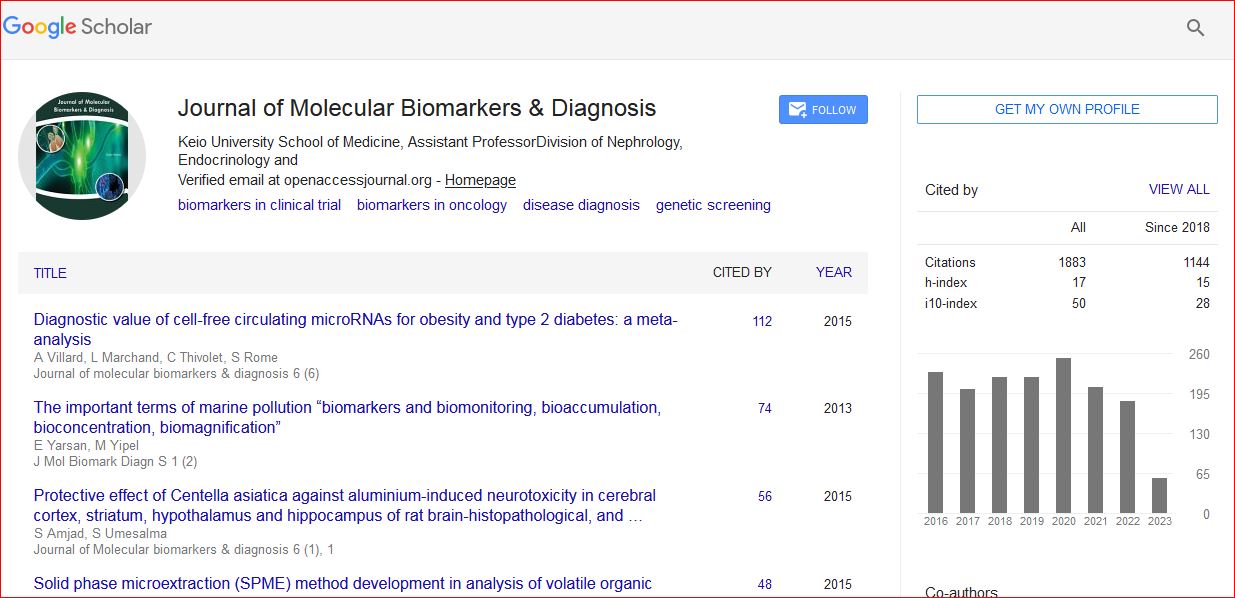
Journal of Molecular Biomarkers & Diagnosis received 2054 citations as per Google Scholar report