Opinion - (2025) Volume 16, Issue 5
Received: 01-Oct-2025, Manuscript No. jmbd-26-179565;
Editor assigned: 03-Oct-2025, Pre QC No. P-179565;
Reviewed: 15-Oct-2025, QC No. Q-179565;
Revised: 23-Oct-2025, Manuscript No. R-179565;
Published:
30-Oct-2025
, DOI: 10.37421/2155-9929.2025.16.726
Citation: Bello, Zainab. ”Omics, AI, and Biomarkers for Precision Medicine.” J Mol Biomark Diagn 16 (2025):726
Copyright: © 2025 Bello Z. This is an open-access article distributed under the terms of the Creative Commons Attribution License, which permits unrestricted use, distribution and reproduction in any medium, provided the original author and source are credited.
The field of molecular biomarker discovery is undergoing a significant transformation, driven by technological advancements and innovative analytical approaches. Emerging trends indicate a paradigm shift towards more precise and personalized diagnostic and prognostic tools across various disease areas. The integration of cutting-edge technologies and computational methods is central to unlocking the full potential of biomarkers for improving patient outcomes. The rapid evolution of omics technologies, coupled with the power of artificial intelligence, is accelerating the identification of novel biomarkers. These innovations are critical for early disease detection, predicting disease progression, and forecasting therapeutic responses. The spectrum of conditions benefiting from these advances includes complex diseases such as cancer and neurodegenerative disorders. This enhanced capability allows for a deeper understanding of disease mechanisms and the development of more sensitive diagnostic assays [1].
Single-cell technologies represent a revolutionary leap in biomarker discovery, offering unprecedented resolution in characterizing cellular heterogeneity within tissues. This detailed cellular analysis is indispensable for comprehending intricate disease states, as distinct cell populations often harbor unique molecular signatures. The applications are diverse, ranging from the identification of rare cancer cells to the dynamic tracking of immune cell responses in infectious and autoimmune diseases, ultimately leading to more refined diagnostic and therapeutic strategies [2].
Liquid biopsies, employing circulating tumor DNA (ctDNA), circulating tumor cells (CTCs), and extracellular vesicles (EVs) found in bodily fluids, are emerging as potent non-invasive tools. These methods are instrumental in cancer detection, monitoring disease progression, and guiding treatment selection. Progress in next-generation sequencing and digital PCR has significantly boosted the sensitivity and specificity of these assays, paving the way for their routine clinical implementation in early diagnosis, recurrence surveillance, and personalized therapy selection [3].
Artificial intelligence (AI) and machine learning (ML) are profoundly reshaping the analysis of complex biological data in biomarker discovery. These computational techniques excel at identifying subtle patterns and correlations that might elude traditional statistical analyses. AI/ML models are increasingly applied to integrate multi-omics datasets, predict disease risk, classify disease subtypes, and optimize the design of diagnostic assays, thereby expediting the translation of research findings into clinical practice [4].
The development of robust and reproducible assays is a critical prerequisite for the clinical utility of newly identified biomarkers. Microfluidic devices and point-of-care testing (POCT) platforms are gaining prominence due to their capacity for rapid, sensitive, and cost-effective biomarker detection. These technologies facilitate decentralized testing, enhancing patient access to diagnostic services, particularly in settings with limited resources [5].
Exosomes and other extracellular vesicles (EVs) are increasingly recognized as valuable sources of biomarkers. Their endogenous cargo, consisting of proteins, nucleic acids, and lipids, mirrors the physiological state of their originating cells. Their inherent role in intercellular communication and their prevalence in biofluids position them as promising candidates for non-invasive diagnostics across a range of diseases, including cancer, cardiovascular conditions, and neurological disorders [6].
The integration of multi-omics data is essential for capturing the multifaceted nature of disease. By combining genomic, transcriptomic, proteomic, and metabolomic information, researchers gain a more comprehensive understanding of biological processes and disease pathogenesis. This holistic approach enhances the discovery of synergistic biomarkers that exhibit superior diagnostic power and predictive accuracy compared to those derived from single data modalities [7].
Circular RNAs (circRNAs) represent a novel class of non-coding RNAs characterized by a unique covalently closed loop structure. Their inherent stability and abundance in various biofluids make them promising candidates for biomarker development. The observation of their dysregulation in numerous diseases, including cancer and neurological disorders, underscores their potential for early detection and prognosis [8].
Personalized medicine is fundamentally dependent on identifying biomarkers that can accurately predict an individual patient's response to specific therapies. For instance, pharmacogenomic biomarkers are crucial for guiding drug selection and optimizing dosage, thereby maximizing treatment efficacy and minimizing adverse effects. Advancements in high-throughput sequencing and bioinformatics are significantly accelerating the discovery and application of these personalized biomarkers [9].
The field of molecular biomarker discovery is rapidly evolving, driven by advancements in omics technologies and artificial intelligence. These innovations are enabling the identification of novel biomarkers for early disease detection, prognosis, and therapeutic response prediction across a spectrum of conditions, including cancer and neurodegenerative diseases. The integration of multi-omics data, such as genomics, transcriptomics, proteomics, and metabolomics, is proving crucial for a comprehensive understanding of disease mechanisms and for developing more accurate and sensitive diagnostic assays [1].
Single-cell technologies are revolutionizing biomarker discovery by allowing for the characterization of cellular heterogeneity within tissues. This detailed resolution is critical for understanding disease states, as distinct cell populations can harbor unique molecular signatures. Applications range from identifying rare cancer cells to tracking immune cell dynamics in infectious diseases and autoimmune disorders, leading to more precise diagnostic and therapeutic strategies [2].
Liquid biopsies, utilizing circulating tumor DNA (ctDNA), circulating tumor cells (CTCs), and extracellular vesicles (EVs) in bodily fluids, are emerging as powerful non-invasive tools for cancer detection, monitoring, and treatment selection. Advances in next-generation sequencing and digital PCR are enhancing the sensitivity and specificity of these methods, paving the way for routine clinical applications in early diagnosis, recurrence monitoring, and guiding personalized therapies [3].
Artificial intelligence (AI) and machine learning (ML) are transforming the analysis of complex biological data in biomarker discovery. These computational approaches enable the identification of subtle patterns and correlations that may be missed by traditional statistical methods. AI/ML models are being applied to integrate multi-omics data, predict disease risk, classify disease subtypes, and optimize diagnostic assay design, accelerating the translation of research findings into clinical practice [4].
The development of robust and reproducible assays is paramount for the clinical utility of newly discovered biomarkers. Microfluidic devices and point-of-care testing (POCT) platforms are gaining traction for their ability to enable rapid, sensitive, and cost-effective biomarker detection. These technologies facilitate decentralized testing, improving patient access to diagnostics, particularly in resource-limited settings [5].
Exosomes and other extracellular vesicles (EVs) are increasingly recognized as valuable sources of biomarkers due to their cargo of proteins, nucleic acids, and lipids that reflect the physiological state of their parent cells. Their role in intercellular communication and their presence in biofluids make them promising for non-invasive diagnostics of various diseases, including cancer, cardiovascular disease, and neurological disorders [6].
The integration of multi-omics data is crucial for capturing the complexity of disease. Combining genomic, transcriptomic, proteomic, and metabolomic information provides a more holistic view of biological processes and disease pathogenesis. This integrated approach enhances the discovery of synergistic biomarkers that offer greater diagnostic power and predictive accuracy than single-modality biomarkers [7].
Circular RNAs (circRNAs) are a novel class of non-coding RNAs with a unique covalently closed loop structure. They are emerging as promising biomarkers due to their stability and abundance in various biofluids. Their dysregulation in numerous diseases, including cancer and neurological disorders, highlights their potential for early detection and prognosis [8].
The development of personalized medicine hinges on the identification of biomarkers that predict individual patient response to therapy. Pharmacogenomic biomarkers, for example, can guide drug selection and dosing, optimizing treatment efficacy and minimizing adverse effects. Advances in high-throughput sequencing and bioinformatics are accelerating the discovery and application of such personalized biomarkers [9].
The regulatory landscape for novel diagnostic biomarkers is complex, requiring rigorous validation to ensure their safety and efficacy before clinical adoption. Streamlined regulatory pathways, coupled with robust analytical and clinical validation studies, are essential for translating promising discoveries from the laboratory to the patient bedside. This ensures that new diagnostic tools meet high standards of reliability and clinical utility [10].
The field of molecular biomarker discovery is rapidly advancing due to innovations in omics technologies and artificial intelligence, enabling early disease detection and treatment response prediction. Single-cell technologies offer detailed cellular insights for understanding disease states. Liquid biopsies provide non-invasive methods for cancer monitoring and management. AI and machine learning are crucial for analyzing complex biological data and identifying subtle patterns. The development of robust assays, including microfluidic devices and point-of-care testing, is essential for clinical utility. Extracellular vesicles and circular RNAs are emerging as promising sources of biomarkers due to their stability and reflective nature of cellular states. Integrating multi-omics data provides a holistic view of disease mechanisms. Pharmacogenomic biomarkers are key to personalized medicine, guiding tailored therapies. Rigorous validation and regulatory oversight are critical for translating biomarker discoveries into clinical practice.
None
None
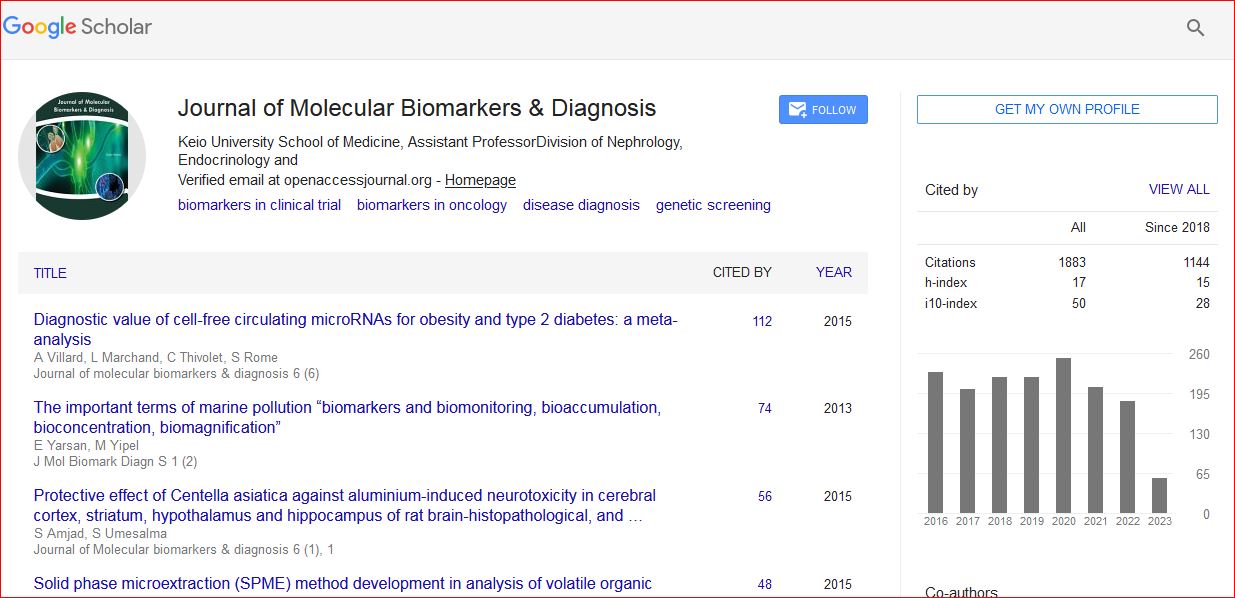
Journal of Molecular Biomarkers & Diagnosis received 2054 citations as per Google Scholar report