Opinion - (2025) Volume 14, Issue 4
Received: 01-Jul-2025, Manuscript No. aim-25-177762;
Editor assigned: 03-Jul-2025, Pre QC No. P-177762;
Reviewed: 17-Jul-2025, QC No. Q-177762;
Revised: 22-Jul-2025, Manuscript No. R-177762;
Published:
29-Jul-2025
, DOI: 10.37421/2427-5162.2025.14.582
Citation: Carter, Emily Rose. ”Nutritional Interventions: Managing Chronic Inflammation.” Alt Integr Med 14 (2025):582.
Copyright: © 2025 Carter R. Emily This is an open-access article distributed under the terms of the Creative Commons Attribution License, which permits unrestricted use, distribution and reproduction in any medium, provided the original author and source are credited.
Omega-3 polyunsaturated fatty acids (PUFAs) are increasingly recognized for their critical role in modulating inflammatory processes pertinent to inflammatory bowel disease (IBD). Recent scientific inquiries have elucidated updated mechanisms through which these essential fatty acids interact with complex immune pathways, thereby providing valuable insights into their potential as a therapeutic intervention for alleviating symptoms and slowing the progression of IBD. This understanding is vital for advancing targeted nutritional strategies in clinical practice [1].
The intricate relationship between the gut microbiome, dietary patterns, and the manifestation of inflammatory bowel disease constitutes a pivotal area of ongoing research. Studies underscore how specific dietary components exert a profound influence on the composition and function of microbial communities within the gut, subsequently impacting intestinal immunity and the overall inflammatory milieu. This critical nexus offers promising avenues for developing innovative therapeutic interventions [2].
A comprehensive systematic review and meta-analysis have meticulously assessed the impact of adhering to the Mediterranean diet on inflammatory bowel disease. The aggregate findings consistently suggest that this established dietary pattern may significantly contribute to reducing systemic inflammation and improving disease outcomes, thereby positioning it as a robust complementary therapeutic strategy within the holistic management of IBD [3].
Vitamin D plays a multifaceted and increasingly recognized role in both the prevention and treatment of a spectrum of inflammatory diseases. Updated scientific literature details how vitamin D effectively modulates diverse immune responses and actively suppresses the production of pro-inflammatory cytokines, underscoring its substantial potential as a supplementary intervention in the comprehensive management of chronic inflammatory conditions [4].
Curcumin, a natural compound derived from the turmeric plant, has been the subject of extensive scientific scrutiny regarding its therapeutic efficacy in inflammatory bowel disease. Research spanning from rigorous preclinical studies to controlled clinical trials consistently highlights curcumin's potent anti-inflammatory properties and its notable potential as an adjunct therapy, necessitating further exploration into its optimal application [5].
The burgeoning field of prebiotics, probiotics, and postbiotics offers substantial promise in the context of inflammatory bowel disease, as detailed in recent comprehensive reviews. These biologically active compounds exert their beneficial effects by precisely modulating the gut microbiota and fine-tuning immune responses, suggesting a significant therapeutic utility in effectively managing inflammation and fostering the restoration of intestinal health [6].
Beyond individual nutrients, the adoption of specific anti-inflammatory dietary patterns exerts a broad and beneficial impact on overall health outcomes. Contemporary reviews meticulously detail how particular food selections and carefully composed nutrient ratios can profoundly influence systemic inflammation, thereby offering clear guidance on dietary strategies aimed at mitigating chronic inflammatory processes throughout the human body [7].
Micronutrients, including but not limited to zinc and selenium, possess an underappreciated yet critical significance in both the pathogenesis and subsequent management of inflammatory bowel disease. Research consistently illuminates how deficiencies or, conversely, appropriate supplementation of these essential elements can directly influence immune function and modulate inflammatory responses, pointing towards their distinct therapeutic potential [8].
The ketogenic diet, characterized by its high-fat and very low-carbohydrate composition, has drawn attention for its potential benefits and inherent risks when applied to autoimmune diseases. Scientific investigations propose that this unique metabolic state may influence fundamental metabolic pathways and immune responses, leading to a reduction in inflammation, although its practical application warrants careful consideration of potential adverse effects [9].
An overarching review of various nutritional interventions for managing chronic inflammation consolidates a wealth of current evidence concerning specific nutrients, distinct dietary patterns, and various supplements known to modulate inflammatory pathways. This foundational understanding is indispensable for guiding their effective therapeutic application within clinical practice, promoting an integrated approach to patient care [10].
Understanding the detailed mechanisms and therapeutic implications of nutritional components in inflammatory bowel disease is crucial for developing targeted interventions. This section elaborates on the findings from recent studies, highlighting how specific dietary elements, microbial interactions, and nutrient supplementation contribute to managing and mitigating the symptoms and progression of IBD. Each article provides a unique perspective on the intricate balance between diet, immunity, and inflammation, offering a comprehensive view of potential therapeutic pathways. A detailed review on omega-3 polyunsaturated fatty acids explores their updated mechanisms of action in inflammatory bowel disease, emphasizing their capacity to modulate key inflammation pathways. The authors suggest that leveraging these fatty acids could offer significant therapeutic potential for alleviating symptoms and slowing the progression of IBD by influencing cellular and molecular responses [1]. The critical interplay between the gut microbiome, specific dietary patterns, and inflammatory bowel disease is comprehensively analyzed. This article highlights how various dietary components actively shape the composition and metabolic activity of gut microbial communities, which in turn profoundly influences intestinal immunity and the inflammatory cascade, providing crucial insights for future therapeutic strategies [2]. A systematic review and meta-analysis specifically investigates the Mediterranean diet's efficacy in managing inflammatory bowel disease. The compelling findings suggest that consistent adherence to this dietary pattern is associated with a notable reduction in inflammation markers and an improvement in overall disease outcomes, strongly supporting its integration as a valuable complementary therapeutic approach [3]. Updated insights into vitamin D's multifaceted role reveal its broad impact on the prevention and treatment of various inflammatory diseases. This paper elaborates on how vitamin D actively modulates immune responses, effectively suppressing pro-inflammatory cytokines and thus demonstrating significant potential as a supplementary intervention for individuals grappling with chronic inflammatory conditions [4]. The scientific investigation into curcumin's efficacy for inflammatory bowel disease, spanning both preclinical research and human clinical trials, is meticulously reviewed. This comprehensive analysis outlines curcumin's potent anti-inflammatory properties and its emerging potential as a safe and effective adjunct therapy, prompting further research into its precise mechanisms and optimal clinical utility [5]. A thorough examination of prebiotics, probiotics, and postbiotics in the context of inflammatory bowel disease elucidates their mechanisms of action. The review clarifies how these beneficial compounds modulate the gut microbiota and immune responses, thereby suggesting their substantial therapeutic utility in effectively managing intestinal inflammation and facilitating the restoration of gut health [6]. Various anti-inflammatory dietary patterns are discussed regarding their extensive impact on broad health outcomes. This review meticulously details how specific food combinations and nutrient profiles can profoundly influence systemic inflammation, offering practical guidance for implementing dietary strategies specifically designed to mitigate chronic inflammatory processes throughout the human system [7]. The crucial role of specific micronutrients, such as zinc and selenium, in both the pathogenesis and management of inflammatory bowel disease is thoroughly explored. This article underscores how imbalances or appropriate supplementation of these essential elements can significantly influence immune function and effectively temper inflammation, thereby pointing to their distinct therapeutic potential in IBD care [8]. An insightful paper investigates the ketogenic diet's potential benefits and associated risks in autoimmune diseases, including those with inflammatory components. It discusses how this unique high-fat, low-carbohydrate dietary approach might influence specific metabolic pathways and immune responses to reduce inflammation, while also carefully considering its practical application and potential drawbacks for patients [9]. Finally, a comprehensive review provides an overarching summary of diverse nutritional interventions tailored for managing chronic inflammation. This synthesis of current evidence encompasses specific nutrients, established dietary patterns, and various supplements that are capable of modulating inflammatory pathways, thereby offering a foundational understanding for their practical application in clinical settings [10].
Nutritional strategies play a pivotal role in managing inflammatory bowel disease and other chronic inflammatory conditions. Research consistently highlights the therapeutic potential of various dietary components and patterns. Omega-3 fatty acids, for instance, modulate inflammatory pathways, offering a foundational approach to symptom management. The gut microbiome is intricately linked to IBD, with diet significantly shaping microbial communities and influencing intestinal immunity. Specific dietary patterns, such as the Mediterranean diet, have shown efficacy in reducing inflammation and improving disease outcomes, suggesting their value as complementary therapies. Furthermore, micronutrients like vitamin D, zinc, and selenium are critical for immune function, and their proper supplementation can help mitigate inflammation. Curcumin, a natural anti-inflammatory compound, is also being explored as an adjunct therapy. The complex role of prebiotics, probiotics, and postbiotics in modulating gut microbiota and immune responses offers another promising avenue for restoring gut health. Even specialized diets like the ketogenic diet are under investigation for their potential to reduce inflammation in autoimmune diseases. Collectively, these studies emphasize the profound impact of nutritional interventions on inflammatory pathways, advocating for integrated dietary approaches in clinical practice to manage chronic inflammation and improve patient well-being.
None
vNone
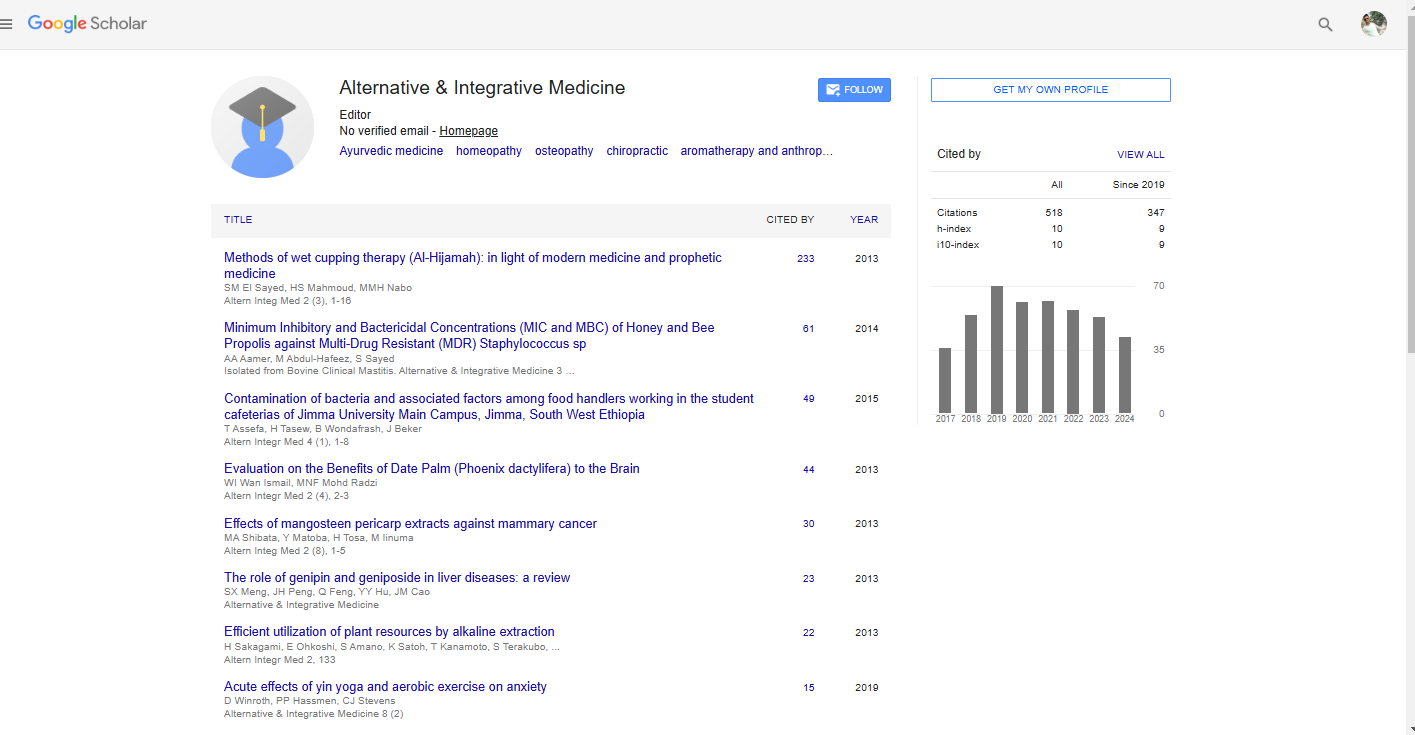
Alternative & Integrative Medicine received 476 citations as per Google Scholar report