Short Communication - (2025) Volume 14, Issue 6
Received: 01-Dec-2025, Manuscript No. jnc-25-178151;
Editor assigned: 03-Dec-2025, Pre QC No. P-178151;
Reviewed: 17-Dec-2025, QC No. Q-178151;
Revised: 22-Dec-2025, Manuscript No. R-178151;
Published:
29-Dec-2025
, DOI: DOI: 10.37421/2167-1168.2025.14.743
Citation: Jae, Choi Min. ”Nursing Communication: Building Trust, Enhancing Outcomes.” J Nurs Care 14 (2025):743.
Copyright: © 2025 Jae M. Choi This is an open-access article distributed under the terms of the Creative Commons Attribution License, which permits unrestricted use, distribution and reproduction in any medium, provided the original author and source are credited.
Effective communication stands as a cornerstone in the nursing profession, essential for forging robust therapeutic relationships with patients. It encompasses a multifaceted approach that includes attentive active listening, genuine empathy, and precise verbal and non-verbal exchanges. These elements are paramount for ensuring patient safety, elevating satisfaction levels, and ultimately achieving positive health outcomes, particularly within the high-stakes environment of critical care settings [1].
The competence of nurses in their communication directly influences the delivery of patient-centered care. Research indicates a strong correlation between high communication competence and enhanced patient trust, improved adherence to prescribed treatment plans, and increased patient engagement in their own healthcare journey. This collaborative approach fosters a more effective therapeutic alliance between the nurse and the patient [2].
Within critical care units, several barriers can impede effective nurse-patient communication. These challenges often arise from factors such as the high acuity of patients, severe time constraints faced by nursing staff, and the frequent use of complex medical jargon. Recognizing these obstacles underscores the critical need for targeted training programs and the development of strategic interventions to overcome them [3].
Empathy plays a pivotal role in the establishment and sustenance of therapeutic nurse-patient relationships. Empathetic communication serves to build trust, mitigate patient anxiety, and is consistently associated with improved patient experiences and better health outcomes. This is especially true when nurses are navigating sensitive or distressing situations with their patients [4].
Systematic reviews have evaluated the effectiveness of specialized communication skills training programs for nurses. The findings consistently demonstrate that well-structured training can significantly enhance nurses' communication abilities. This enhancement subsequently leads to more positive patient interactions and the cultivation of stronger therapeutic relationships [5].
Non-verbal communication significantly influences the dynamics of therapeutic relationships in nursing. A nuanced understanding and skillful utilization of non-verbal cues, including body language and facial expressions, can profoundly impact how patients perceive the care they receive and the overall quality of the nurse-patient interaction [6].
The critical care setting presents unique challenges and necessitates specific strategies for effective communication with both critically ill patients and their families. Maintaining open and consistent communication channels is vital for facilitating shared decision-making, effectively managing expectations, and providing crucial emotional support during periods of severe illness [7].
Active listening is a fundamental skill for building trust and rapport in nursing practice. When nurses actively listen, they gain a deeper understanding of their patients' needs, concerns, and preferences. This deeper understanding enables more effective care delivery and strengthens the therapeutic alliances formed with patients [8].
Cultural competence is a key determinant in the success of nurse-patient communication. Communication that is sensitive to cultural nuances can lead to increased patient satisfaction, better adherence to medical advice, and improved health outcomes. This highlights the imperative for nurses to cultivate an understanding and respect for diverse cultural backgrounds [9].
Both verbal and non-verbal communication play crucial roles in patient education. The ability of nurses to convey information clearly and with empathy, employing appropriate verbal explanations alongside relevant non-verbal signals, is critical for ensuring patient comprehension and promoting effective self-management of health conditions [10].
Effective communication is indispensable for establishing and maintaining strong therapeutic relationships in nursing practice. This involves a combination of active listening, empathetic understanding, and clear articulation through both verbal and non-verbal channels. These skills are fundamental to ensuring patient safety, fostering satisfaction, and achieving optimal health outcomes, especially in demanding critical care environments [1].
Nurses' proficiency in communication is directly linked to the quality of patient-centered care provided. A high level of communication competence has been associated with increased patient trust, better adherence to treatment regimens, and greater patient involvement in their own healthcare. This fosters a more collaborative and effective therapeutic partnership [2].
Several factors can hinder effective nurse-patient communication within intensive care units. These include the severity of patient conditions, significant time pressures on healthcare providers, and the use of technical medical terminology. Addressing these barriers requires dedicated training and the implementation of practical strategies [3].
Empathy is a critical component in the development and maintenance of therapeutic nurse-patient relationships. Empathetic communication enhances trust, alleviates patient anxiety, and contributes to a more positive patient experience and improved clinical outcomes, particularly when patients are dealing with difficult or distressing health issues [4].
Studies on communication skills training for nurses have consistently shown positive results. Structured training programs are effective in enhancing nurses' communication abilities, which in turn leads to improved interactions with patients and the strengthening of therapeutic bonds [5].
The impact of non-verbal communication on the therapeutic relationship is significant. Nurses' awareness and application of non-verbal cues, such as body language and facial expressions, can greatly influence patient perceptions of care and the overall quality of the interaction [6].
Effective communication with critically ill patients and their families presents distinct challenges and requires specific strategies. Maintaining open lines of communication is essential for enabling shared decision-making, managing patient and family expectations, and providing necessary emotional support during critical illness [7].
Active listening is a foundational technique for building trust and rapport in nursing. Nurses who actively listen are better equipped to understand patient needs, concerns, and preferences, which leads to more effective care and stronger therapeutic alliances [8].
Cultural competence significantly impacts nurse-patient communication. Communication that respects cultural diversity can lead to higher patient satisfaction, improved adherence to care plans, and better health outcomes. Nurses must be attuned to and respectful of diverse cultural backgrounds [9].
Verbal and non-verbal communication are both vital in patient education. Nurses' ability to clearly and empathetically impart information, using both spoken words and appropriate non-verbal signals, is crucial for patient understanding and successful self-management of health conditions [10].
Effective communication is fundamental in nursing for building therapeutic relationships, ensuring patient safety, and improving health outcomes. Key communication skills include active listening, empathy, and clear verbal and non-verbal exchanges. High communication competence enhances patient trust, treatment adherence, and engagement, fostering a collaborative alliance. Barriers in critical care include patient acuity, time constraints, and medical jargon, necessitating targeted training. Empathy reduces anxiety and improves patient experiences. Communication skills training can significantly improve nurse-patient interactions. Non-verbal cues influence patient perceptions of care. Open communication is vital for shared decision-making and emotional support, especially in critical illness. Cultural competence improves patient satisfaction and outcomes. Clear and empathetic patient education, using both verbal and non-verbal methods, is crucial for self-management.
None
None
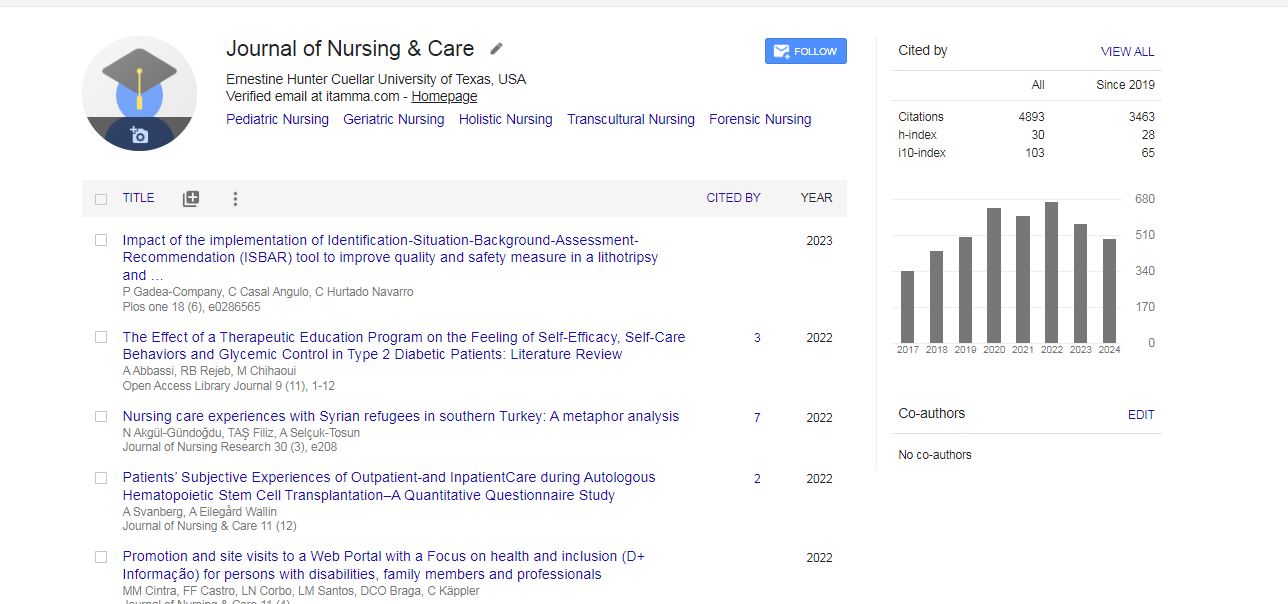
Journal of Nursing & Care received 4230 citations as per Google Scholar report