Opinion - (2025) Volume 10, Issue 3
Received: 01-May-2025, Manuscript No. apn-26-179117;
Editor assigned: 04-May-2025, Pre QC No. P-179117;
Reviewed: 14-May-2025, QC No. Q-179117;
Revised: 21-May-2025, Manuscript No. R-179117;
Published:
28-May-2025
, DOI: 10.37421/2573-0347.2025.10.433
Citation: Sørensen, Henrik. âNursesâ Vital Role in Cardiac Emergencies: ACLS Mastery.â J Adv Practice Nurs 10 (2025):433.
Copyright: © 2025 Sørensen H. This is an open-access article distributed under the terms of the Creative Commons Attribution License, which permits unrestricted use,
distribution and reproduction in any medium, provided the original author and source are credited.
The significance of Advanced Cardiac Life Support (ACLS) training for nurses in emergency cardiac care cannot be overstated. This specialized training equips nurses with critical skills necessary to manage life-threatening cardiac events effectively, thereby improving patient outcomes [1].
Simulation-based training within ACLS programs has proven to be an exceptionally effective method for nurses to acquire and retain essential skills. This approach creates a safe yet realistic environment for practicing high-stakes procedures and decision-making, ultimately fostering confidence and competence [2].
Nurses play a pivotal role in the early management of ST-elevation myocardial infarction (STEMI). Their ability to recognize symptoms, interpret ECGs, and initiate timely reperfusion therapy, enhanced by ACLS knowledge, directly impacts survival rates [3].
Maintaining nursing competency in ACLS presents challenges, particularly in high-turnover emergency departments. Regular in-service training, skills refreshers, and competency assessments are vital strategies to ensure sustained proficiency in this demanding field [4].
During sudden cardiac arrest (SCA), nurses are at the forefront of critical interventions. ACLS training empowers them to act swiftly and competently, from initiating CPR to administering life-saving medications, directly influencing patient survival and recovery [5].
Technological innovations, such as virtual reality (VR) and augmented reality (AR), are transforming ACLS training for nurses. These immersive technologies offer realistic practice environments, potentially enhancing decision-making and procedural accuracy in emergencies [6].
The psychological well-being of nurses in emergency cardiac care is closely linked to their ACLS competency. Feeling well-prepared through rigorous training contributes to greater job satisfaction, resilience, and a higher quality of care under pressure [7].
Interprofessional collaboration is a cornerstone of effective ACLS. Advanced training ensures nurses can confidently participate in and lead team efforts, fostering synchronized actions with physicians and other healthcare providers for optimal patient resuscitation [8].
Staying abreast of evolving ACLS guidelines is fundamental for nurses to provide evidence-based care. Continuous learning regarding updates in CPR techniques, defibrillation strategies, and pharmacological interventions is crucial for expert practice [9].
Nursing leadership in emergency cardiac events is often facilitated by advanced ACLS training. Competent nurses can effectively direct resuscitation efforts, manage teams, and delegate tasks, thereby optimizing patient care and outcomes during crises [10].
Advanced Cardiac Life Support (ACLS) training significantly enhances nursing proficiency in emergency cardiac care. It imparts essential skills such as rapid assessment, effective defibrillation, airway management, and drug administration, all of which are critical for improving patient outcomes during life-threatening cardiac events. Continuous education, simulation-based training, and interdisciplinary teamwork are emphasized as vital for maintaining and improving these competencies [1].
The integration of simulation-based training within ACLS programs for nurses demonstrates high efficacy in skill acquisition and retention. This method provides a safe space for nurses to practice high-stakes procedures, make critical decisions, and receive immediate feedback, thereby building confidence and competence. Repeated exposure to various scenarios through simulation improves performance during actual emergencies, leading to better patient care [2].
Research highlights the critical role nurses play in the immediate management of ST-elevation myocardial infarction (STEMI). Nurses are often the first to recognize symptoms, initiate electrocardiogram (ECG) interpretation, and facilitate timely reperfusion therapy. Enhanced ACLS competency empowers nurses to proactively manage these patients, reducing door-to-balloon times and improving survival rates [3].
Maintaining nursing competency in ACLS poses distinct challenges, especially in environments with high staff turnover, such as emergency departments. Regular in-service training, skills refreshers, and robust competency assessments are crucial for ensuring nurses remain proficient in emergency cardiac care. A supportive organizational culture and access to updated guidelines are also identified as key factors for sustained high performance [4].
Nurses' actions during sudden cardiac arrest (SCA) are pivotal for patient survival. ACLS training equips them with the knowledge and skills to recognize SCA, initiate CPR, perform defibrillation, and administer life-saving medications. The article underscores that a nurse's rapid and skilled response, guided by ACLS principles, is a primary determinant of patient survival and recovery [5].
Technological advancements are reshaping ACLS training for nurses. Virtual reality (VR) and augmented reality (AR) offer immersive and realistic learning experiences, allowing nurses to practice complex skills in a controlled yet interactive environment. This can lead to improved decision-making and greater procedural accuracy in real-world emergency situations [6].
The psychological impact of caring for critically ill cardiac patients can be substantial for nurses. ACLS competency plays a role in mitigating stress and burnout by ensuring nurses feel well-prepared and capable. This preparedness contributes to greater job satisfaction and resilience, positively influencing the quality of care provided during high-pressure scenarios [7].
Interprofessional collaboration is essential for successful ACLS. This article emphasizes how effective communication and synchronized actions among nurses, physicians, and other healthcare providers are critical for optimal patient resuscitation. Advanced ACLS training enables nurses to confidently contribute to and lead team efforts, enhancing the efficiency and effectiveness of emergency cardiac interventions [8].
Keeping nurses current with the evolution of ACLS guidelines is imperative for delivering evidence-based care. The article outlines key updates in recent guidelines, focusing on areas such as CPR techniques, defibrillation strategies, and pharmacological interventions, reinforcing the importance of continuous learning for expert practice in emergency cardiac settings [9].
Nurses often demonstrate leadership in emergency cardiac events, a role facilitated by their advanced ACLS training. Competent nurses can effectively direct resuscitation efforts, delegate tasks, and manage team dynamics during crises, thereby optimizing patient care and outcomes. This leadership is crucial for ensuring organized and efficient responses to life-threatening situations [10].
This collection of articles highlights the critical role of nurses in emergency cardiac care, emphasizing the indispensable nature of Advanced Cardiac Life Support (ACLS) training. ACLS equips nurses with essential skills for rapid assessment, defibrillation, airway management, and drug administration, directly impacting patient survival during life-threatening events like sudden cardiac arrest and ST-elevation myocardial infarction. Simulation-based training and technological innovations like VR/AR are presented as effective methods for skill acquisition and retention. The importance of continuous education, staying updated with evolving guidelines, and interprofessional collaboration is stressed for maintaining competency. Furthermore, ACLS training enhances nurses' psychological well-being and leadership capabilities in high-pressure situations, ultimately contributing to improved patient outcomes and efficient emergency response.
None
None
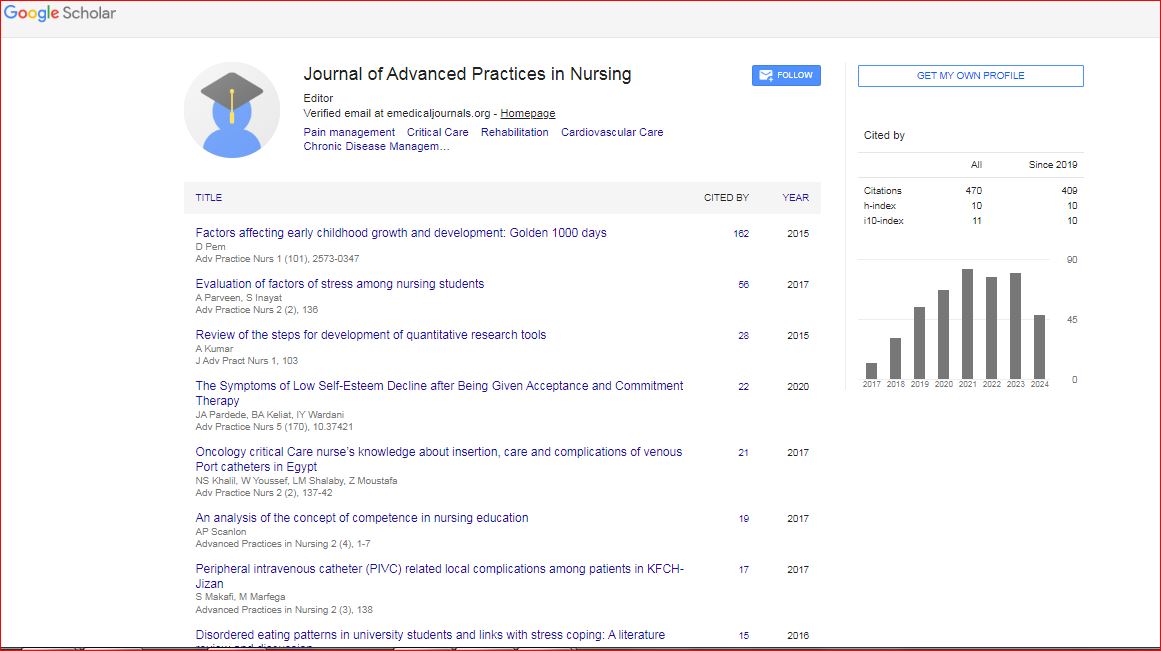
Journal of Advanced Practices in Nursing received 410 citations as per Google Scholar report