Perspective - (2025) Volume 14, Issue 6
Received: 01-Dec-2025, Manuscript No. jnc-25-178145;
Editor assigned: 03-Dec-2025, Pre QC No. P-178145;
Reviewed: 17-Dec-2025, QC No. Q-178145;
Revised: 22-Dec-2025, Manuscript No. R-178145;
Published:
29-Dec-2025
, DOI: DOI: 10.37421/2167-1168.2025.14.740
Citation: Malhotra, Arjun. ”Nurses: Comprehensive Psychosocial Support And Holistic Care.” J Nurs Care 14 (2025):740.
Copyright: © 2025 Malhotra A. This is an open-access article distributed under the terms of the Creative Commons Attribution License, which permits unrestricted use, distribution and reproduction in any medium, provided the original author and source are credited.
The field of mental health nursing is continuously evolving, with a significant focus on enhancing the psychosocial support provided to individuals experiencing mental health challenges. This multidisciplinary approach recognizes the intricate interplay between psychological, social, and biological factors in the development and recovery from mental illness. Psychiatric nurses play a pivotal role in this domain, employing a range of therapeutic strategies to foster well-being and facilitate healing. The integration of evidence-based interventions into nursing practice is paramount. These interventions are designed to address the multifaceted needs of patients, encompassing therapeutic communication, empathy, and active listening as foundational elements for building therapeutic relationships. The use of established therapeutic modalities such as Cognitive Behavioral Therapy (CBT) and Dialectical Behavior Therapy (DBT) is increasingly recognized as crucial for managing a diverse spectrum of mental health conditions, underscoring the need for nurses to be adept in their application [1].
Beyond individual therapeutic interventions, the importance of peer support in the recovery journey of individuals with severe mental illness cannot be overstated. Peer specialists, drawing from their lived experiences, offer a unique perspective and invaluable support, fostering hope and reducing feelings of isolation. The research highlights how peer-led groups and one-on-one support can powerfully complement traditional clinical interventions, empowering individuals and significantly contributing to their recovery [2].
Mindfulness-based interventions have also emerged as a significant tool in psychiatric nursing. Techniques such as mindful breathing and body scans are being utilized by nurses to help patients manage anxiety and depression. These practices not only promote self-regulation and emotional resilience in patients but also contribute to the well-being of nurses by mitigating occupational stress, creating a more supportive and sustainable care environment [3].
Family involvement is another critical component of effective mental health care. Family psychoeducation, particularly for conditions like schizophrenia, empowers families with the knowledge and skills to manage the illness, improve communication, and implement coping mechanisms. Such interventions are proven to reduce relapse rates, enhance patient functioning, and alleviate the burden on caregivers, thereby strengthening the entire family unit's capacity for support and recovery [4].
Furthermore, the principles of trauma-informed care are increasingly being integrated into mental health nursing practice. Recognizing the profound and pervasive impact of trauma on an individual's mental and physical health, nurses are trained to create safe environments. Strategies focused on sensitive communication, avoiding re-traumatization, and promoting patient empowerment and choice are essential for building trust and facilitating healing in individuals who have experienced trauma [5].
Specific therapeutic modalities continue to be refined and applied within nursing practice. Dialectical Behavior Therapy (DBT) skills training, for instance, has shown considerable efficacy when delivered in group settings for individuals with borderline personality disorder. These groups focus on teaching crucial skills for emotion regulation, distress tolerance, and interpersonal effectiveness, leading to improved symptom management and enhanced quality of life [6].
Community-based interventions are also vital for broader mental health promotion. Nurses are instrumental in enhancing mental health literacy within communities, providing accurate information, reducing stigma, and encouraging help-seeking behaviors. Through public education, advocacy, and early intervention, nurses can foster mental well-being across diverse populations, making mental health a community-wide priority [7].
For individuals with specific conditions like schizophrenia, targeted interventions such as social skills training (SST) have demonstrated significant benefits. Delivered by nurses, SST systematically equips clients with practical skills for social interaction, communication, and problem-solving, thereby improving social functioning, reducing isolation, and enhancing overall quality of life [8].
Innovative therapeutic approaches, such as Acceptance and Commitment Therapy (ACT), are also being explored and applied in mental health nursing. ACT principles help patients accept difficult thoughts and feelings while committing to values-driven actions, which can improve psychological flexibility and manage symptoms of depression and anxiety, offering a dynamic pathway to psychosocial support [9].
Finally, it is imperative to acknowledge the critical importance of self-care for mental health nurses themselves. The emotional demands of their profession necessitate robust self-care strategies to prevent burnout and ensure sustained, effective patient care. Practices such as mindfulness, seeking supervision, and maintaining a healthy work-life balance are crucial for professional sustainability and the overall quality of care provided [10].
Mental health nursing is characterized by its commitment to providing comprehensive psychosocial support, a cornerstone of effective mental healthcare. This support is built upon a foundation of strong therapeutic relationships, cultivated through skilled communication techniques, genuine empathy, and attentive active listening. The application of evidence-based interventions, such as Cognitive Behavioral Therapy (CBT) and Dialectical Behavior Therapy (DBT), is integral to addressing the wide array of mental health conditions encountered in practice, reflecting a commitment to utilizing scientifically validated approaches [1].
Complementing individual therapeutic efforts, the impact of peer support on the psychosocial well-being of individuals with severe mental illness is profoundly significant. Trained peer specialists leverage their own lived experiences to instill hope, enhance treatment adherence, and combat the pervasive feelings of isolation often associated with these conditions. The integration of peer-led groups and individual support offers a vital addition to traditional clinical interventions, empowering individuals and fostering their journey towards recovery [2].
Psychiatric nurses are increasingly incorporating mindfulness-based interventions into their practice to assist patients in managing anxiety and depression. Techniques like mindful breathing and body scans, facilitated by nurses, empower patients with tools for self-regulation and emotional resilience. Importantly, these practices have also been observed to benefit the nurses themselves, offering a means to reduce occupational stress and promote their own mental well-being [3].
The crucial role of families in the recovery process is further amplified through family psychoeducation programs. Nurses are key in delivering these structured educational initiatives, particularly for conditions like schizophrenia. These programs equip families with essential knowledge about illness management, effective communication strategies, and coping mechanisms, leading to tangible improvements such as reduced relapse rates, better patient functioning, and eased caregiver burden [4].
Adherence to trauma-informed care principles is a vital aspect of contemporary mental health nursing. This approach emphasizes creating a safe and supportive environment for individuals who have experienced trauma, acknowledging its widespread effects on both mental and physical health. Nurses employ strategies for sensitive communication, diligent avoidance of re-traumatization, and the active promotion of patient empowerment and autonomy within the care setting [5].
Specialized therapeutic modalities continue to be a focus within mental health nursing. For instance, Dialectical Behavior Therapy (DBT) skills training groups, expertly facilitated by nurses, have shown considerable success in managing borderline personality disorder. These groups provide a structured environment for patients to learn and practice emotion regulation, distress tolerance, and interpersonal effectiveness, contributing to improved symptom control and overall life quality [6].
Beyond direct patient care, nurses play a significant role in broader community mental health initiatives. Enhancing mental health literacy within communities is a key objective, involving the dissemination of accurate information about mental health conditions, the active reduction of stigma, and the encouragement of individuals to seek help. Nurses can lead public education campaigns, engage in advocacy, and implement early intervention strategies to foster mental well-being across diverse populations [7].
For individuals with schizophrenia, specific nursing interventions like social skills training (SST) have been extensively evaluated for their effectiveness. Through systematic instruction, nurses help clients develop practical skills necessary for social interaction, effective communication, and adept problem-solving. The outcomes of SST demonstrate notable improvements in social functioning, a reduction in social isolation, and an enhanced overall quality of life for those affected by this condition [8].
Acceptance and Commitment Therapy (ACT) represents another valuable therapeutic framework being integrated into mental health nursing. Nurses utilizing ACT principles guide patients in accepting challenging thoughts and emotions while fostering commitment to actions aligned with their personal values. This approach has been shown to enhance psychological flexibility and effectively manage symptoms of depression and anxiety, offering a contemporary and beneficial method for psychosocial support [9].
Lastly, the importance of self-care for mental health nurses themselves cannot be overstated. The inherent emotional demands of the profession necessitate dedicated attention to personal well-being to prevent burnout and maintain the capacity for delivering high-quality patient care. Essential strategies include mindfulness practices, seeking regular supervision, and diligently maintaining a healthy work-life balance, all of which are crucial for professional longevity and effectiveness [10].
This collection of articles highlights the multifaceted role of mental health nurses in providing comprehensive psychosocial support. Key areas explored include the integration of evidence-based therapies like CBT and DBT, the importance of therapeutic communication, and the application of mindfulness-based interventions for managing anxiety and depression. The impact of peer support and family psychoeducation on recovery is emphasized, alongside the crucial principles of trauma-informed care. Specific interventions such as social skills training for schizophrenia and DBT skills training for borderline personality disorder are detailed. Furthermore, the role of nurses in promoting community mental health literacy and the adoption of innovative therapies like ACT are discussed. Finally, the critical necessity of self-care strategies for mental health nurses to prevent burnout is underscored, highlighting the holistic approach to mental well-being for both patients and practitioners.
None
None
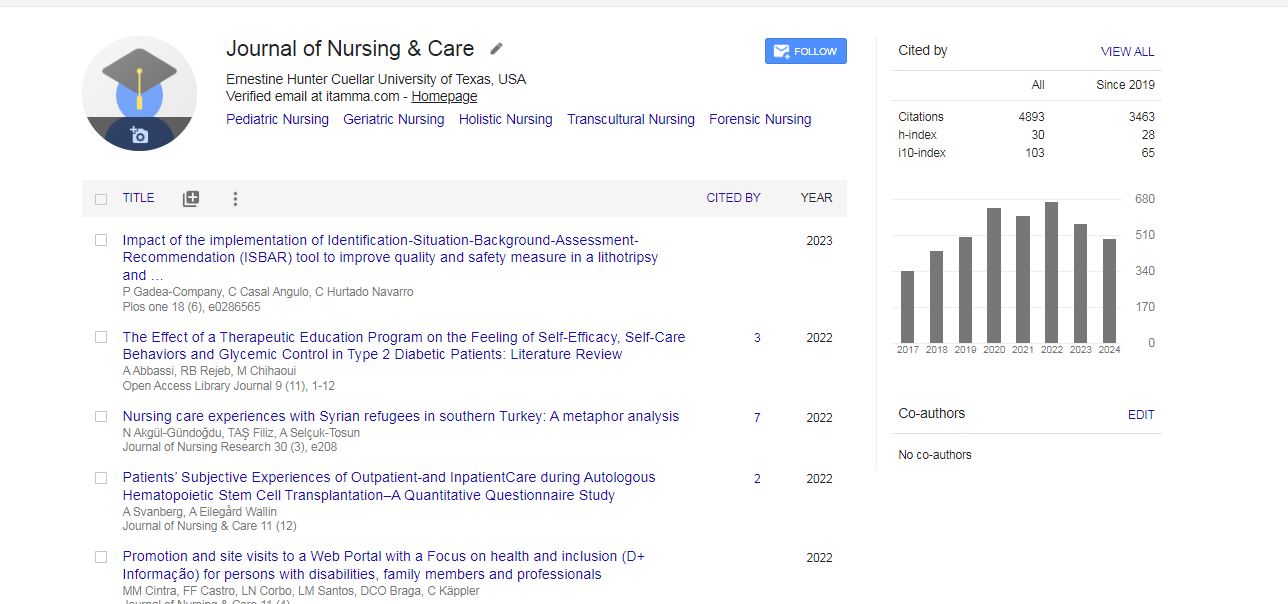
Journal of Nursing & Care received 4230 citations as per Google Scholar report