Commentary - (2025) Volume 11, Issue 6
Received: 01-Dec-2025, Manuscript No. cdp-26-185477;
Editor assigned: 03-Dec-2025, Pre QC No. P-185477;
Reviewed: 17-Dec-2025, QC No. Q-185477;
Revised: 22-Dec-2025, Manuscript No. R-185477;
Published:
29-Dec-2025
, DOI: 10.37421/2572-0791.2025.11.208
Citation: Dimitrov, Ivan. ”Novel Targets And New Frontiers In Depression Pharmacotherapy.” Clin Depress 11 (2025):208.
Copyright: © 2025 Dimitrov I. This is an open-access article distributed under the terms of the Creative Commons Attribution License, which permits unrestricted use, distribution and reproduction in any medium, provided the original author and source are credited.
Received: 01-Dec-2025, Manuscript No. cdp-26-185477; Editor assigned: 03-Dec-2025, PreQC
Recent pharmacological advancements for depression are exploring novel targets beyond traditional monoaminergic systems, signaling a significant shift in therapeutic strategies. This includes the development of drugs acting on the glutamatergic system, such as NMDA receptor modulators, offering a new mechanistic approach to managing depressive symptoms [1].
There's also a growing interest in psychedelic-assisted therapies and rapid-acting antidepressants, providing much-needed hope for individuals with treatment-resistant depression [1].
The development of selective serotonin reuptake inhibitors (SSRIs) and serotonin-norepinephrine reuptake inhibitors (SNRIs) continues to be refined, with ongoing research focused on optimizing their efficacy and minimizing side effects [2].
New formulations and combination therapies involving these established drug classes are being investigated to improve patient outcomes and adherence [2].
The role of ketamine and esketamine in rapidly alleviating depressive symptoms represents a significant advancement in acute treatment options [3].
These drugs, by acting on the NMDA receptor, offer a fast-acting alternative for individuals experiencing severe or suicidal depression, although their long-term effects and optimal administration protocols are still under active investigation [3].
Targeting the neurotrophic hypothesis of depression, compounds that promote neurogenesis and synaptic plasticity, such as those modulating BDNF signaling, are showing considerable promise [4].
While these approaches are largely in preclinical or early clinical stages, they signify a shift towards more restorative mechanisms of action in depression treatment [4].
Psychedelic-assisted psychotherapy, particularly involving psilocybin, is emerging as a potential breakthrough for treatment-resistant depression [5].
Early studies suggest that a few guided therapeutic sessions can lead to sustained mood improvement, likely by facilitating emotional processing and cognitive flexibility [5].
The exploration of non-monoaminergic targets extends to drugs that modulate the GABAergic system and investigate the endocannabinoid system [6].
These diverse approaches aim to address different facets of depression pathophysiology, potentially offering solutions for individuals who do not respond to conventional treatments [6].
Pharmacogenomics is increasingly being integrated into antidepressant prescribing to enable personalized treatment strategies [7].
By analyzing an individual's genetic makeup, clinicians can better predict their response to specific medications and identify potential adverse effects, leading to more efficient and effective treatment selection [7].
The development of novel antidepressant formulations, including extended-release and orally disintegrating tablets, is specifically designed to improve patient adherence and pharmacokinetic profiles, thereby enhancing therapeutic outcomes [8].
These innovations are particularly beneficial for individuals who face challenges with medication management [8].
Research into the role of inflammation in depression is actively leading to the investigation of adjunctive therapies that target inflammatory pathways, such as cytokine inhibitors [9].
Although still an emerging area of study, this approach holds potential as a new avenue for treating individuals with comorbid inflammatory conditions [9].
The understanding of the gut-brain axis is opening new possibilities for depression treatment, including the utilization of probiotics and prebiotics [10].
These interventions aim to modulate the gut microbiome, which has been increasingly linked to mood regulation and inflammatory processes relevant to the pathophysiology of depression [10].
Recent pharmacological advancements for depression are exploring novel targets beyond traditional monoaminergic systems, with a notable focus on the glutamatergic system. Compounds like NMDA receptor modulators are being investigated as alternative treatment options [1].
The emergence of psychedelic-assisted therapies and rapid-acting antidepressants also offers new hope for individuals with treatment-resistant depression [1].
The established class of selective serotonin reuptake inhibitors (SSRIs) and serotonin-norepinephrine reuptake inhibitors (SNRIs) continues to be a cornerstone of treatment, with ongoing research aimed at refining their efficacy and minimizing adverse effects [2].
Efforts are underway to develop new formulations and combination therapies involving SSRIs and SNRIs to enhance patient outcomes and improve adherence [2].
A significant advancement has been the role of ketamine and esketamine in rapidly alleviating depressive symptoms, providing a crucial rapid-acting alternative for severe or suicidal depression, although long-term effects and optimal administration protocols remain subjects of active investigation [3].
Approaches targeting the neurotrophic hypothesis of depression are showing promise, with compounds designed to promote neurogenesis and synaptic plasticity, particularly those modulating BDNF signaling [4].
These strategies, while primarily in early clinical or preclinical development, represent a fundamental shift towards therapies that aim for restorative mechanisms of action [4].
Psychedelic-assisted psychotherapy, especially with psilocybin, is gaining attention as a potential breakthrough for treatment-resistant depression [5].
Preliminary studies indicate that a limited number of guided sessions can result in sustained mood improvements, potentially by fostering emotional processing and enhancing cognitive flexibility [5].
The investigation into non-monoaminergic targets includes research into drugs affecting the GABAergic system and the endocannabinoid system [6].
These diverse pharmacological avenues aim to address multiple facets of depression pathophysiology, offering new possibilities for patients unresponsive to conventional treatments [6].
The integration of pharmacogenomics into antidepressant prescribing is becoming increasingly important for personalizing treatment approaches [7].
By analyzing an individual's genetic profile, clinicians can gain better insights into predicting medication response and identifying potential adverse effects, leading to more precise and effective treatment selection [7].
Innovations in antidepressant formulations, such as extended-release and orally disintegrating tablets, are being developed to improve patient adherence and optimize pharmacokinetic profiles, thereby enhancing therapeutic outcomes [8].
These formulation advancements are particularly valuable for patients who experience difficulties with managing their medication regimens [8].
Research exploring the role of inflammation in depression is driving the investigation of adjunctive therapies targeting inflammatory pathways, including cytokine inhibitors [9].
This emerging area of research presents a potential new avenue for treating depression, especially in individuals with co-occurring inflammatory conditions [9].
The growing understanding of the gut-brain axis is paving the way for novel depression treatments, including the use of probiotics and prebiotics [10].
These interventions focus on modulating the gut microbiome, which has been implicated in mood regulation and inflammatory processes relevant to the development and persistence of depression [10].
Current research in depression pharmacotherapy is moving beyond traditional monoamine-based treatments to explore novel targets. This includes drugs acting on the glutamatergic system, such as NMDA receptor modulators, and those influencing neurotrophic factors like BDNF. Psychedelic-assisted therapies and rapid-acting antidepressants like ketamine and esketamine are showing significant promise, especially for treatment-resistant cases. Established SSRIs and SNRIs are still being refined for better efficacy and fewer side effects, with new formulations and combination therapies under investigation. Emerging areas include targeting inflammation and the gut-brain axis through interventions like cytokine inhibitors and microbiome modulation. Pharmacogenomics is also being integrated to personalize treatment decisions. The overarching goal is to develop more effective and targeted therapies for a broader range of patients.
None
None
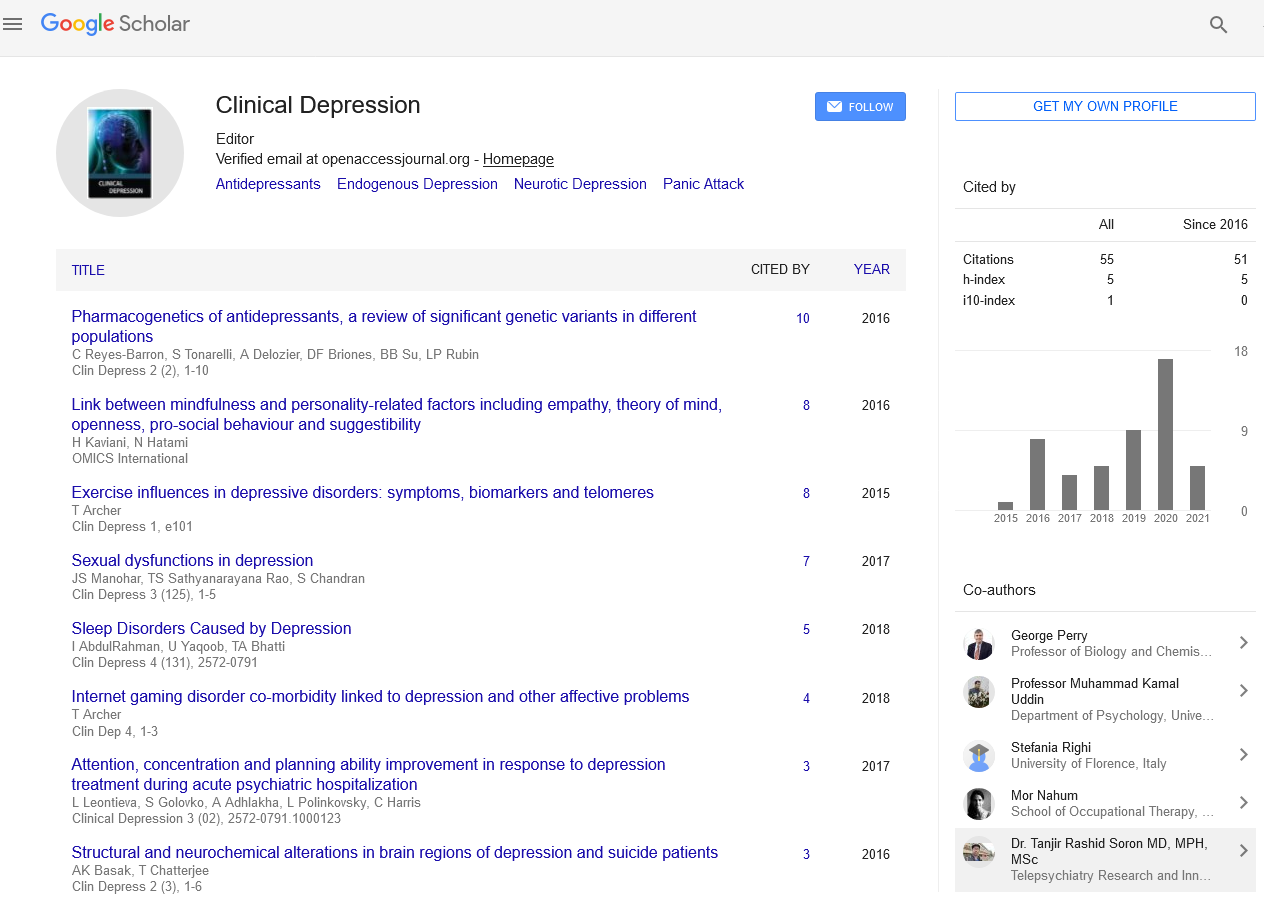
Clinical Depression received 89 citations as per Google Scholar report