Opinion - (2026) Volume 16, Issue 2
Received: 02-Mar-2026, Manuscript No. jnt-26-191280;
Editor assigned: 04-Mar-2026, Pre QC No. P-191280;
Reviewed: 18-Mar-2026, QC No. Q-191280;
Revised: 23-Mar-2026, Manuscript No. R-191280;
Published:
30-Mar-2026
, DOI: 10.37421/2161-0959.2026.16.613
Citation: Greene, Samuel. ”Novel Biomarkers Revolutionizing Acute Kidney Injury Detection.” J Nephrol Ther 16 (2026):613.
Copyright: © 2026 Greene S. This is an open-access article distributed under the terms of the Creative Commons Attribution License, which permits unrestricted use, distribution and reproduction in any medium, provided the original author and source are credited.
Biomarkers play an indispensable role in the early detection, diagnosis, prognosis, and monitoring of acute kidney injury (AKI). While traditional markers such as serum creatinine and urine output have demonstrated limitations in their sensitivity and specificity, the advent of novel biomarkers offers substantially improved insights into the complex pathophysiology of AKI. This review endeavors to highlight current advancements in AKI biomarker research, with a particular focus on their potential to refine clinical decision-making processes and facilitate the personalization of therapeutic strategies within the Department of Renal Therapeutics Research.[1] Neutrophil gelatinase-associated lipocalin (NGAL) and kidney injury molecule-1 (KIM-1) stand out as two of the most extensively studied biomarkers for AKI. Their capacity to detect AKI earlier than creatinine, especially across a diverse range of clinical settings, represents a significant clinical advantage. This section of the review will delve into their diagnostic accuracy, prognostic value, and potential roles in guiding therapeutic interventions.[2] The role of microRNAs (miRNAs) as potential AKI biomarkers is an increasingly prominent area of research. These small non-coding RNA molecules, readily detectable in biofluids, can provide a reflection of cellular stress and injury. Their promise for non-invasive and early detection of AKI positions them as highly promising candidates for future clinical applications.[3] The tissue inhibitor of metalloproteinases-2 (TIMP-2) and insulin-like growth factor-binding protein 7 (IGFBP7) complex has been rigorously validated as a biomarker capable of predicting AKI within a 12-hour timeframe. This specific combination offers a rapid assessment of kidney injury risk, which is critically important for initiating timely and appropriate interventions.[4] Furthermore, the integration of multi-omics approaches, encompassing genomics, transcriptomics, proteomics, and metabolomics, holds substantial promise for the discovery of novel AKI biomarkers. These comprehensive strategies are instrumental in identifying complex molecular signatures that are intricately associated with the development and progression of AKI.[5] The clinical implementation of AKI biomarkers necessitates robust validation studies and a thorough understanding of their performance characteristics across diverse patient populations and varying AKI etiologies. Future research efforts should be directed towards developing point-of-care tests and effectively integrating biomarker data into predictive models for the personalized management of AKI.[6] Beyond their role in initial detection, AKI biomarkers are actively being explored for their ability to predict AKI progression and patient response to therapy. Gaining a deeper understanding of the dynamic changes in biomarker levels over time can yield valuable prognostic information and guide crucial treatment adjustments.[7] The development of urinary biomarkers is particularly attractive due to the inherent ease of sample collection and the considerable potential for continuous monitoring. Ongoing research into novel urinary proteins and metabolites is crucial for identifying more sensitive and specific indicators of AKI.[8] The application of machine learning and artificial intelligence in the analysis of large biomarker datasets is significantly paving the way for the discovery of complex AKI patterns and the development of predictive algorithms. This data-driven approach has the potential to substantially enhance diagnostic accuracy and refine treatment personalization.[9] Future directions in AKI biomarker research are focused on identifying biomarkers that can effectively differentiate between the various causes of AKI, predict the likelihood of AKI recurrence, and accurately assess the effectiveness of specific therapeutic interventions. The ultimate objective is to transition towards a paradigm of precision medicine in AKI management.[10]
Biomarkers are fundamental to the early detection, diagnosis, prognosis, and monitoring of acute kidney injury (AKI). While conventional markers such as serum creatinine and urine output have inherent limitations in sensitivity and specificity, novel biomarkers provide enhanced insights into the condition. This review critically examines the current state of AKI biomarker research, emphasizing their potential to improve clinical decision-making and personalize therapeutic strategies within the Department of Renal Therapeutics Research.[1] Among the most extensively studied biomarkers for AKI are neutrophil gelatinase-associated lipocalin (NGAL) and kidney injury molecule-1 (KIM-1). Their ability to detect AKI earlier than creatinine, particularly in a wide array of clinical scenarios, offers a significant advantage. This section explores their diagnostic accuracy, prognostic value, and potential role in guiding therapeutic interventions.[2] MicroRNAs (miRNAs) are emerging as important biomarkers in AKI research. These small non-coding RNA molecules can be detected in biological fluids and reflect cellular stress and injury. Their capacity for non-invasive and early detection of AKI makes them promising candidates for future clinical applications.[3] The complex formed by tissue inhibitor of metalloproteinases-2 (TIMP-2) and insulin-like growth factor-binding protein 7 (IGFBP7) has been validated as a biomarker for predicting AKI within a 12-hour window. This combination allows for a rapid assessment of kidney injury risk, which is crucial for timely intervention.[4] The integration of multi-omics approaches, including genomics, transcriptomics, proteomics, and metabolomics, shows significant promise for discovering novel AKI biomarkers. These comprehensive strategies can identify complex molecular signatures associated with AKI development and progression.[5] The clinical implementation of AKI biomarkers requires thorough validation and a clear understanding of their performance in diverse patient populations and various AKI etiologies. Future research should focus on developing point-of-care tests and integrating biomarker data into predictive models for personalized AKI management.[6] Beyond their role in detection, AKI biomarkers are being investigated to predict AKI progression and the response to therapy. Understanding the temporal changes in biomarker levels can provide valuable prognostic information and guide treatment adjustments.[7] The development of urinary biomarkers is particularly appealing due to the ease of sample collection and the potential for continuous monitoring. Research into novel urinary proteins and metabolites continues to aim for more sensitive and specific indicators of AKI.[8] The use of machine learning and artificial intelligence in analyzing extensive biomarker datasets is advancing the discovery of complex AKI patterns and predictive algorithms. This data-driven methodology can enhance diagnostic accuracy and treatment personalization.[9] Future research in AKI biomarkers aims to identify markers that can distinguish between different causes of AKI, predict recurrence, and evaluate the efficacy of specific therapies. The ultimate goal is to advance precision medicine in AKI management.[10]
This review examines the evolving landscape of acute kidney injury (AKI) biomarkers. It highlights the limitations of traditional markers like creatinine and emphasizes the advantages offered by novel biomarkers such as NGAL, KIM-1, miRNAs, and the TIMP-2/IGFBP7 complex for early detection and prognosis. The review also discusses the potential of multi-omics approaches, machine learning, and urinary biomarkers in discovering new diagnostic tools. Emphasis is placed on the importance of clinical validation, the development of point-of-care tests, and the integration of biomarkers into predictive models for personalized AKI management and precision medicine.
None
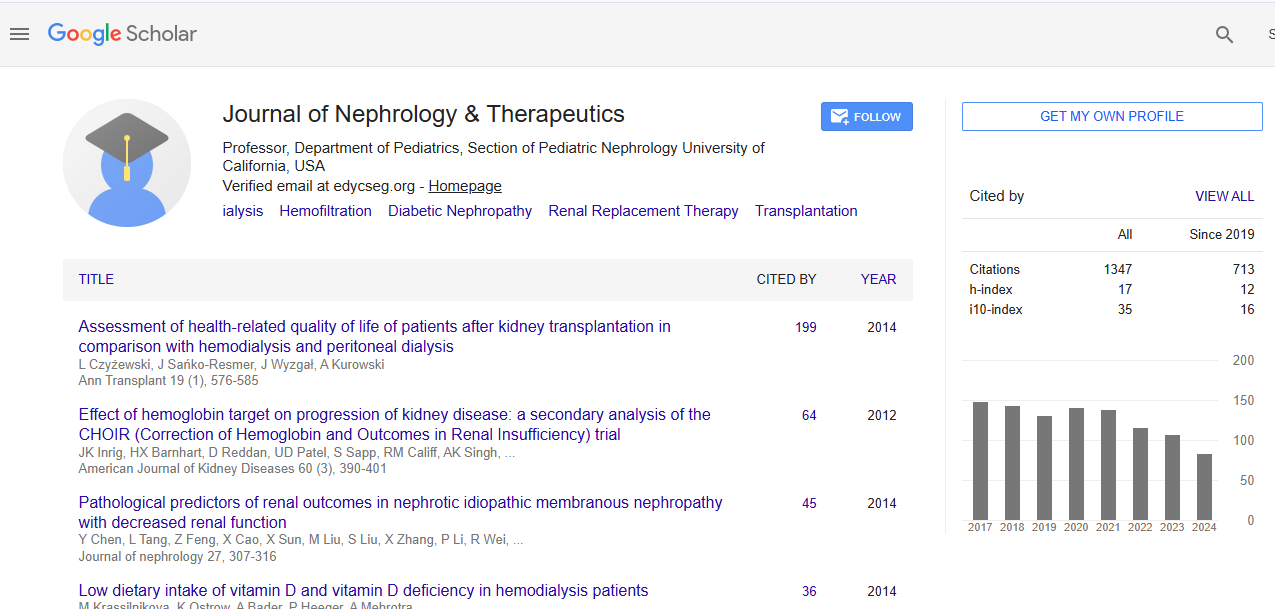
Journal of Nephrology & Therapeutics received 784 citations as per Google Scholar report